
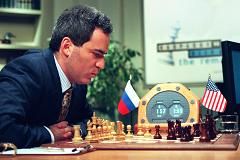
© Stan Honda | AFP | Getty ImagesWorld Chess Champion Garry Kasparov ponders his next move during third game against the IBM Deep Blue computer. May, 1997
This past week, there was an old-school battle of wits that captured the world's attention: a chess championship. How quaint! A realm in which the human mind is still king, it was dubbed the most exciting chess championship in decades, with the 22-year-old chess sensation Magnus Carlsen, the "Mozart of chess," at work on the board while the titans of Wall Street hung on the edge of their seats - they claim it's pure interest in the beauty of chess; we imagine they have uses for Carlsen's brain in structured products units.
It was a good reminder that even with the overwhelming nature of the information economy and long past Garry Kasparov's waving of the white flag against IBM's chess-playing grandmaster machines, human ingenuity still has a role to play - and, in fact, even Google admitted as much this past week. There are just some tasks at which Google's algorithms remain at a competitive disadvantage to actual human beings, one being personalized answers to questions that require expert assistance. And so Google announced its "helpouts" product, which the New York Times said was "an acknowledgement by the company that its search engine misses a lot of information that people want."
Now, you may ask, doesn't Google already have YouTube for that purpose? Not exactly. Consider that Magnus Carlsen could consult with IBM's Deep Blue on a move in real time, something he could not do through YouTube footage of Deep Blue beating Kasparov. Wait, that's not right. Here's the example the Times and Google provided: "a yoga teacher could instruct a student to hold her arm at a different angle or a lactation consultant could suggest that a mother position her infant in a different way." Namaste.
For more on the battle between man and machine, we recommend for this weekend's reading list Brian Christian's "The Most Human Human," one man's - who happens to be a computer scientist and poet - account of his role in the annual Turing Competition, as he tried to convince human judges he was a human against a bunch of computers aiming to do the same thing. It's sort of like "The Voice" meets "Blade Runner."



Reader Comments
to our Newsletter