
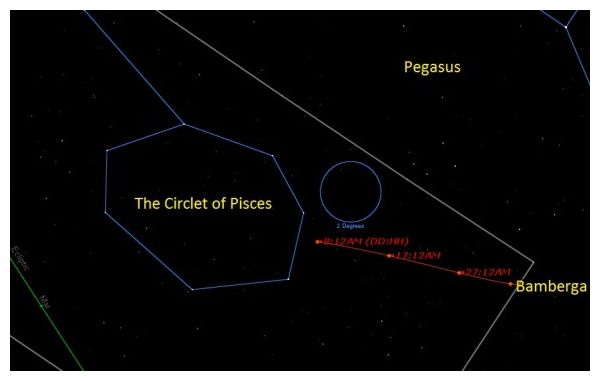
© Created by thAuthor using Starry Night Education softwareThe path of 324 Bamberga through Pisces from September 8th to October 10th.
324 Bamberga reaches opposition this week in the constellation Pisces on (friggatriskaidekaphobics take note) Friday the 13th at 2PM EDT/16:00 Universal Time.
About 230 kilometres in size, 324 Bamberga reaches 0.81 astronomical units from the Earth this week. No other asteroid so large gets so close. Discovered on February 25th, 1892 by Johann Palisa, 324 Bamberga only reaches a favorable opposition once every 22 years.
Shining at magnitude +8.1, 324 Bamberga is also one of the highest numbered asteroids visible with binoculars. Earth-crossing asteroids 433 Eros, which made a close pass last year, and 4179 Toutatis are two of the very few asteroids that possess a larger number designations that can regularly reach +10th magnitude.
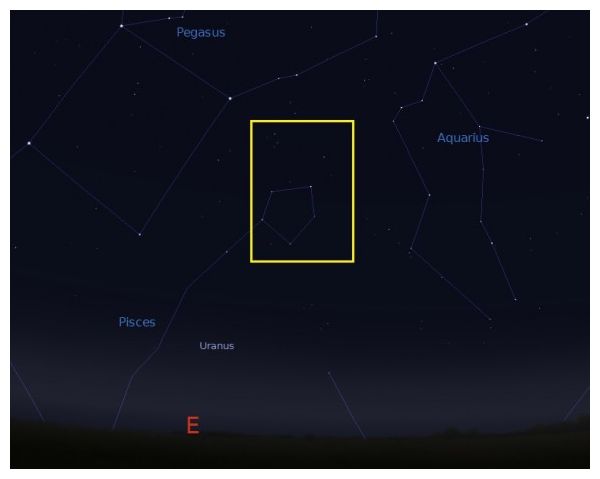
© Created by the author using StellariumLook east in mid-September about an hour after sunset. The inset covers the region that 324 Bamberga is currently traversing in the introductory graphic.
The resonance between 324 Bamberga and Earth is nearly five Earth orbits for every one circuit of the Sun for the asteroid and is offset by only 9 days, meaning that the 22 year window to see the asteroid will actually become less favorable in centuries to come. 324 Bamberga made its last favorable appearance on September 15th, 1991 and won't surpass +10th magnitude again until September 2035.
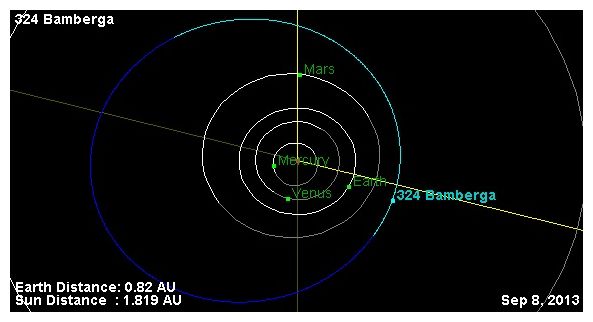
© Created using the JPL Small-Body Database BrowserThe orbit of 324 Bamberga.
324 Bamberga will be moving too slow to pick up any motion in real time, but you can spy it by either sketching the field on successive nights or photographing the region and noting if the asteroid can be seen changing position against the background of fixed stars. Start hunting for 324 Bamberga tonight, as the Full Harvest Moon will be visiting Pisces later next week on the 19th.
324 Bamberga is also unique as the brightest C-type asteroid that is ever visible from Earth. The runner up in this category is asteroid 10 Hygiea, which can shine a full magnitude fainter at opposition.
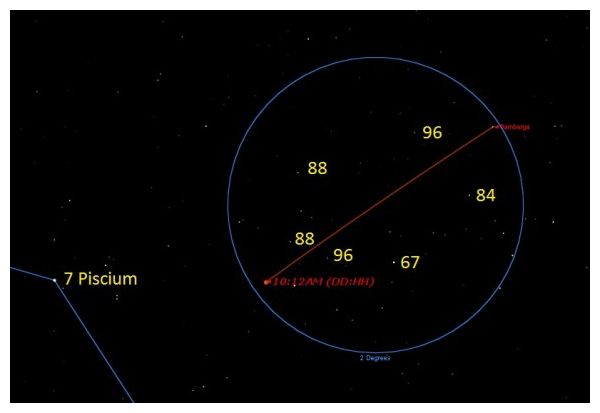
© Created by the author using Starry Night Education softwareA closeup of the path of 324 Bamberga for the week of September 10-17th. Decimal points for comparison stars are omitted.
324 Bamberga itself takes its name from the town of Bamberg in Bavaria, the site of the 1896 meeting of the Astronomische Gesellschraft.
An occultation of a star by 324 Bamberga on December 8th, 1987 allowed astronomers to pin down its approximate size. Searches have also been carried out during occultations for any possible moons of this asteroid, though thus far, none have been discovered.
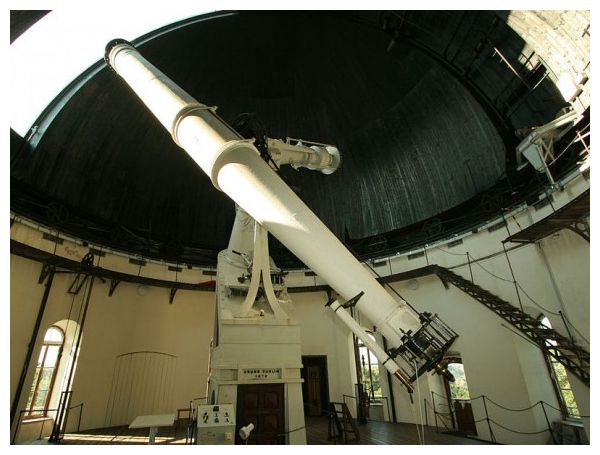
© Prof. Franz Kerschbaum/Wikimedia Commons The Great Refractor of the University of Vienna used to discover asteroid 324 Bamberga.
There's also something special about this time of year and the region that 324 Bamberga is crossing. More visual discoveries of asteroids have been historically made in the month of September than any other calendar month. In fact, 344 of the first 1,940 numbered asteroids were found in September, more than twice the average. Palisa's own track record bears this out, though 324 Bamberga was discovered in February.
One of the primary reasons for a September surge in discoveries is viewing direction. Astronomers of yore typically hunted for asteroids approaching opposition in the anti-sunward direction, which in September lies in the relatively star poor fields of Pisces. In December and June - the months with the lowest numbers of visual discoveries at only 75 and 65 for the "first 1,940" respectively - the anti-sunward point lies in the star-rich regions of Sagittarius and Gemini. And by the way, the meteor that exploded over the city of Chelyabinsk on February 15th was sneaking up on the Earth from the sunward direction.
Be sure to catch a glimpse of this unique asteroid through either binoculars or a telescope over the coming weeks. The next chance to observe 324 Bamberga won't roll around again until September 2035... it'll be great to compare notes of the 2013 apparition on that far off date!



Reader Comments
to our Newsletter