
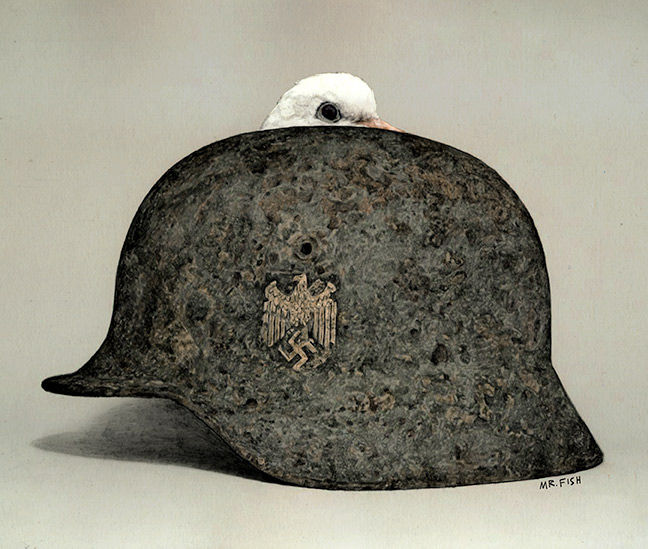
© Mr. Fish
I was reminded of my visit with von dem Bussche, whom I was interviewing for The Dallas Morning News, by the 70th anniversary of the execution of five Munich University students and their philosophy professor who were members of the White Rose resistance movement in Nazi Germany. The BBC last week interviewed the 99-year-old Liselotte Furst-Ramdohr, who hid leaflets for the group in her closet and helped make stencils used to paint slogans on walls. [Click here to hear the interview or click here to see the BBC's article based on the interview.] The six White Rose members managed to distribute thousands of anti-Nazi leaflets before they were arrested by the Gestapo and guillotined. The text of their sixth and final set of leaflets was smuggled out of Germany by the resistance leader Helmuth James Graf von Moltke, who was arrested in 1944 and hanged by the Nazis in January 1945. Copies of the leaflets' language were dropped over Germany by Allied planes in July 1943. Furst-Ramdohr, who was widowed during the war when her first husband was killed on the Russian front, also was arrested by the Gestapo. She was imprisoned but eventually released.
The White Rose has been lionized by postwar Germans - one of its members, Alexander Schmorell, was made a saint by the Russian Orthodox Church last year, and squares and schools in Germany are named for the resisters - but in the BBC interview Furst-Ramdohr curtly dismissed the adulation of the group.
"At the time, they'd have had us all executed," she said in speaking of most Germans' hatred of resisters during the war.
Although history has vindicated resistance groups such as the White Rose and plotters such as von dem Bussche, they were desperately alone, reviled by the wider public and forced to defy the law, their oaths of national allegiance, and public opinion. The resisters, once exposed, were condemned in vitriolic terms by most of the German public, and their lopsided trials were state-choreographed lynchings. Von dem Bussche said that even after the war he was spat upon as he walked down a city street. He and those like him who made a moral choice to physically defy evil teach us something extremely important about rebellion. It is, when it begins, not safe, comfortable or popular. Those rare individuals who have the moral and physical courage to resist must accept that they will be pariahs. They must live outside the law. And they must be prepared to be condemned.
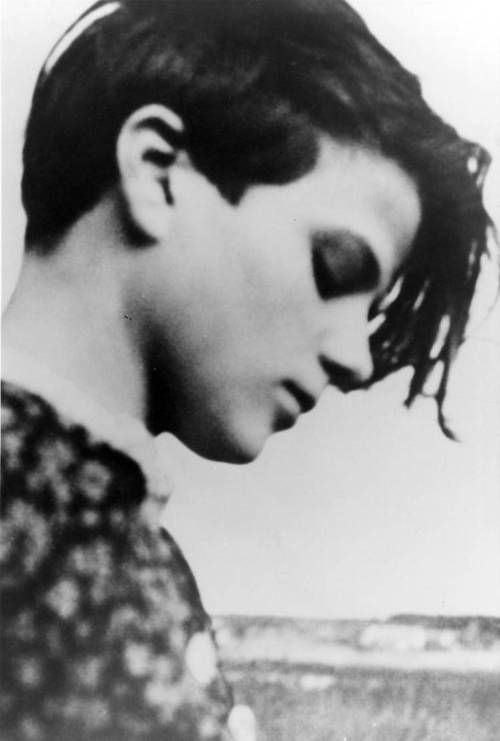
Sophie Scholl
Von dem Bussche, who died in 1993, took part as a 20-year-old lieutenant in the invasions of Belgium, Luxembourg, France - where a French sniper blasted off his right thumb and he was shot through the shoulder - and Poland. He was stationed after the invasion of Poland in the town of Dubno in the western Ukraine. His military unit was ordered to secure an abandoned air base, and the young officer watched as the SS took some 2,000 Jews into the airfield.
"The Jews were trucked in from the surrounding countryside, stripped and forced by the black-uniformed officers toward long, deep trenches," von dem Bussche told me when I interviewed him. "They were shot in their heads by an SS officer with a machine pistol and then the next row was made to lie down and shot in their heads. It is not an easy memory to live with, especially as I considered myself, as an officer of the German army, to be an accessory to these murders."
It was then that he decided to defy Hitler. But it would only be in 1943, when it was clear that the Germans were losing the war, that he and a small group of other officers led by Col. Claus von Stauffenberg began to plot to assassinate Hitler. The conspirators did not defy the Nazi regime on behalf of the Jews, von dem Bussche conceded, but to save the country from defeat, dismemberment and catastrophe.
"One motive, along with just stopping the killing, was the most valid, to stop the Russians east of Poland," he said of the plotters. "If we had managed to keep the Russians out, Europe would have been spared the division and pain of the last 44 years."
By 1943 von dem Bussche was a captain. He was asked to model the army's new winter coat for Hitler at the Wolfsschanze, the Nazi leader's headquarters in East Prussia. He and von Stauffenberg managed to get silent fuses - the German fuses hissed when lit - and plastic explosives from the British underground. Von dem Bussche also had two hand grenades. He planned to physically seize Hitler and ignite the grenades in a suicide mission intended to kill the führer and perhaps other high-ranking Nazi officials in the room. The code name for the operation was "Overcoat."
Von Stauffenberg at the time told von dem Bussche, "I am committing high treason with all my might and means" and added that under natural law the rebels had a duty to use violence to defend the innocent from the horrific crimes of the state.
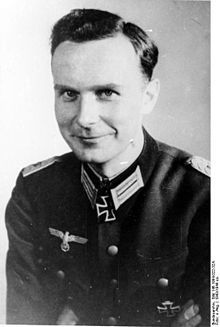
Axel Freiherr von dem Bussche-Streithorst
Von dem Bussche, 6 feet 5 inches tall and with cobalt-blue eyes and a voice that rumbled like a freight train during the interview, refused to describe what he or the other plotters did as heroism. He detested words like "honor" or "glory" when they were applied to warfare. He had no time for those who romanticized war. He said he had no option as a human being but to resist. He acted, he said, to save his "self-esteem."
"There was no hero stuff involved, none at all," he said. "I thought this was an adequate means to balance out what I had seen. I felt that this was justifiable homicide and was the only means to stop mass murder inside and outside Germany."
His was the 10th thwarted attempt on Hitler's life. There would be one more.
On July 20, 1944, von Stauffenberg carried two small bombs in a briefcase to a meeting with Hitler. He struggled before the meeting to arm the bombs with pliers, a difficult task as he had lost his right hand and had only three fingers on his left hand after being wounded in North Africa. He managed to arm only one bomb. He placed the briefcase with the bomb under the table near Hitler. He left the room and was outside at the time of the explosion, which killed four people - including Hitler's security double - but only slightly wounded Hitler, who was shielded by a table leg. Nazi propaganda chief Joseph Goebbels announced over the radio that Hitler had survived. Hitler spoke to the nation not long afterward. Von Stauffenberg and other conspirators were captured and hastily executed by a firing squad.
Von dem Bussche, recovering in a Waffen-SS hospital outside Berlin from the loss of his leg, anxiously followed the news of the assassination attempt on the radio. He listened to Hitler's angry tirade against the "traitors" who had attempted to kill him. He knew it would not be long before the SS appeared at his bedside. He spent the night eating page after page of his address book, which had the name of every major conspirator who was under arrest or dead. The British explosive material from his aborted suicide bombing was in a suitcase under his bed. He asked another officer to spirit the suitcase out of the hospital and toss it into a lake. He was repeatedly interrogated over the next few days but because none of the other plotters had implicated him, even under torture, he managed to elude their fate.
He suffered lifelong guilt over his survival. As a rebel he did not succeed, at least not in killing Hitler and terminating the regime. He felt that as an army officer, even with his involvement in the assassination plots, he remained part of the murderous apparatus that unleashed indefensible suffering and death. He worried that he had not done enough. The brutality and senselessness of the war haunted him. The German public's enthusiastic collusion with the Nazi regime haunted him. And the ghosts of the dead, including those he admired, haunted him. He understood, as we must, that to do nothing in a time of national distress is to be complicit in acts of radical evil.
"I should have taken off my uniform in the Ukraine," he told me on the last afternoon of my visit, "and joined the line of Jews to be shot."





I'm so glad that I read it.
I feel that this is very important advice, if you want to change the world you should be ready to be hated by it.