
For the new study, scientists investigated the Campi Flegrei caldera volcano in southern Italy. About 39,000 years ago, it experienced the largest volcanic eruption that Europe has seen in the last 200,000 years. This super-eruption may have played a part in wiping out or driving away Neanderthal and modern human populations in the eastern Mediterranean.
To learn more about this outburst, scientists measured 115 sites for the ash layer it laid down, known as Campanian Ignimbrite. They next analyzed this data with a 3D ash-dispersal computer model.
The researchers discovered the super-eruption behind the Campanian Ignimbrite would have spewed 60 to 72 cubic miles (250 to 300 cubic kilometers) of ash across 1.4 million square miles (3.7 million square km). This is twice to triple the previous estimate of the volume of ash spouted by the eruption.
These findings, detailed online May 30 in the journal Geophysical Research Letters, suggest the super-eruption would have spread up to 990 million pounds (450 million kilograms) of poisonous sulfur dioxide into the atmosphere. This air pollution would have cooled the Northern Hemisphere, driving down temperatures by 1.8 to 3.6 degrees Fahrenheit (1 to 2 degrees Celsius) for two to three years, enough to have severe effects on the environment. (For comparison, the air pollutants generated by the 1991 eruption of Mount Pinatubo reduced global temperatures by about 0.9 degrees Fahrenheit (0.5 degrees Celsius).
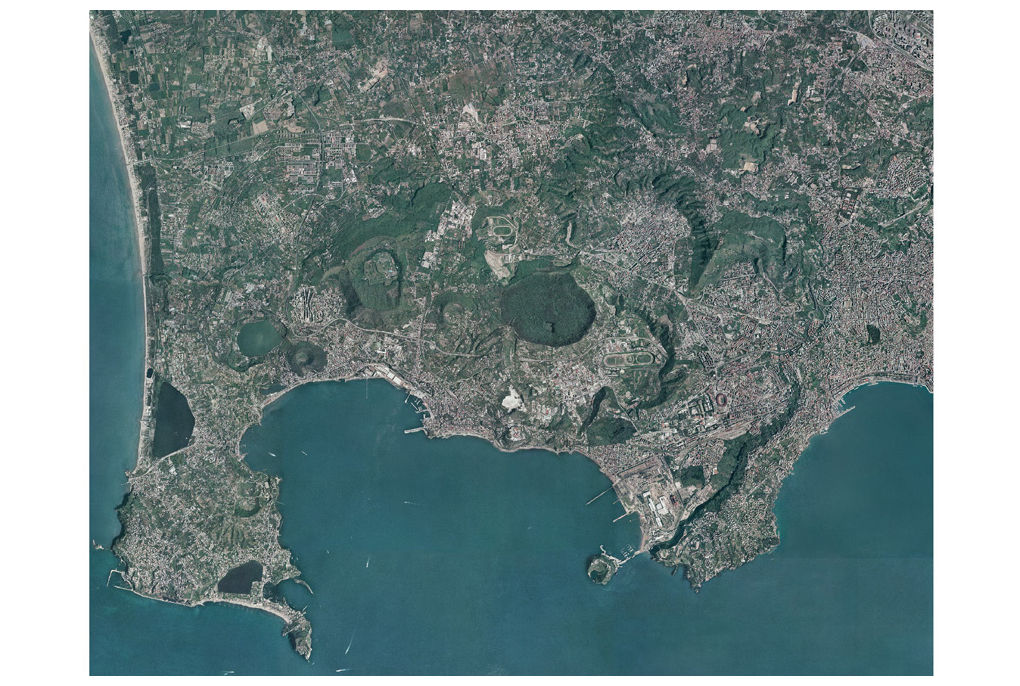
© Geppi Vilardo, INGV-OVAerial photograph of the Campi Flegrei caldera. The structure, formed during the Campanian Ignimbrite super-eruption, lies west of the city of Naples, Italy.
Fluorine-laden ash from the eruption that later became incorporated into plant matter eaten by these hominids could have also potentially caused a condition known as fluorosis, which can lead to eye, tooth and organ damage. In addition, sulfur dioxide, fluorine and chlorine emissions from the volcano would have generated intense acid rain downwind of the volcano.
The researchers plan to look at other super-eruptions, such as the Toba outburst about 75,000 years ago, "which was much larger than the Campanian Ignimbrite," Costa said. "We can also study the Yellowstone super-volcano."



Now the question is why these periodic volcano blasts that rules our lives then and now. Also interesting is a park at the edge of N Dak and Neb that contains hugh amounts of bones. The speculation is that animals on the run from a volcano got caught there and died. The bones show deformities that result from flouride, one of the deadly volcanic gases. One of the reasons flouride was OKd first, that it was known to deposit bone only it was discovered later that flouride deposited it where it was not wanted, line in the spine.