
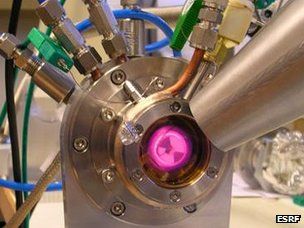
© ESRFMaterials are heated to searing temperatures before being probed with a spray of intense X-rays
The ID24 beam line at the European Synchrotron Radiation Facility (ESRF) will use X-ray beams to subject iron and other materials to extraordinary temperatures and pressures.
How the X-rays are absorbed should give insight into the mysterious processes going on at and near the Earth's core.
For example, the work could unravel why the Earth's magnetic field can "flip".
The Earth's core, some 3,000km (1,900 miles) below sea level, will never be reached directly by scientists. In fact, research continues in an attempt to drill through the Earth's outermost layer, the crust. At its thinnest, beneath the oceans, the crust is just 10km thick.
So it is left to laboratory experiments to attempt to recreate the conditions at the core, to investigate how the Earth's magnetic field comes about, why it changes, and how shock waves from earthquakes propagate through it.
Diamonds are for pressure
At the heart of the experiments to be carried out at ID24 is what is known as a diamond anvil cell - an established and remarkably simple means to create high pressures by confining tiny samples between the points of two carefully cut diamonds.
The samples are compressed at a pressure millions of times higher than that on the Earth's surface.
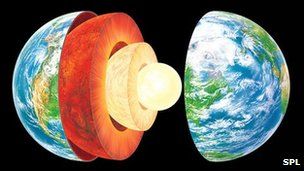
© SPLThe inner and outer core of the Earth give rise to its magnetic field, but mysteries remain as to how
The newly upgraded ID24 makes it possible to focus the X-rays to a much smaller spot than existing facilities - just millionths of a metre.
What is more, the reactions that go on as matter is heated and squeezed can be monitored with a resolution hundreds of times higher, with "snapshots" occurring every millionth of a second.
"Scientists can use several other synchrotrons notably in Japan and the US for fast X-ray absorption spectroscopy, but it is the microsecond time resolution... coupled to the micron-sized spot that makes ID24 unique worldwide," said Sakura Pascarelli, the chief scientist on the ID24 beam line.
"The rebuilt ID24 sets the ESRF apart, and even before the first users have arrived, I am asked to share our technology."
ID24 is the first of eight beam lines at the ESRF, located in Grenoble, France, that will be radically overhauled as part of the eight-year, 180m euro (£154m) ESRF Upgrade Programme.



I was talking to someone the other day about X-raying the Earth to see what is inside. I was thinking on the lines of finding oil, gold, and other ore that would show up in the X-ray image. Then I thought about the huge radiation that would be emitted through the Earth and thought the idea seemed dangerous. Perhaps I am confusing Human Body X-Rays, those of the mouth to find cavities or tumors in the brain.