
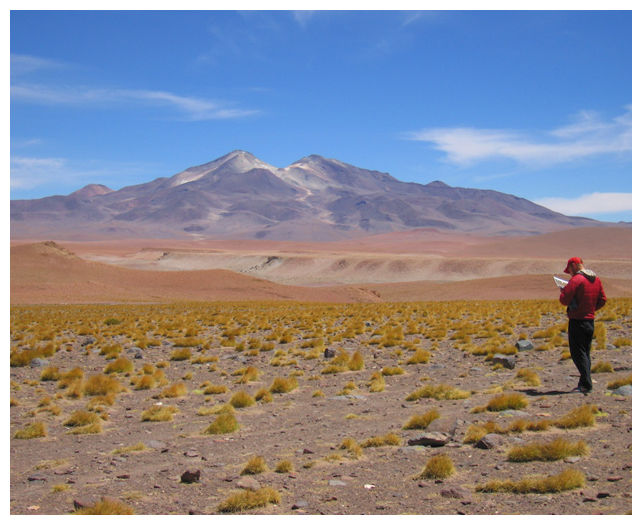
© Noah FinneganUturunca volcano in southwestern Bolivia.
So far, they know the inflation is surprisingly fast: the center of the patch has risen 7.9 inches (20 centimeters) in the past 20 years. What is more, the uplift extends about 43 miles (70 kilometers) across -- similar in size to the caldera that formed in the wake of the latest eruption of the Yellowstone supervolcano, which blanketed half of the U.S. in ash 640,000 years ago.
At the center of all recent intrigue is Uturuncu, a nearly 20,000-foot (6,000 meter) ancient volcano long given up for dead. Based on the spewage from its last eruption, 300,000 years ago, it would not qualify as a supervolcano on its own. (Its peers are far tamer, including Mount St. Helens in Washington state). But Uturunca could be drawing magma from a dense swarm of nearby volcanoes, many of which are currently active.
The big question is how much magma has accumulated so far. Based on Uturunca's rate of inflation, scientists calculated the magma chamber has been growing by about 27 cubic feet (1 cubic meter) per second. But for how long? Amassing magma at that rapid clip for thousands of years would make for a serious amount of fuel for an eruption. Or maybe its only just begun gathering steam. The rate measurements are based on satellite data the go back only 20 years.
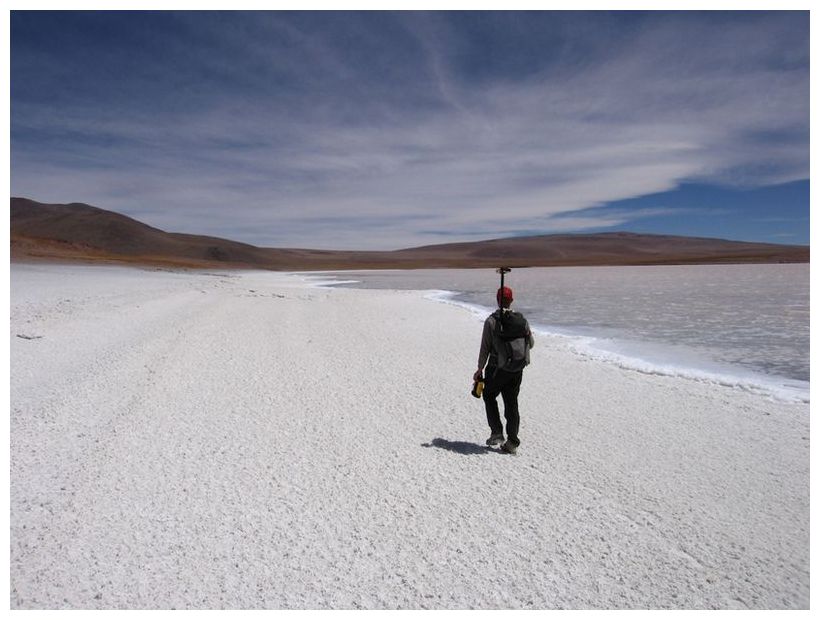
© Noah FinneganGeologist Jonathan Perkins surveys the shifting shoreline elevation of a dry lake bed, now salt-covered, in Uturuca's shadow. He carries a differential GPS antenna, which can have decimeter-scale accuracy in elevation.
"Because the uplift of Uturuncu is more pronounced in the center and tapers out toward the edges, that produces an uplift gradient, which is what will cause the lakes to tilt," Perkins told Discovery News. "It's kind of like having a jack in the center that slowly ramps up the topography over geologic time."
The pair's preliminary findings, which they reported at the annual meeting of the Geological Society of America in October, indicate that the expansion probably started only recently, and so the magma chamber probably has not yet grown to supervolcanic proportions. (For comparison, the chamber seething underneath Yellowstone is at least 200 miles deep and 400 miles east to west.)
It is important to note that the pair's initial conclusions are far from definitive, Perkins cautions. He and Finnegan are planning a trip back to Uturunca in the spring, this time to look at rivers. "Because rivers are longer features than the lakes here, they will potentially experience more overall deformation, and thus may have a stronger signal than the lake shorelines," Perkins says.
Meanwhile, the world has more imminent eruptions to worry about.
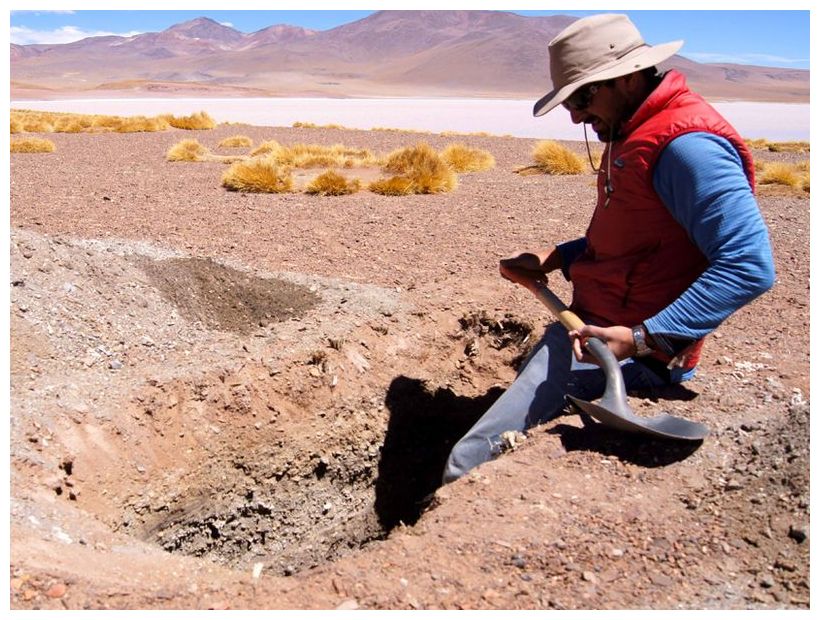
© Jonathan PerkinsGeologist Noah Finnegan digs a pit to try to trace shifting shorelines of one of Uturunca's ancient lakes.



Reader Comments
to our Newsletter