
At its closest approach, the spacecraft flew approximately 62 miles (100 kilometres) above the moon's surface. The close approach was designed to give some of Cassini's instruments, including the ion and neutral mass spectrometer, the chance to "taste" the jets themselves.
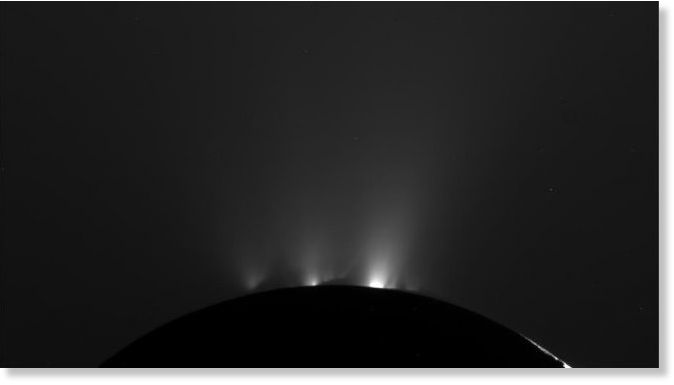
© NASA/JPL-Caltech/Space Science Institute Cassini sees jets of water vapor and ice from Enceladus.
Cassini's next pass of the moon will be Wednesday, October 19th, when the spacecraft flies by at an altitude of approximately 765 miles (1231 kilometres).
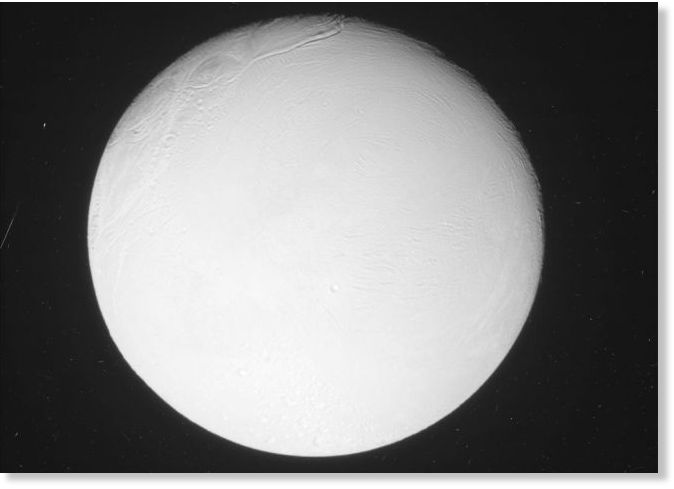
© NASA/JPL-Caltech/Space Science InstituteDuring Cassini's Oct. 1, 2011 flyby, Saturn's moon Enceladus was in full view.
The Cassini-Huygens mission is a cooperative project of NASA, the European Space Agency and the Italian Space Agency.



Reader Comments
to our Newsletter