

© Unknown
The scale starts with a Category 1, which ranges from 74 to 95 mph. A Category 5 storm has winds of 156 mph or stronger. An extrapolation of the scale suggests that if a Category 6 were created, it would be in the range of 176-196 mph.
Hurricane Wilma, in 2005, had top winds of 175 mph.
How much higher could hurricane winds blow? A hurricane gains strength by using warm water as fuel. With Earth's climate warming, oceans may grow warmer, too. And so, some scientists predict, hurricanes might become stronger.
Comment: They undoubtedly will, but not due to Global Warming!
From Connecting the Dots: Earth Changes Are Upon Us:
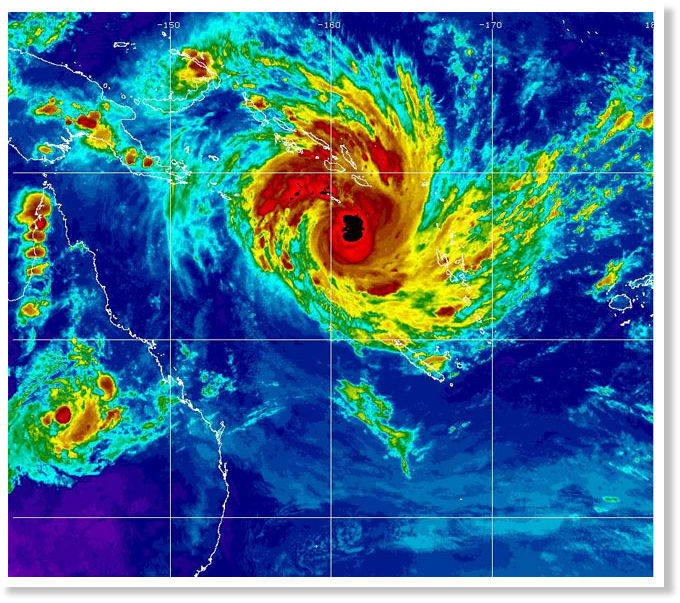
The increase in extreme weather events noted above can be understood in the context of theories that take cosmic events into account. One such theory by James McCanney proposes that electromagnetic interaction between the planets, moons, comets and the sun result in tremendous discharges of energy which directly impact our weather. Sott editor RyanX made the case for a cosmic connection to Earth Changes in January and February 2011 as follows:© US Geostationary SatelliteYasi cyclone approaching AustraliaRecent events provide us with a great case study of the cosmic forces that may lie behind large storms such as cyclones, hurricanes, blizzards and much more. The recent events I speak of include the major blizzard that swept across the Midwestern and Eastern US as well as the punishment Cyclone Yasi inflicted on eastern Australia earlier last week.We can further complement the theory with the following hypothetical scenario. There is a correlation between the electrical activity of the sun and planets and an increase of matter in the inner solar system in the form of comet dust and comets. The earth's upper atmosphere cools as a result of the influx of particles, explaining recently observed atmospheric anomalies such as noctilucent clouds and spirals created by falling debris, while an increase in volcanic activity warms parts of the oceans from below - all of which contributes to the climatic chaos.
Both of these storms grew to enormous sizes during a time period that coincided with the Earth being lashed by a solar storm just following a New Moon. As strange as this may sound, this isn't the first time that celestial alignments alongside of solar activity have spurred such events.
If a correlation between these factors exists, as we suspect, then this overturns much of what is commonly believed about Earth weather and, as we'll see, even geology.
To understand how this all works, let's start with the sun. On January 31st a massive coronal hole opened up on the sun, hurling another sledgehammer of charged particles in the direction of Earth. This was due to impact us sometime between February 2nd and February 4th. Not only this, but we recently passed through a new Moon on February 2nd. But why is the Moon of any significance here, one might ask?
As James McCanney explains in an interview he did for Spectrum Magazine in 2003:The [New] Moon moves in front of Earth, breaks that electrical flow [between the sun and Earth], and then moves out of the way. It gives us tremendous bombardment after that Moon moves out of the way, the first and second day after the New Moon. That's the condition that has been identified as being one of the leading causes of kicking-off major hurricanes and storms. What it does is: The Moon is interacting with the solar electric field. It's that CHANGE which causes the storms, and causes the environment around Earth to change, and thus affects Earth weather.So the picture we're painting is this: The sun blasts a massive front of solar wind in the direction of the Earth. As the New Moon moves out of the way of the sun and Earth, this, by itself, creates a significant increase in charged particles hitting the Earth. With the excess of charged particles from this solar storm hitting us nearly simultaneously, all of this excess charge ends up in the radiation belts surrounding the Earth.
The Earth then finds ways to discharge this imbalance such as these two major storms we've seen. One storm takes the form of a massive blizzard covering about half of the US. The other takes the form of a cyclone storm, Yasi, that pounds the already flooded east coast of Australia. Increased volcanic and earthquake activity was also noted during this time as well.
But physics dictates there must be a limit. Based on ocean and atmospheric conditions on Earth nowadays, the estimated maximum potential for hurricanes is about 190 mph, according to a 1998 calculation by Kerry Emanuel, a climatologist at the Massachusetts Institute of Technology.
This upper limit is not absolute, however. It can change as a result of changes in climate. Scientists predict that as global warming continues, the maximum potential hurricane intensity will go up. They disagree, however, on what the increase will be.
200 mph or more
Emanuel and other scientists have predicted that wind speeds - including maximum wind speeds - should increase about 5 percent for every 1 degree Celsius increase in tropical ocean temperatures.
Chris Landsea, a meteorologist at the National Hurricane Center, disagrees.
After Wilma, Landsea said that even in the worst-case global warming scenarios, where global temperatures ratchet up by an additional 1-6 degrees Celsius, there would be about a 5 percent change, total, by the end of the 21st century. That means that hurricane-force winds are unlikely to exceed 200 mph, Landsea said.
However, Typhoon Nancy in 1961, in the Northwest Pacific Ocean, was said to have maximum sustained winds of 215 mph, according to the World Meteorological Organization's Commission on Climatology, a new clearinghouse for climate records set up at Arizona State University to settle the many disputes on weather and climate extremes. (A typhoon is the same thing as a hurricane, just in a different part of the world.)
There are known records for wind speeds that outstrip anything ever measured in a hurricane. The fastest "regular" wind that's widely agreed upon was 231 mph, recorded at Mount Washington, New Hampshire, on April 12, 1934. During a May 1999 tornado in Oklahoma, researchers clocked the wind at 318 mph.
Fix the scale?
Shortly after Wilma topped out in 2005, Emanuel called the Saffir-Simpson scale irrational, in part because it deals only with wind, ignoring factors such as a storm's size, rainfall potential and forward speed. "I think the whole category system needs serious rethinking," Emanuel told LiveScience then.
But Herbert Saffir, co-creator of the scale, countered that his scale was useful because it was simple. "As simple as it is, I like the scale," Saffir said in a post-Wilma telephone interview. "I don't like to see it too complex."
Here's why no Category 6 was included: The scale was designed to measure the amount of damage inflicted by winds, and beyond 156 mph, the damage begins to look about the same, according to Simpson.



who had a motorbike that would run 146 mph. IT was in perfect condition and flawless. I thought it was his only wheels until one day I saw him in a truck, when I asked about his scooter, he told me "In the shop, I tore it down to rebuild it". So I asked what was wrong with it. To which he replied " I want to go 200 mph". When I asked why, he said " What difference does it make if you crash at 100 mph or 2000"?
"Here's why no Category 6 was included: The scale was designed to measure the amount of damage inflicted by winds, and beyond 156 mph, the damage begins to look about the same, according to Simpson."
Although I'll take a Cat 5 over a Cat 6 anyday....