
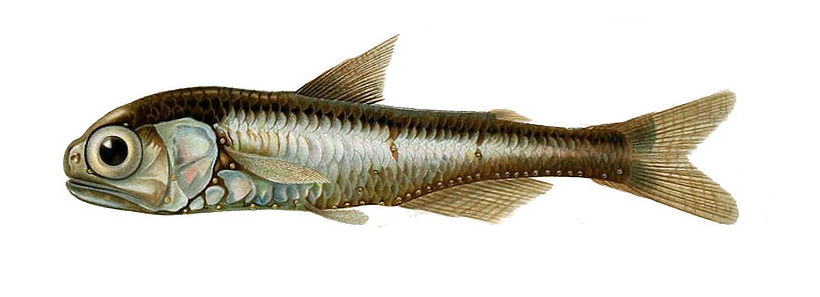
© Emma Kissling / WikipediaLanternfish, Myctophum punctatum
Washington -- A study related to plastic marine debris found that 35 percent of ocean fish had plastic in their stomachs.
Of the fish that ate plastic, the average had two pieces of plastic. Some had as many as 83 pieces.
Most of the fish that ate plastic were deepwater lanternfish, which may come to the ocean surface after dark to feast on plankton.
"As the larger pieces of plastic break down, they mimic the size, shape and texture of natural food," said Charles Moore, founder of the Algalita Marine Research Foundation in Costa Mesa., California, and an author of the study. "What we're seeing is the entire food web being contaminated by plastic."
Lanternfish are a food source for mahi-mahi, tuna, whales, dolphins, sharks, penguins and seabirds.
Steve Russell, vice president of plastics for the American Chemistry Council in Washington, said ACC has not had an opportunity to review the study.
But Russell was quick to add that "We certainly agree that plastics don't belong in our oceans and waterways."
He added that ACC has sponsored and conducted "national and localized educational programs to increase awareness of the need to prevent litter," and worked with other organizations to place recycling bins on California beaches.
The research was based on a 2008 research expedition off the West Coast in an area of the northern Pacific Ocean known as the Eastern Garbage Patch. Researchers trawled an area 1,000 miles off the coast to collect fish, which were dissected at a lab in Costa Mesa.
The findings were released March 11 by Algalita and the Southern California Coastal Water Research Project during the Plastics Are Forever International Youth Summit in Long Beach, California.
The researchers said it was the first study to document the amount of plastics in smaller fish. Lanternfish typically range in size from two to 12 inches, with most of them less than six inches in size.



Reader Comments
to our Newsletter