
The rebels fled eastward in cars and pickup trucks mounted with machine guns.

Battle: A rebel vehicle is hit by a shell fired by soldiers loyal to Libyan leader Muammar Gaddafi, during a battle along the road between Ras Lanuf and Bin Jiwad today.

Forced back: The rebels take over as shrapnel from exploding tank shells fired by Gaddafi's troops rains down on them near the town of Ras Lanuf

All out assault: Gaddafi's tanks head towards Ras Lanuf as the rebels flee before them

Chaotic: The fighters could not resist the full onslaught of Gaddafi's troops who have fought back after initial defeat
One said government forces were raining rockets or tank shells on the city in what appeared to be preparation for a full-scale advance.
Shells fell near a city hospital and hit a series of residential buildings as Gaddafi's tanks moved further along Libya's main Mediterranean coastal road than they have been since the rebels seized most of the country's east.
An opposition fighter with a Kalashnikov rifle said he had fled the frontline outside Ras Lanouf.
NATO defence ministers met in Brussels today to discuss the escalating crisis. Britain had been pushing for a no-fly zone over Libya but after hours of talks, members concluded that the action would not be taken without a unanimous UN resolution.
However, the body resolved to increase the number of ships in the Mediterranean and to tighten up the arms embargo. Extra humanitarian assistance will also be offered.
The meeting came just hours after France became the first country to formally recognise the rebels' Interim Governing Council as Libya's legitimate government.

Rallying cry: Seif al-Islam Gadhafi, son of Libyan Leader Moammar Gadhafi, today vowed to retake the eastern half of his country. He is pictured during a TV interview in Tripoli today
Paris said it planned to exchange ambassadors after President Nicolas Sarkozy met two representatives of the group based in the eastern city of Benghazi.
'It breaks the ice,' said Mustafa Gheriani, an opposition spokesman. 'We expect Italy to do it, and we expect England to do it.'
Germany said it froze billions in assets of the Libyan Central Bank and other state-run agencies. The U.S., UK, Switzerland, Austria and other countries have also frozen Gaddafi's assets.
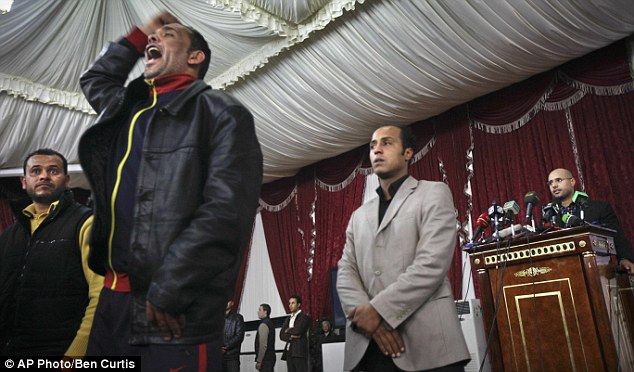
Watchful eye: An excited supporter, 2nd left, is watched closely by a bodyguard, center-right, as Seif al-Islam Gadhafi speaks in Tripoli today
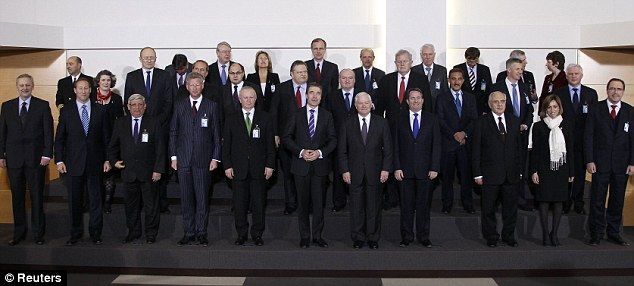
No no-fly zone without a UN resolution: NATO Secretary-General Anders Fogh Rasmussen poses for a family photo with defence ministers following a meeting at the Alliance headquarters in Brussels
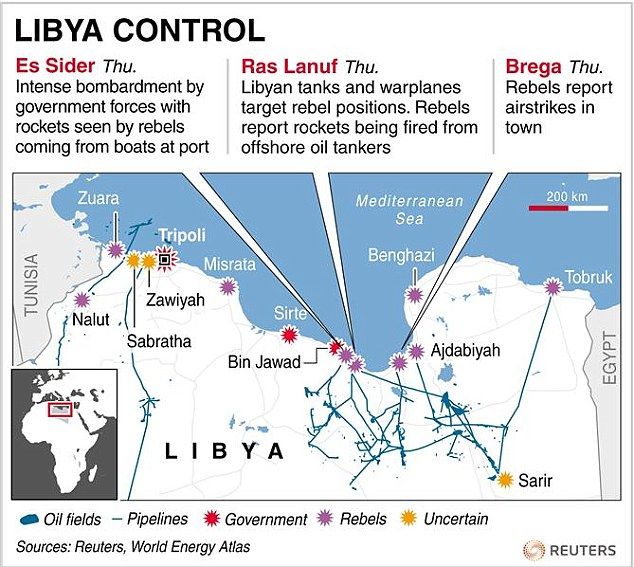
Both sides in Libya are lobbying for support from Western countries as their leaders debate whether to protect the rebels from Gaddafi's air force by putting a no-fly zone over some or all of the country.
Britain and France have backed the rebels' calls for a no-fly zone, but the Obama administration has expressed deep reservations about involvement in another conflict in the greater Middle East.
Nato said it had started round-the-clock surveillance of the air space over Libya, and British Foreign Secretary William Hague said a meeting of EU foreign ministers would discuss how to isolate the regime.
The Libyan government tried to stave off tough action, sending envoys to Egypt, Portugal and Greece.
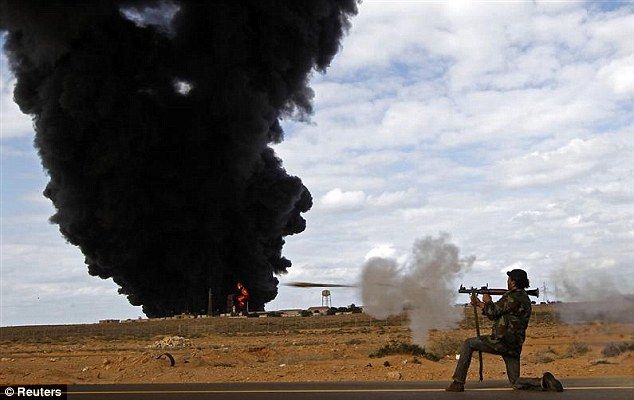
Up in flames: A rebel fighter fires a rocket-propelled grenade launcher in front of a gas storage terminal during a battle on the road between Ras Lanuf and Bin Jiwad
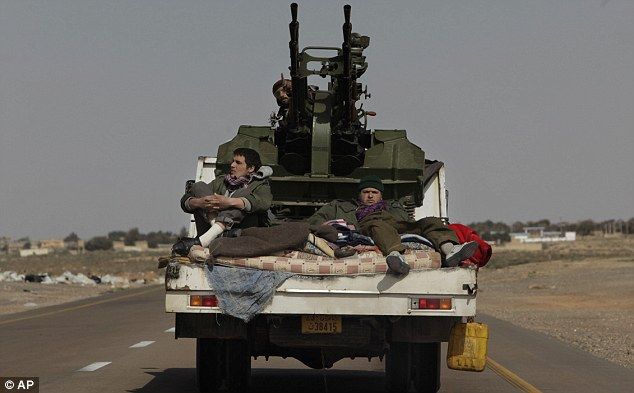
Resting where they can: Rebel fighters ride on the back of a heavily armed truck as they abandon Ras Lanouf
The international Red Cross said dozens of civilians have been wounded or killed in recent days in battles between the army and opposition.
Fighting between rebels and Gaddafi forces around Ras Lanouf set two oil installations ablaze and inflicted yet more damage on Libya's crippled energy industry.
In the west, Gaddafi claimed victory in recapturing Zawiya, the city closest to the capital that had fallen into opposition hands.
Western journalists based in Tripoli were taken to a stadium on the outskirts of Zawiya that was filled with Gaddafi loyalists waving green flags and launching fireworks.
Government escorts refused journalists' requests to visit the city's main square.; phone lines there have not been working during a deadly, six-day siege.
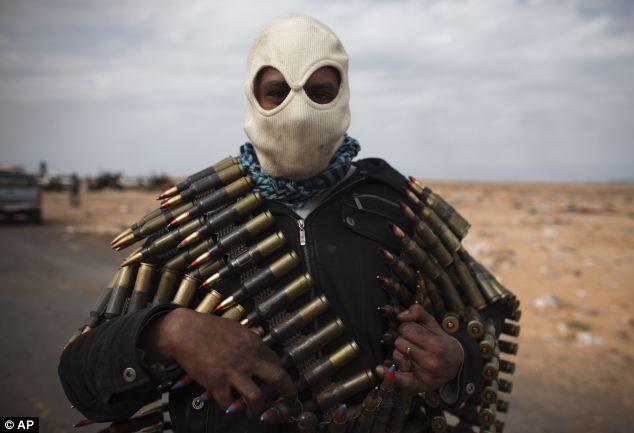
Fighting for their lives: A Libyan volunteer carries ammunition on the outskirts of the eastern town of Ras Lanouf
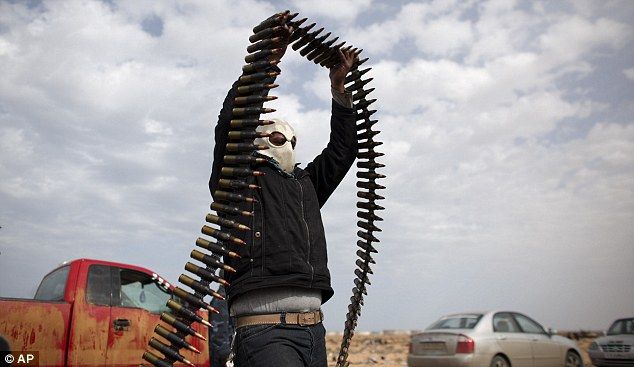
Moving on out: A member of the Libyan volunteer army prepares to load ammunition on to a van
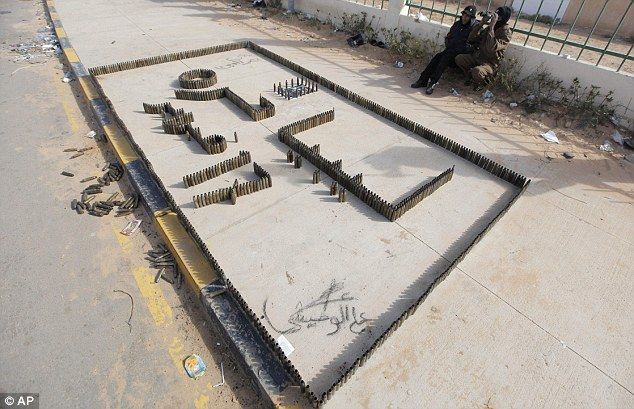
Defiant: Spent shell casings spell out February 17, Free Libya in Arabic at the entrance of Ras Lanouf
Red Cross President Jakob Kellenberger said local doctors over the past few days saw a sharp increase in casualties arriving at hospitals in Ajdabiya, in the rebel-held east, and Misrata, in government territory.
Kellenberger said 40 patients were treated for serious injuries in Misrata and 22 dead were taken there.
He said the Red Cross surgical team in Ajdabiya operated on 55 wounded over the past week and 'civilians are bearing the brunt of the violence.'
He said the aid organisation is cut off from access in western areas including Tripoli but believes those are 'even more severely affected by the fighting' than eastern rebel-held territories.


two photos of the "volunteer are one and the same...not two seperate volunteers....