
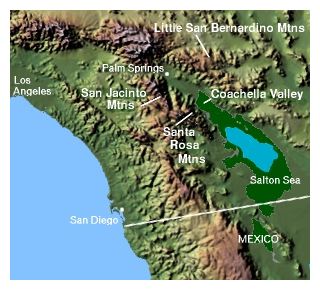
© Matthew Trump / WikipediaCoachella Valley
The United States Geological Survey is burying 3,000 seismographs near the San Andreas fault in the Coachella and Imperial valleys for its Salton Seismic Imaging Project.
They're being distributed among seven stretches of land and will measure seismic waves from small explosions simulating 1.5- to 2-magnitude earthquakes.
"We're trying to see below the ground surface and look for the possibility of hidden faults and categorize the nature of sediments," USGS spokeswoman Leslie Gordon said Tuesday. "You set off one explosion and record it along a line of many, many sensors."
The project also will help determine the underground shape of the San Andreas fault and the difference in shaking on both ends, USGS Geophysicist Gary Fuis said.
The project is "the only way to get some of these important answers about underground structures," he said. "We have to go make our own (earthquakes) to get a useful picture."
Officials wouldn't disclose the exact locations of the testing, but said it's all happening in rural and agricultural areas.
The longest stretch is 138 miles long, moving northeast to southwest in the Imperial Valley, Gordon said.
Another section is in the mountains and desert about 45 miles north of the Salton Sea, and a 24-mile stretch is north of Palm Springs and runs to Yucca Valley.
Explosives will be buried at least 60 feet underground and cause no property damage, USGS officials say.
Testing is being done in the evenings because there's less noise, Gordon said.
Experts will analyze underground sound waves to create images of Earth's crust, which reveals its geologic structure.
They want to determine the thickness and shape of sedimentary basins, which affect the strength of an earthquake, according to the USGS.
Seismic energy travels at a slower pace through sediments, becomes trapped and allows amplitudes to build up.
The Salton Seismic Imaging Project, Gordon added, will help experts understand what needs to be done to protect infrastructure from an earthquake, including the "Big One."
According to the USGS, nearly 2,000 people would die in a magnitude-7 scenario on the San Andreas fault, with some 50,000 injured and more than $200 billion in damage.
"I don't think it would be possible to be over-prepared for the possibility of an earthquake," Coachella Valley Association of Governments Executive Director Tom Kirk said. "This kind of work reminds us we can't be complacent; that the more analysis we can do - great."


Reader Comments
to our Newsletter