
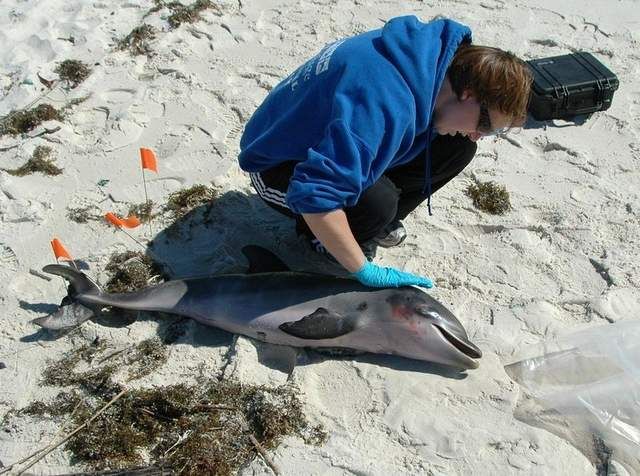
© Pensacola News JournalStephanie Kadletz, animal care specialist with Bayside Hospital for Animals in Fort Walton Beach, examines a baby bottlenose dolphin that was found on Perdido Key earlier this week.
The number of deaths has peaked three times in the past 13 months for all dolphins and whales along the northern Gulf Coast. Normally, one to two dolphins wash up in each state in January and February.
"We don't know what the cause is," Amendola said. "Everything has an equal playing field, from a virus, weather to the oil spill."
Steve Shippee, Marine Mammal Stranding team coordinator, offered another possibility. He said the increase could be because more people have been monitoring beaches since April 20 spill.
"This year, there's more eyes looking," he said.
In the past, if a fragile, baby dolphin washed up on the beach on a frigid day in the winter, predators may well have eaten it before someone could discover it, he said.
Emerald Coast Wildlife Refuge in Fort Walton Beach collected the baby dolphin found this week and sent it to Bayside Hospital for a necropsy, the animal version of an autopsy. It could take months before results are available.
The other two dolphins were found on the shore of a Paradise Bay home on East Bay on Jan. 5 and at Fort Pickens beach on Jan. 21.
"Is there some type of virus or algae bloom, or is it the cold temperatures we had? Or does it have something to do with the BP disaster?" Shippee asked. "No one is pointing a finger to any one thing."


Reader Comments
to our Newsletter