

© PAWhat lies beneath: Silbury Hill has long been thought to be concealing treasure, a temple or a tomb
The 4,000 year old earth mound, which towers over the Wiltshire countryside, was the tallest man-made structure in Europe until the Middle Ages.
But despite its size, and repeated attempts to tunnel into the heart of the mound, archaeologists have long been puzzled about how and why it was created.
Now a new book published by English Heritage suggests that the 120 ft high hill was not built to a grand blueprint, but was assembled by at least three generations of Bronze Age Britons between 2400 and 2300 BC.
A study of soil, rocks, gravel and tools inside the hill show that it went through 15 distinct stages of development.
Dr Jim Leary, English Heritage archaeologist, said the creators were building the mound as part of a 'continuous story telling ritual' - and that the final shape of the mound may have been unimportant.
He argues that the familiar outline of stepped sides and the flat top visible today is largely the result of Anglo-Saxons and later alterations.
'Most interpretations of Silbury Hill have, up to now, concentrated on its monumental size and its final shape,' he said.
'It has generally been thought to be a concerted effort of generations of people building something out of a common vision and spiritual zeal akin to that spurred the creation of soaring medieval cathedrals.
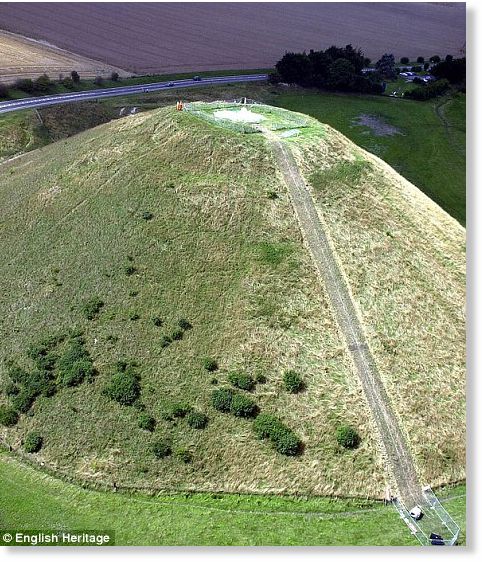
© English HeritageSilbury Hill: Mysterious prehistoric man-made structure's creation may have been an accident
'But new evidence is increasing telling us that our Neolithic ancestors display an almost obsessive desire to constantly change the monument - to rearrange, tweak and adjust it. It's as if the final form of the Hill did not matter - it was the construction process that was important."
Silbury Hill lies close to the stone circles of Avebury and a few miles from Stonehenge. Archaeologists estimate that it would have taken 700 men working for 10 years to build out of soil and chalk.
It started as a low gravel mound before it was transformed into a pile of soil and rock surrounded by a ditch.
Dr Leary added: 'The most intriguing discovery is the repeated occurrence of antler picks, gravel, chalk and stones in different kinds of layering, in ways that suggest that these materials and their different combinations had symbolic meanings.
'We don't know what myths they were representing but they must have meant something quite compelling and personal.
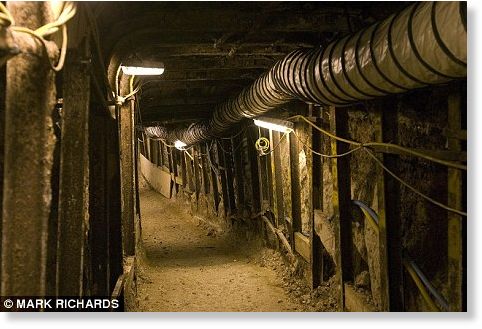
© Mark RichardsUnderground: A central tunnel that has been dug underneath the mound near Avebury
'What is emerging is a picture of Neolithic people having the same need to anchor and share ideas and stories as we do now, and that built structures like Silbury Hill may not be conceived as grand monuments of worship but intimate gestures of communication.'
The hill was damaged in the 18th century when archaeologists sank a vertical shaft from the top. In the 1840s a tunnel was dug into the mound from the edge, while in 1968 BBC2 filmed a new attempt to tunnel into the centre of the mound.
After parts of the mound began to sink in 2002, English Heritage reopened the BBC tunnel, took samples of soil and rock, filled in the gaps and sealed the mound for good.




What a lame bunch of mental gymnastics! How about the hill was continually improved as an observatory and what needed observing was dangerous stuff in the skies? See Knight & Lomas book: Uriel's Machine.