

© National News and PicturesAfrotarsius (top left) Karanesia (top right) Biretia (bottom left) and Talahpithecus (bottom Right) were early pre-cursors to humans.
The astonishing claim follows the discovery of four species of early primate in the Sahara desert, dating back 39million years.
The creatures, or anthropoid primates, are unlike anything yet found in Africa from the same time period or before, suggesting that they evolved elsewhere.
Scientists say there is overwhelming fossil evidence that mankind evolved from ape-like creatures in Africa, two to three million years ago. The last common ancestor of humans and chimpanzees lived five to seven million years ago, while we split off from the gorilla branch of the family tree around 10million years ago.
Many researchers believe that the common ancestors of all apes, monkeys and humans also evolved in Africa. But the new finding challenges that view.
Dr Christopher Beard, of Carnegie Museum of Natural History and an author of a paper in today's Nature journal, said: 'If our ideas are correct, this early colonization of Africa by anthropoids was a truly pivotal event - one of the key points in our evolutionary history.'
At the time, Africa was an island continent. When these anthropoids appeared - after possibly crossing the sea clinging to trees or mats of vegetation - there was nothing on that island that could compete with them, he said. 'It led to a period of flourishing evolutionary divergence among anthropoids, and one of those lineages resulted in humans.
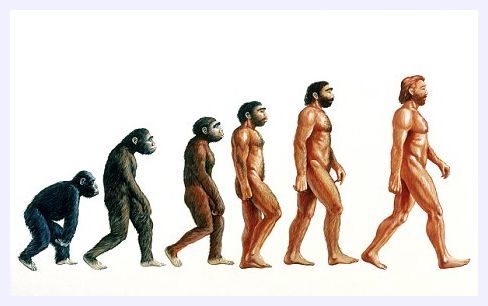
© The Daily Mail, UKThe ascent of man: Human evolution, from apelike beings of 20million years ago to modern man.
Although the researchers found only fossilised teeth at the Dur At-Talah escarpment - part of the unspoilt, remote Sahara in central Libya - they have a rough idea of their size and shape. The four creatures were small, weighing 4oz to 16oz, and resembled monkeys or lemurs.
Three of the creatures came from distinct families, or 'clades', of primates - showing that they had been evolving from a common ancestor for a long time.
The researchers say there is no evidence of similar primates from Africa before 39million years ago.
So either there is a 'striking gap' in the fossil record of North Africa - despite more than 100 years of fossil hunting expeditions in the region - or the early primates came from elsewhere, said Dr Beard.
'This sudden appearance of such diversity suggests that these anthropoids probably colonised Africa from somewhere else,' he said. 'Without earlier fossil evidence in Africa, we're currently looking to Asia as the place where these animals first evolved.'





Is it so hard for most scientist to say I m wrong? Why do they cling to theories that are most likely out dated. Why do they try to make the fact fit the theory instead of throwing the theory out and making a new one? I just don't get it. When I was in college studying chemistry that was one of the first things i was told in lab. Expect to be wrong, be glad to be wrong cause it can lead you on the right track eventually. Keep an open mind.
GAH its like a cult of personality. If SCIENTIST Q says it then we have to follow Q no matter if Q's data is 200 years out of date. WE shall make the fact and add facts to make the theory RIGHT!.