Storms
S


Ice Cube

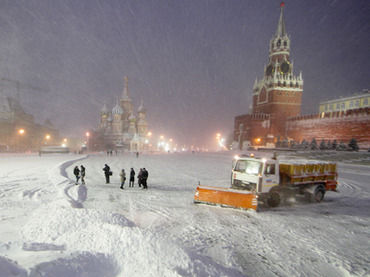
Snowiest winter in 100 years paralyzes Moscow

Image
© RIA Novosti / Denis Tyrin
The snowiest winter in a century has hit the Russian capital, causing Muscovites to get stuck in traffic jams 3,500km in length on Monday evening - the distance from Moscow to Madrid.

­Since the beginning of the winter, over 2 meters of snow has fallen on the Russian capital, the Moscow mayor's aide in housing and public utilities Pyotr Biryukov told Interfax. Snowfall is expected in Moscow for four or five more days, he added.

On Monday, 45,000 community services employees and 15,000 units of equipment were attempting to cope with 26 cm of snow - nearly a fifth of the average annual fall.

The latest snowfall has become a nightmare for drivers with the capital's commuters trapped in gridlock.

Many of those who left their workplace in the evening had to spend five to 10 hours getting home. The average speed of vehicles was no more than 7-9 km/h. The number of road accidents - 3,000 - was much higher than during an ordinary day, with minor accidents quadrupling, according to Channel One TV.

Bizarro Earth

Nine people killed as freak hailstorm rains massive boulders down on Indian villages

Hailstones the size of boulders have rained down on villages in southern India.At least nine people were killed when the violent weather hit several villages in the state of Andhra Pradesh. The hailstorm which lasted for almost 20 minutes, destroyed crops, houses and live stock, causing devastating financial implications for residents.
Freak Hailstorm_1
© Mohammed Aleemuddin/Barcroft lRaining down: People cleaning the streets covered with large boulders of hailstorm Andhra Pradesh, India.

Saturn

Cassini watches storm on Saturn choke on its own tail

cassiniwatch
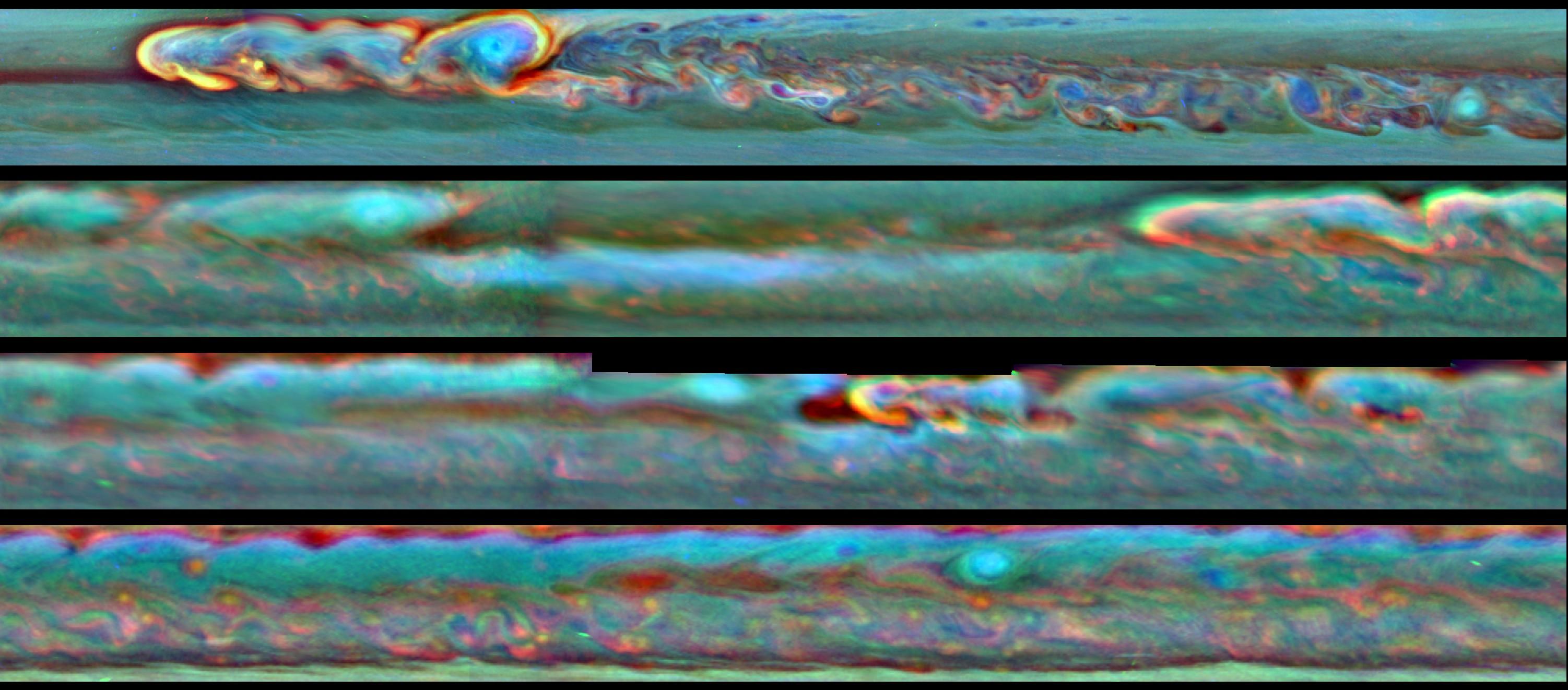
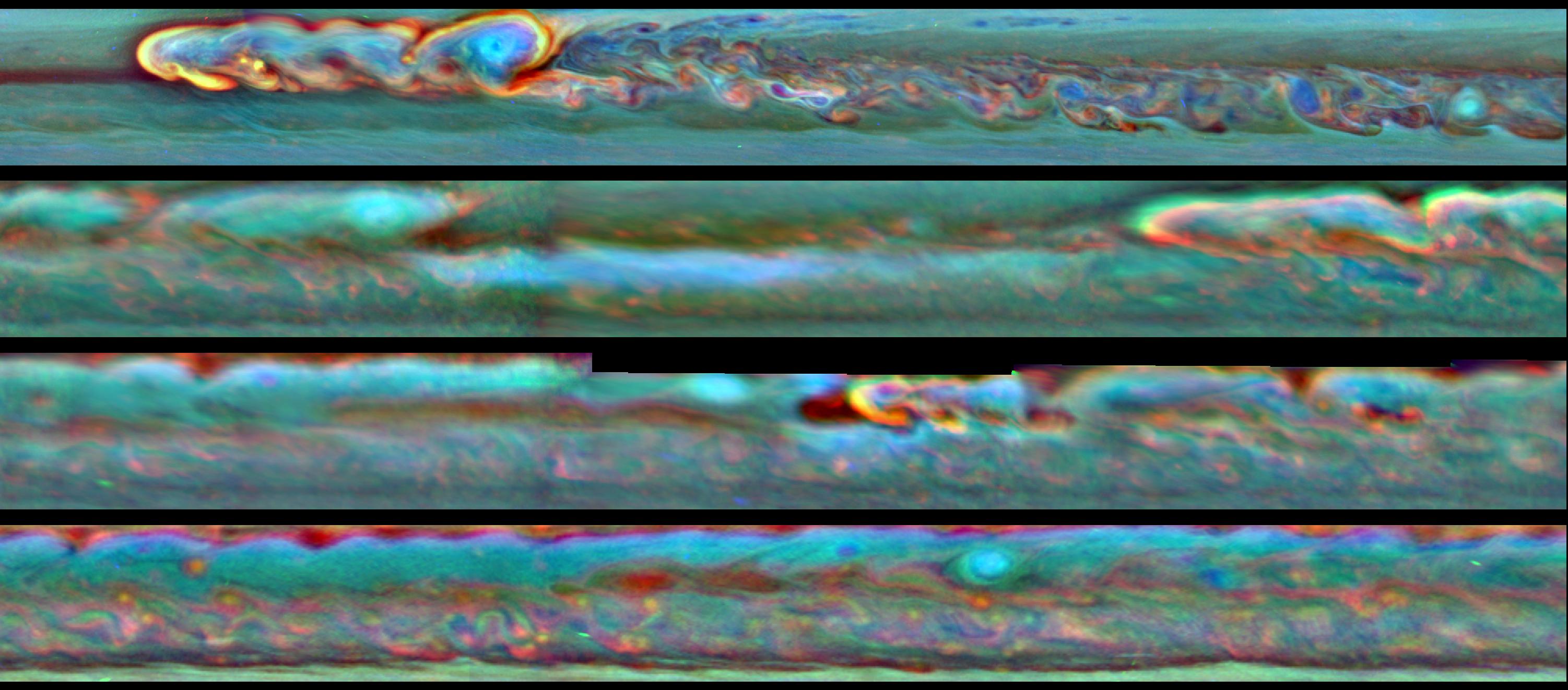
© NASA/JPL-Caltech/SSI/Hampton UniversityThis set of images from NASA's Cassini mission shows the evolution of a massive thunder-and-lightning storm that circled all the way around Saturn and fizzled when it ran into its own tail. The storm was first detected on Dec. 5, 2010. That month, it developed a head of bright clouds quickly moving west and spawned a much slower-drifting clockwise-spinning vortex.
Call it a Saturnian version of the Ouroboros, the mythical serpent that bites its own tail. In a new paper that provides the most detail yet about the life and death of a monstrous thunder-and-lightning storm on Saturn, scientists from NASA's Cassini mission describe how the massive storm churned around the planet until it encountered its own tail and sputtered out. It is the first time scientists have observed a storm consume itself in this way anywhere in the solar system.

"This Saturn storm behaved like a terrestrial hurricane - but with a twist unique to Saturn," said Andrew Ingersoll, a Cassini imaging team member based at the California Institute of Technology, Pasadena, who is a co-author on the new paper in the journal Icarus. "Even the giant storms at Jupiter don't consume themselves like this, which goes to show that nature can play many awe-inspiring variations on a theme and surprise us again and again."

Earth's hurricanes feed off the energy of warm water and leave a cold-water wake. This storm in Saturn's northern hemisphere also feasted off warm "air" in the gas giant's atmosphere. The storm, first detected on Dec. 5, 2010, and tracked by Cassini's radio and plasma wave subsystem and imaging cameras, erupted around 33 degrees north latitude. Shortly after the bright, turbulent head of the storm emerged and started moving west, it spawned a clockwise-spinning vortex that drifted much more slowly. Within months, the storm wrapped around the planet at that latitude, stretching about 190,000 miles (300,000 kilometers) in circumference, thundering and throwing lightning along the way.

Satellite

Satellite image shows Eastern U.S. severe weather system

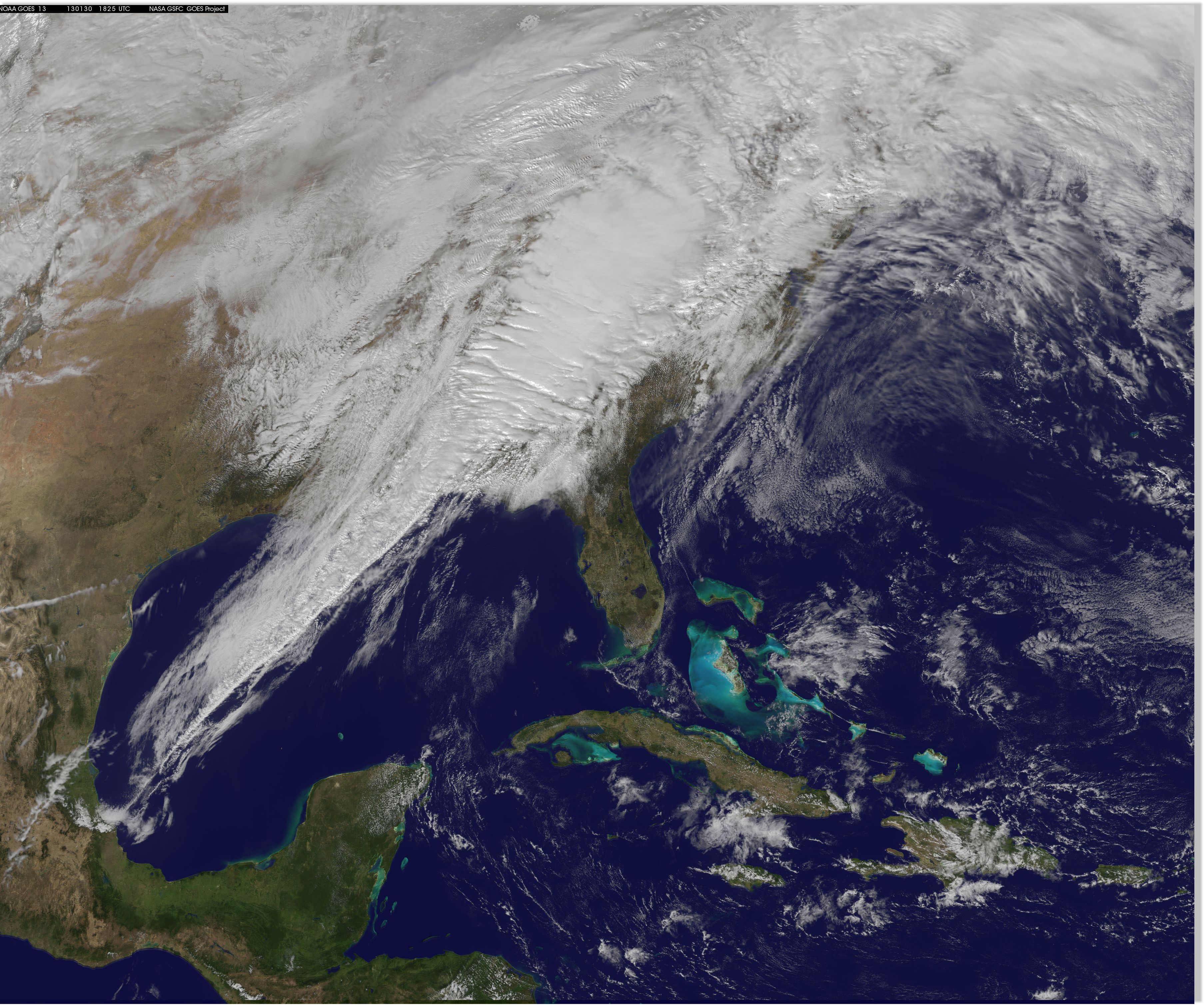
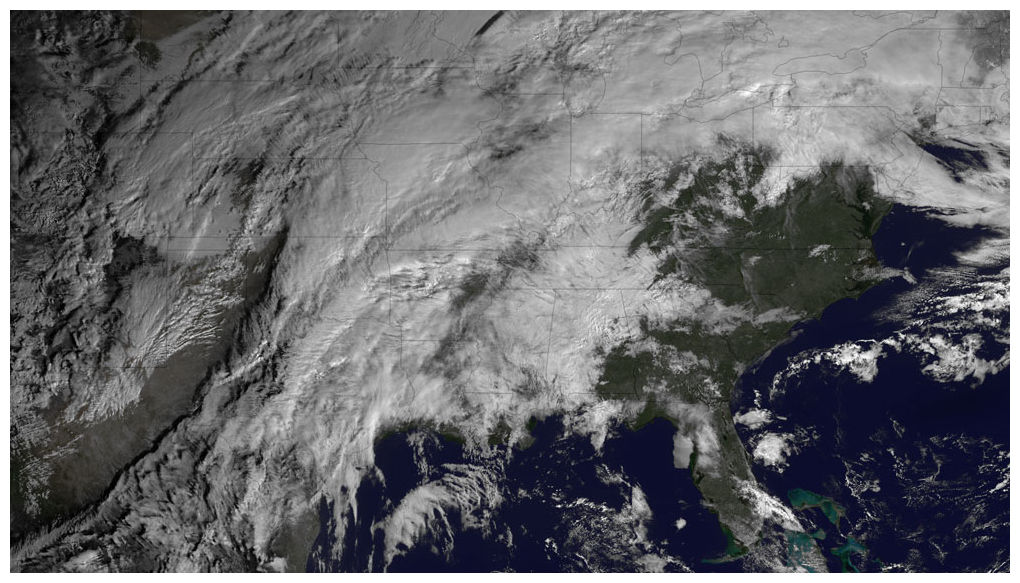
A powerful cold front moving from the central United States to the East Coast is wiping out spring-like temperatures and replacing them with winter-time temperatures with powerful storms in between. An image released from NASA using data from NOAA's GOES-13 satellite provides a stunning look at the powerful system that brings a return to winter weather in its wake.

On Jan. 30 at 1825 UTC (1:25 p.m. EST), NOAA's GOES-13 satellite captured an image of clouds associated with the strong cold front. The visible GOES-13 image shows a line of clouds that stretch from Canada to the U.S. Gulf Coast and contain powerful thunderstorms with the potential to be severe. The front is moving east to the Atlantic Ocean.
Image
© NOAA/NASA/GOES Project
NOAA's GOES-13 satellite continually provides real-time visible and infrared imagery of weather over the eastern United States. The NASA GOES Project, located at NASA's Goddard Space Flight Center in Greenbelt, Md., created the image from GOES data. The colorized image uses GOES-13 satellite visible data of clouds, and is overlaid on a U.S. map created by imagery from the Moderate Resolution Spectroradiometer instrument (MODIS), an instrument that flies aboard both the NASA Aqua and Terra satellites.

Cloud Precipitation

State of Emergency declared in the Seychelles after tropical cyclone Felleng

Seychelles map
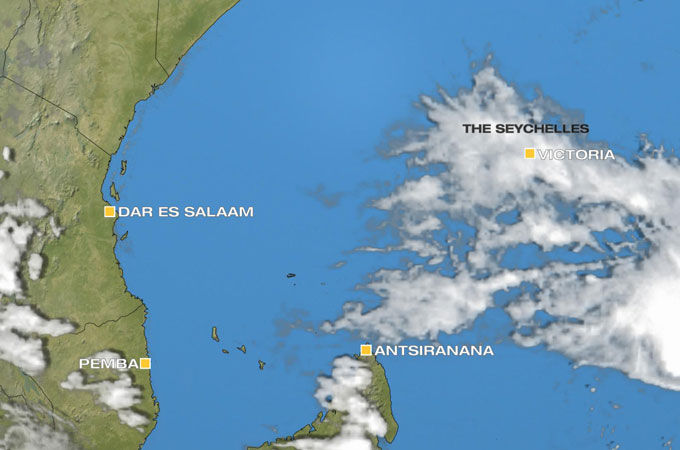
© Al JazeeraA state of emergency has been declared in three districts of Mahe, the largest island in the Seychelles
Flooding and landslides have destroyed well over a hundred houses on the main island of Mahe.

Parts of the Seychelles have been declared a state of emergency after severe weather hit the country.

Fortunately no casualties have been reported, but flooding, landslides and rock falls have hit the main island of Mahe. Over 150 houses have been damaged by the extreme conditions.

Pointe Au Sel in the southeast of the island reported 184mm of rain in a 24 hour period. This is nearly half the amount of rain which is expected in the entire month of January, which is the wettest month of the year.

Many other parts of the island also received well over 100mm, easily enough to generate flooding. With the ground fully saturated, landslides were inevitable.

Windsock

Tropical cyclone Felleng strongest of the season so far

Cyclone Felleng
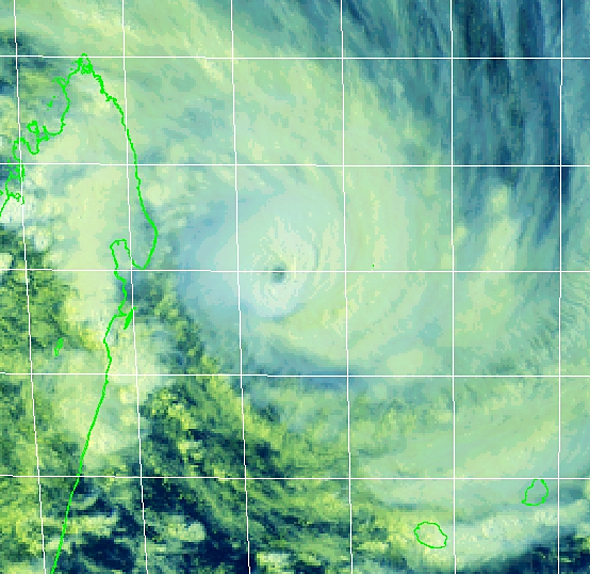
© Joint Typhoon Warning CenterCategory-4 equivalent Tropical Cyclone Felleng as of 1130 UTC Wednesday, Jan. 30, 2013. To the west lies Madagascar; Reunion and Mauritius to the southeast (lower right).
Tropical Cyclone Felleng has become the strongest cyclone of the South Indian 2012-2013 storm season and the strongest storm in this tropical cyclone region since last February.

Highest sustained winds rose to an estimated 115 knots, or about 215 km/h, as of 1200 UTC Wednesday, the Joint Typhoon Warning Center (JTWC) said.

The dangerous storm, equivalent to a Category-4 hurricane, was centered less than 400 miles northwest of Reunion and within 360 miles east-northeast of Antananarivo, Madagascar. Storm movement was towards the south-southwest 13 knots, or 24 km/h.

Official forecasts tracking Felleng have been consistent since the first of the week, inasmuch as they have shown the southward-veering cyclone tracking "safely" between Madagascar and Reunion before racing southward over open water.

Cloud Lightning

2 dead after storms rake U.S. South, take aim at East

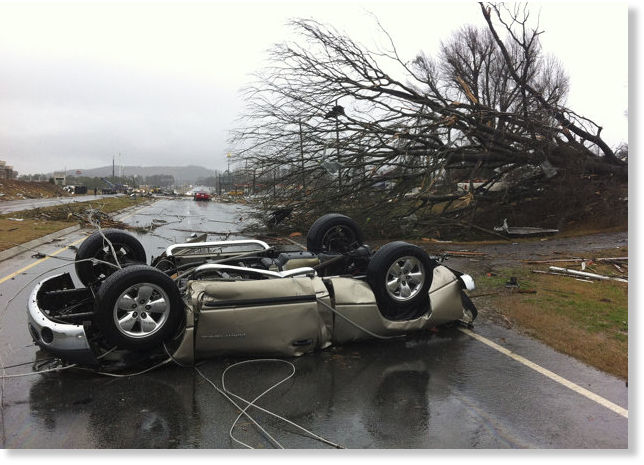
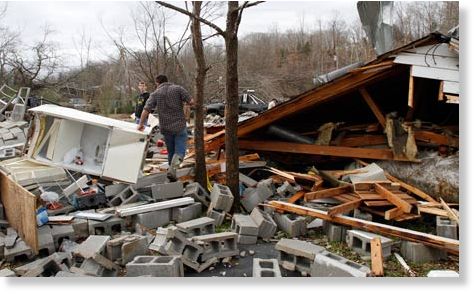
Kandi Cash trudged in rain through the splintered debris of her grandparents' home, hoping to salvage photos and other keepsakes after violent storms and tornadoes scoured the Southeast, leaving two people dead before the system advanced on the Northeast. The demolished home was one of many in the Georgia city of Adairsville splintered by a massive storm front as it punched across the Southeast on Wednesday and then headed across the densely populated Eastern seaboard on Thursday.
Image
© AP Photo/David GoldmanA vehicle lies on a road after a tornado moved through Adairsville, Ga. on Wednesday, Jan. 30, 2013. A fierce storm system that roared across northwest Georgia has left at least one person dead and a trail of damage that included demolished buildings in downtown Adairsville and vehicles overturned on Interstate 75 northwest of Atlanta.
The vast storm front stretching on a slanting north-south arc for hundreds of miles shattered homes and businesses around the Midwest and South with tornadoes and high winds earlier in the week. By Thursday, it had spread power outages from the Carolinas to Connecticut, triggered flash floods and forced water rescues in areas outside Washington, D.C.

In the Northeast, utilities reported power outages affecting 74,000 users in Connecticut, nearly 25,000 others in Rhode Island and some 24,000 in upstate New York. Authorities in Rhode Island said gusting winds blew the roof off a building in Central Falls. A wind gust of 63 mph was recorded in the Finger Lakes region of upstate New York as temperatures plunged with the cold air mass creeping up behind the front. Forecasters said snowfall was possible from the Great Lakes to the Northeast - some of it lake-effect snow.

Windsock

Tornadoes tear through four states in the U.S., killing at least two

Image
© Photograph: Butch Dill/APResidents search through debris after a suspected tornado ripped Coble, Tennessee, destroying several homes and businesses.
Tornadoes were reported in Mississippi, Georgia, Indiana and Tennessee, an unusual development in January

Tornadoes ripped through four states on Tuesday night and Wednesday, killing at least two people, as an Arctic cold front clashed with warm air to produce severe weather over a wide swath of the nation.

Tornadoes were reported in Mississippi, Georgia, Indiana and Tennessee, an unusual development in January when the focus is more likely to be on snow and ice.

The National Weather Service said twisters touched down in Sardis, Mississippi, and heavily damaged homes in Solsberry, Indiana, wiping out power in the surrounding areas. Three twisters were confirmed in Tennessee and a possible tornado hit southeastern Arkansas.

In Georgia, a man was killed when a tornado hit his mobile home late Wednesday morning, said Bartow County administrator Pete Olson.

In north Nashville, a man died when a tree fell on his garage apartment, according to Jeremy Heidt, spokesman for the Tennessee Emergency Management Agency.

Cloud Lightning

1 dead as powerful winds, rain batter the U.S. South

Powerful winds, rain and hail battered parts of the South on Wednesday, killing at least one person as the large storm system damaged homes, overturned cars on an interstate and knocked out electricity to thousands.At least one tornado was confirmed and several more suspected, and conditions remained ripe for more. Since Tuesday, the system had caused damage across a swath from Missouri to Georgia.

In recent days, people in the South and Midwest had enjoyed unseasonably balmy temperatures in the 60s and 70s. A system pulling warm weather from the Gulf of Mexico was colliding with a cold front moving in from the west, creating volatility.

Police said high winds toppled a tree onto a shed in Nashville, Tenn., where a man had taken shelter, killing him. As the storm crept eastward, officials reported a possible tornado in Adairsville, Ga., about 60 miles northwest of Atlanta. At least 10 cars were overturned on Interstate 75, and emergency crews were trying to get to people reported trapped in homes and buildings, said Bartow County Fire Chief Crag Millsap.

Across the region, downed power lines, trees and tree limbs were making it difficult to reach people who needed help.

Cloud Lightning

Satellite spies severe weather brewing over U.S.

Severe Weather
© NOAAIn this GOES East satellite image taken at 10:15 a.m. ET on Jan. 29, 2013, severe weather can be seeing brewing over the central portions of the United States.
After an Arctic blast left much of the United States out in the cold, a new system is bringing the threat of severe weather to the central portions of the country this evening and through the night. A satellite snapped an image of the system earlier this morning (Jan. 29).

The National Weather Service's (NWS) Storm Prediction Center, located in Norman, Okla., has forecast severe thunderstorms, with damaging winds and hail - and possibly even tornadoes - for the lower Ohio Valley, the mid-South and the lower Mississippi Valley. The SPC says the threat will increase through the night, with squall lines (or long lines of thunderstorms) and individual storms rolling through along with a cold front.

Nighttime storms and tornadoes can be particularly deadly, as people tend to be in bed and unaware of warnings and the storms are harder to see as they bear down. A 2008 study in the American Meteorological Society's journal Weather and Forecasting found that nighttime tornadoes were 2.5 times as likely to cause a death as those that occurred in the daytime. The threat of deadly nighttime tornadoes is exacerbated in the winter with the season's shorter daylight hours.