VLT's NACO instrument reveals a triple cosmic collision
Using ESO's Very Large Telescope, an international team of astronomers has discovered a stunning rare case of a triple merger of galaxies. This system, which astronomers have dubbed 'The Bird' - albeit it also bears resemblance with a cosmic Tinker Bell - is composed of two massive spiral galaxies and a third irregular galaxy.
There could be enough computing ability in just one brain cell to allow humans and animals to feel, a study suggests.
Researchers in Israel say they have succeeded in putting a version of the Bible on a chip smaller than a pinhead.
Its 300,000 words in Hebrew were inscribed on a silicon surface at the Haifa Institute of Technology.
Scientists say the aim of the project is to increase young people's interest in nanoscience and nanotechnology.
Mark Kidger of the European Space Agency confesses to a certain obsession at this time of year -- one that has nothing to do with the big bang or dark energy.
"It's probably the oldest mystery in astronomy," the British scientist said.
Kidger is speaking of the "Star of Bethlehem," the heavenly sign in the Gospel of St. Matthew that guided the wise men in their search for the baby Jesus.
Scientists have discovered what they think may be another reason why Greenland 's ice is melting: a thin spot in Earth's crust is enabling underground magma to heat the ice.
Are some experiences so horrific that the human brain seals them away, only to recall them years later? The concept of "repressed memory," known by the diagnostic term dissociative amnesia, has long fueled controversy in psychiatry. During the 1980s, claims of childhood sexual abuse based on recovered memories led to a spate of highly publicized court cases. A number of the supposed victims retracted their allegations in the early 1990s, admitting that they had been swayed by therapeutic techniques. Yet the scientific validity of dissociative amnesia has remained contested ground.
Comment: Anyone up for a challenge?
For several weeks in the fall of 2007, amateur astronomers and sky watchers around the world were entranced by the mysterious, energetic display of Comet Holmes 17P. The Internet still abounds with exotic theories about the comet's nature -- some have claimed it is the "Blue Kachina" foretold in Hopi Prophecy, others assert that the secret government shot it with a nuclear missile, and still others say its nucleus is acquiring mass and turning into a PLANET.
Garish and unfounded speculations aside, it is interesting that Comet Holmes, while providing a remarkable cometary "light show" and inciting great interest, never appeared to the naked eye as more than a tiny, luminous "fluff ball" of light. Certainly, without the aid of telescopes and space satellites, its unremarkable glow amongst a vast network of stars and planets would not have captured the average person's attention. Nor would anyone observing it have had any reason to feel terror.
SABASun, 23 Dec 2007 08:08 UTC
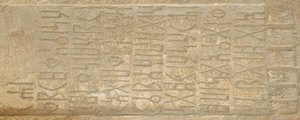
Excavation operations at the area of Khamis Bani Sa'ad in Tehama district of Hodeidah province have discovered over a thousand of rare archaeological pieces dating back to 300 thousand years BC.
A French expert said that some pieces indicated that the area's inhabitants had been fishermen not farmers as they are now, but the most important discovery is a horse tooth and what is amazing here is that this kind of horses dose not live currently in this area but in the Middle Asia.
|
| ©Unknown
|
| Over thousand rare ancient archaeological pieces found in Tehama
|
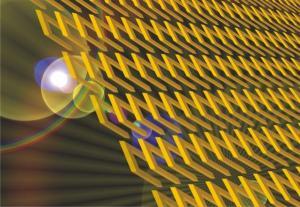
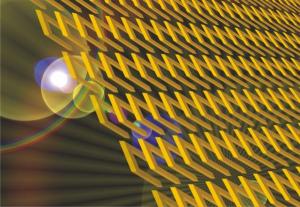
Last year researchers from Duke University stunned the world when they announced a cloaking device for the microwave range. This device made use of metamaterials that had a negative refractive index for electromagnetic radiation. The metamaterials were carefully designed split-ring resonators with a structure size much smaller than the wavelength. Only 10 stacked layers of metamaterials were necessary to achieve the desired invisibility effect.
|
| ©Stuttgart University/ MPI
|
| 3D metamaterials. Gold nano split ring resonators are stacked.
|








Comment: Anyone up for a challenge?