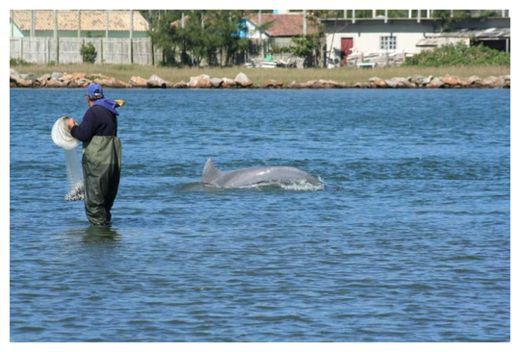
© Fábio Daura-JorgeA helping fin. A fisher in Laguna, Brazil, fishes with the assistance of a local dolphin.
Flipper who? The fictional dolphin may be known for rescuing trapped divers and stranded sailors. But he's got nothing on his real-life kin in Laguna, Brazil. These clever marine mammals are truly helpful, regularly aiding local fishers in trapping schools of tasty fish - a behavior not seen anywhere else in the world. Now, a new study explores the interactions between Laguna's dolphins, providing clues to how they've maintained their long-lasting collaboration with people.
Every autumn, lucky visitors to Laguna, Brazil, which is situated around a narrow lagoon on the Atlantic Ocean, catch an odd sight. Here, resident bottlenose dolphins (
Tursiops truncatus) frequently turn sheepdog, herding schools of small, silver fish called mullets toward the shore - and, it turns out, toward lines of wading fishers. As soon as the dolphins get close to their human companions, they give the signal, slapping their heads or tails against the surf. In an instant, the fishers cast their nets, catching dozens of frenzied mullet.
While it's not clear whether the dolphins themselves get food out of the exchange or benefit in other ways, both people and marine mammals alike have fished side by side like this for generations, says study co-author Simon Ingram, a marine mammal biologist at Plymouth University in the United Kingdom. Still, something intrigued him and his colleagues: Only about one-third of the lagoon's more than 50 dolphins - whose genders and relatedness have yet to be determined - regularly take part in the tradition, and some of them earn nicknames from the locals such as Scooby or Caroba. The others stick to the sidelines, avoiding people. That raised the question, he says: "Why don't they all do it given the opportunity?"
Ingram and his colleagues set out in boats, taking photos of Laguna's dolphins as the creatures swam together. The goal was to explore how these animals interacted - whether some dolphins spent more time with only a few friends, isolating outsiders. For the most part, the dolphins seemed pretty egalitarian, the group discovered. A few stray animals might swim together for a time. Then they'd eventually split up, each darting off to join another group.
Individuals that helped local fishers tended to also cluster more with each other, while dolphins that didn't pitch in kept more to themselves, the team reports online today in
Biology Letters.