
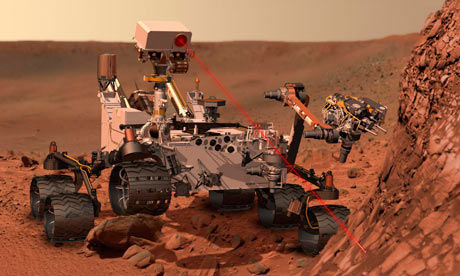
© ReutersHow Curiosity will investigate the composition of rocks on Mars.
The spaceship's hold will open and a one-tonne robot rover, Curiosity, will be lowered - on three nylon cables - on to the surface of the Gale Crater, near the Martian equator, the craft's target landing site.
After two seconds, explosive bolts will cut the cables and the probe will be instructed to give a final blast of its engines to lift itself clear of Curiosity and to crash land at a safe distance. The rover, the size of a small car, will then start its journey over the Martian landscape
It is an intensely delicate operation. Should any part of the landing sequence go wrong, $2.5bn worth of hardware, and a decade of effort by astronomers, will be splattered over the Martian landscape. "We will get seven minutes to descend from the top of the atmosphere to the surface, to go from 13,000mph to zero, in perfect sequence, perfect choreography, perfect timing, with the computer operating all by itself," said Nasa engineer Tom Rivellini. "If any one thing does not work out right, it is game over." Hence the Curiosity team's nickname for its descent: the seven-minutes of terror.




Comment: And if they seeded the oceans, what about oil?
Bit by bit NASA continues to incorporate the work of others who have long since been saying such things:
Planet-X, Comets and Earth Changes by J.M. McCanney