Best of the Web:


Alarm Clock

Best of the Web: Global Warming Caused by Cosmic Rays and the Sun - Not Humans

Image
New, convincing evidence indicates global warming is caused by cosmic rays and the sun - not humans

The science is now all-but-settled on global warming, convincing new evidence demonstrates, but Al Gore, the IPCC and other global warming doomsayers won't be celebrating. The new findings point to cosmic rays and the sun - not human activities - as the dominant controller of climate on Earth.

The research, published with little fanfare this week in the prestigious journal Nature, comes from über-prestigious CERN, the European Organization for Nuclear Research, one of the world's largest centres for scientific research involving 60 countries and 8,000 scientists at more than 600 universities and national laboratories. CERN is the organization that invented the World Wide Web, that built the multi-billion dollar Large Hadron Collider, and that has now built a pristinely clean stainless steel chamber that precisely recreated the Earth's atmosphere.


Smoking

Best of the Web: The Scientific Scandal of Antismoking

Marlene Dietrich
© UnknownMarlene Dietrich

Science is not always a neutral, disinterested search for knowledge, although it may often seem that way to the outsider. Sometimes the story can be very different.

Smoking and health have been the subject of argument since tobacco was introduced to Europe in the sixteenth century. King James I was a pioneer antismoker. In 1604 he declared that smoking was "a custome lothsome to the eye, hatefull to the Nose, harmefull to the braine, dangerous to the Lungs, and in the blacke stinking fume thereof, neerest resembling the horrible Stigian smoke of the pit that is bottomelesse." But like many a politician since, he decided that taxing tobacco was a more sensible option than banning it.

By the end of the century general opinion had changed. The Royal College of Physicians of London promoted smoking for its benefits to health and advised which brands were best. Smoking was compulsory in schools. An Eton schoolboy later recalled that "he was never whipped so much in his life as he was one morning for not smoking". As recently as 1942 Price's textbook of medicine recommended smoking to relieve asthma.

These strong opinions for and against smoking were not supported by much evidence either way until 1950 when Richard Doll and Bradford Hill showed that smokers seemed more likely to develop lung cancer. A campaign was begun to limit smoking. But Sir Ronald Fisher, arguably the greatest statistician of the 20th century, had noticed a bizarre anomaly in their results. Doll and Hill had asked their subjects if they inhaled. Fisher showed that men who inhaled were significantly less likely to develop lung cancer than non-inhalers. As Fisher said, "even equality would be a fair knock-out for the theory that smoke in the lung causes cancer."

Comment: Let's All Light Up!

Aliens Don't Like to Eat People That Smoke!

Health Benefits of Smoking Tobacco

Brain cells work differently than previously thought: Nicotine helps to spark creativity


Radar

Best of the Web: Monsanto's Roundup May End Bananas - Canaries In The Mine

Image
© Unknown
Bananas are dying. They're killed by a fungus, one known to be caused by glyphosate, which is used on bananas. But the loss of bananas may be only the tip of the disaster.

The bananas we eat today are not the same ones that were eaten in the first half of the 20th century. Those were tastier and creamier. They were lost to monoculture. A fungal infection, Fusarium, couldn't be overcome because nearly all bananas were clones, and therefore susceptible to the same disease.

The bananas we eat today, a different variety that had been secure from Fusarium are now falling to the same fungal infection. Agribusiness responds simply by closing up shop where the disease has taken over and starting up in a new area. In true earth scorching approach, they walk away from their disasters and do exactly the same thing elsewhere, thus recreating the same disaster again and again.

Bad Guys

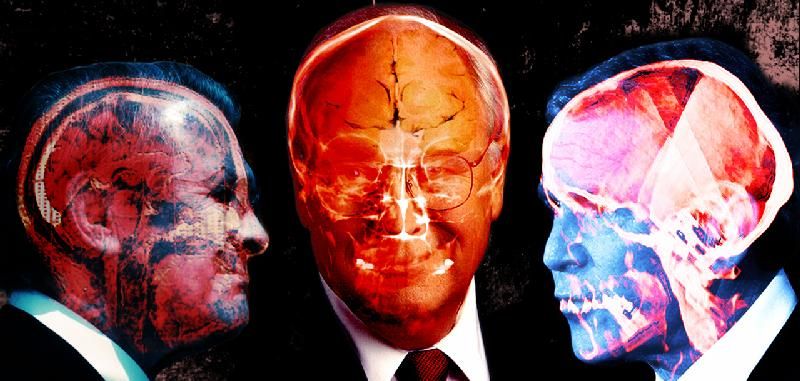
Best of the Web: Dick Cheney's Heart of Evil, Psychopathic Political Systems, And The Correct Uses of Social Stigma

pathocrat graphic
© Hermes Press
"Ponerology was born in the crucible of attempts to understand, scientifically, a macro-social phenomenon of what can only be called extreme and excessive evil: Fascism and Soviet Communism." - Andrew M. Lobaczewski, a Polish psychiatrist and author of the book, Political Ponerology: A Science on the Nature of Evil Adjusted for Political Purposes.

Definition of Pathocracy (from the website The Pathocracy Blog):
pathocracy (n). A system of government created by a small pathological minority that takes control over a society of normal people (from Political Ponerology: A Science on the Nature of Evil Adjusted for Political Purposes, by Andrew Lobaczewski).

From Greek pathos, "feeling, pain, suffering"; and kratos, "rule".

A totalitarian form of government in which absolute political power is held by a psychopathic elite, and their effect on the people is such that the entire society is ruled and motivated by purely pathological values.

A pathocracy can take many forms and can insinuate itself covertly into any seemingly just system or ideology. As such it can masquerade under the guise of a democracy or theocracy as well as more openly oppressive regimes.

"That is the nature of professional politics. Many are called, but few survive the nut-cutting hour--which appears to be coming down on our goofy Child President these days. . . . Ah, but it was ever thus, eh? Vicious thieves have always ruled the world. It is our wa. We are like pigs in the wilderness." - Hunter S. Thompson, from Kingdom of Fear.

Telescope

Best of the Web: Electric Universe: Andromeda's Mother Cassiopeia

cassiopeia
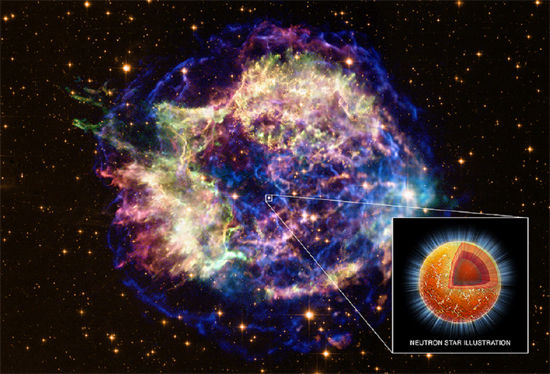
© Credit X-ray: NASA/CXC/UNAM/Ioffe/D. Page, P. Shternin et al; Optical: NASA/STScI; Illustration: NASA/CXC/M. WeissThe remains of an exploding double layer known as Cassiopeia A with an artist's impression of a theoretical entity called a neutron star.

Rather than searching for exotic explanations, this celestial object can best be described using plasma physics.

According to a recent announcement from the Chandra X-ray Observatory, the so-called "supernova remnant" Cassiopeia A (or "Cas A") harbors a strange passenger within the neutron star that is supposed to inhabit its interior, a form of superconductor known as a superfluid.

As theory suggests, neutron stars form when large stars exhaust their fuel supplies as they age. Once a star with about five times the mass of our Sun accumulates enough thermonuclear "ash" composed of non-fusible elements like iron in its core, it undergoes a catastrophic implosion. Since nuclear reactions can no longer be sustained, the star becomes the victim of its own gravity field. The star's outer surface collapses inward at tremendous speed, rebounding off the dense core material. The star then erupts outward in a supernova explosion, blasting its outer layers into space, releasing X-rays, gamma rays, and extreme ultraviolet.

Light Saber

Best of the Web: US: Colin Powell accuses former Vice-President Dick Cheney of taking 'cheap shots' in new book

Image
© The Associated Press/Threshold EditionsThis book cover image released by Threshold Editions shows In My Time: A Personal and Political Memoir, by Dick Cheney with Liz Cheney. The book is scheduled for release on Aug. 30, 2011.
Former Secretary of State Colin Powell is accusing former Vice-President Dick Cheney of taking "cheap shots" at him and others in a new book.

Powell was America's top diplomat during the first four years of President George W. Bush's administration. Cheney's book, In My Time, is set for release Tuesday.

Cheney writes that he thinks Powell tried to undermine Bush by criticizing administration policy to people outside the government.

Powell tells CBS' Face the Nation that he routinely gave his opinion and his best advice on issues to the president.

While Cheney writes that Powell's resignation was "for the best," Powell says he had always planned to leave the administration after the 2004 election.

Powell says Cheney is almost condescending in his remarks about Powell's successor, Condoleezza Rice.

Meteor

Best of the Web: Comet Double Feature: Comets Elenin & Garradd Now Showing in Night Sky

Comet Garradd
© Starry Night SoftwareComet Garradd can be seen right now with binoculars in the constellation Sagitta.

Skywatchers often ask "When's the next comet?" In fact, if you're prepared to do a bit of searching, there are always several comets visible in the night sky, including two right now.

Some comets are like old friends, they keep coming back at regular intervals to visit. These are called periodic comets; Comet Halley was the first such comet to be identified, by Edmond Halley back in 1705. It returns to the inner solar system every 75 to 76 years; its last appearance was in 1986 and its next will be in 2061. At present Halley is out just beyond Neptune's orbit.

Other comets are one-time visitors: they come in to visit us from the Oort Cloud, warm themselves for a few months by the sun, and then head back out to the farthest reaches of the solar system.

There are two comets currently visiting the inner solar system - comet Elenin and comet Garradd - so the next two months will provide some excellent opportunities to observe these unusual visitors. The sky map of the two comets here shows their locations over the next few weeks.

Info

Best of the Web: Falling Meteor Depicted in 5000-Year-Old Rock Carving in North China

Ancient Carvings
© Wikipedia Org
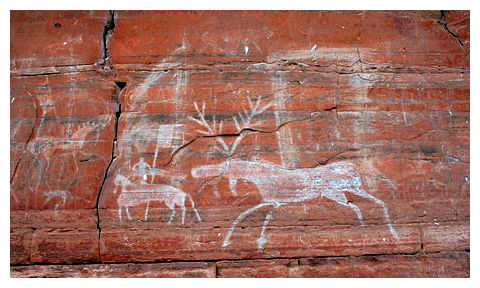
Hohhot -- A 5,000-year old rock carving in north China's Inner Mongolia Autonomous Region depicts a falling meteor, said archaeologists on Saturday.

A rock on the side of Dahei Mountain in the city of Chifeng has images of people, domed houses and a fire ball with a long tail falling from the sky engraved on it, said Wu Jiacai, head of the Inner Mongolia rock paintings protection association.

"I believe it shows prehistoric people returning at dusk from a hunting trip to their domed houses, as a meteor falls from the sky," Wu shared his findings at the 6th Hongshan Cultural Forum that runs from August 25 to 27.

He added that in the same location several years ago, another set of carvings were found showing people fleeing, snakes slithering and birds flying away, which might be what happened after the meteor hit the earth.

The area has about 1000 carvings all believed to be made by the Neolithic Hongshan people, Wu said.

"The pictures can shed some light on the disappearance of the Hongshan culture, which was quite developed," Wu said.

Crusader

Best of the Web: US Tiptoes Towards Theocracy

theocracy
In difficult times, nations sometimes embrace extreme solutions. In 1494 Florence became a Christian Republic and Savonarola commenced his inquisition. Now America is in turmoil and Republicans offer a radical vision -- Michele Bachmann and Rick Perry. Is the US sliding towards Theocracy?

In 1494, Florence, Italy, was in economic and social turmoil. Catholic Priest Girolamo Savonarola declared Florence a Christian Republic and formed a Theocracy. Claiming to receive direction from God, Savonarola preached about the Last Days, and sparked a moral "purification" campaign. Homosexuals and liberal thinkers were killed, thousands of books were burned, and gangs ravaged Florence looking for indications of moral laxity, resulting in the notorious Bonfire of the Vanities.

In 2011, America is in economic and social turmoil and Republicans offer the solution of Theocracy. It's been tried here before. The Massachusetts Bay Colony was a Puritan Theocracy -- in 1660 Quaker Mary Dyer was hanged on Boston Common for advocating her religion. Until the nineteenth century, several states had official Christian churches. Nonetheless, the separation of church and state seems a solid legal principle -- "free exercise" of religion is in the First Amendment of the US Constitution (the notion of "separation" came from an 1802 Thomas Jefferson letter).

Newspaper

Best of the Web: 5 things the media isn't telling you about human activity and earthquakes

police tape
© John Murden

Shortly before midnight Mountain Time on August 23, the largest earthquake in Colorado in more than a century, with a magnitude of 5.3, sent tremors as far away as Kansas. Some twelve hours later, a magnitude 5.8 earthquake centered in Northern Virginia sent shock waves as far away as Toronto. The local damage in each event did not appear extensive, though structural effects, on bridges, tunnels, nuclear power plants and more are yet to be determined.

Through the afternoon and evening of August 23rd, the national media uncovered the big story of the East Coast quake: where their colleagues posted in New York or Washington were and what they thought when they felt a bump, sway, rumble or funny feeling. But with no national correspondents already on site, the Colorado quake was left to the locals. But both quakes were profound, rippling with far-reaching lessons about our outdated and unsafe energy practices that we ignore at great peril.