
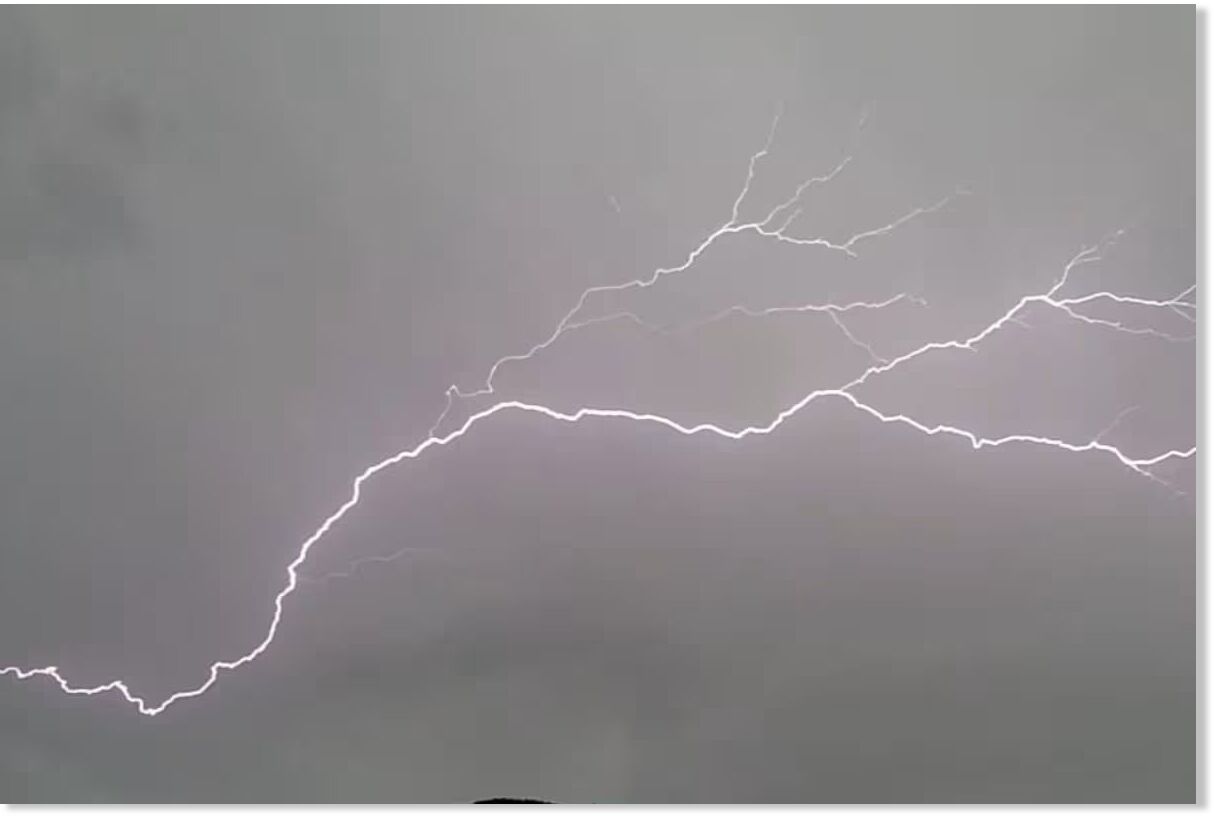
New data from the National Crime Records Bureau (NCRB) shows that lightning killed 2,825 people across India in 2024, a 10.4 percent rise from 2,560 deaths in 2023. It accounted for 35.7 percent of all accidental deaths attributed to forces of nature that year, far ahead of heat stroke, which killed 1,832 people, and floods, which took 361 lives, 833 from cold exposure, and 361 from floods.
The figures are not an anomaly. Over the past six years, lightning has killed more than 19,245 people across India. The annual toll has remained stubbornly high: 2,357 in 2018, 2,876 in 2019, 2,862 in 2020, 2,880 in 2021, 2,887 in 2022 and 2,558 in 2023. Scientists say it will get worse before it gets better.
The Numbers and What They Show
Heat and sun stroke killed 1,832 people, a 127.9 percent jump from 806 deaths in 2023, the sharpest single-year increase of any natural cause recorded in the report. Exposure to cold claimed 833 lives. Floods killed 361. Landslides took 351.
Lightning, despite a modest 10.4 percent rise from 2,560 deaths in 2023, remained the dominant killer by a wide margin.
The toll has stayed consistently high for years. Lightning killed 2,357 people in 2018, 2,876 in 2019, 2,862 in 2020, 2,880 in 2021, and 2,887 in 2022. Over six years, the cumulative death toll crossed 17,000. The number has never fallen below 2,300 in that period.
Of the 7,903 people who died from natural forces in 2024, the majority, 57.2 percent, were between 30 and 60 years old. These are working-age adults, the people most likely to be in fields, on construction sites, or tending livestock when storms arrive without warning.
Where Lightning Kills the Most
Madhya Pradesh recorded the highest number of lightning deaths in 2024 at 577, followed by Bihar at 360, Uttar Pradesh at 275, Odisha at 249, and Chhattisgarh at 241.
In smaller states, lightning accounted for nearly all deaths from natural forces. In Goa and Manipur, every single death from natural forces was caused by lightning. In Tamil Nadu, lightning caused 89.2 percent of such deaths. In West Bengal, 85.9 percent.
In Jammu and Kashmir, the Ganderbal lightning strike that killed 90 sheep and goats belonging to a nomadic Bakarwal family in May 2026 illustrated the reach of the hazard into high-altitude grazing areas where no shelter exists and no warning arrives in time.
Why Central India Bears the Heaviest Burden
Madhya Pradesh's dominance in the lightning death toll is not accidental. Professor Manoranjan Mishra, a lightning expert at Fakir Mohan University in Odisha, points to a combination of industrial, environmental, and geographic factors. "Extensive mining, deforestation, and aerosols contribute to lightning activity in the region," he said. "Combined with heating and moisture before the monsoon, this makes central India more vulnerable than the northeast or the south."
Despite its relatively flat terrain, which typically produces fewer strikes than hilly regions, Madhya Pradesh has a population density of approximately 236 people per square kilometre. More people in open spaces means more deaths when storms arrive.
Dr. Sunita Verma, Associate Professor at Banaras Hindu University, identified two specific behaviours that drive the death toll in rural areas. "The high casualties in Madhya Pradesh are due to the lack of an effective early warning system and unsafe sheltering practices among the rural populace, particularly farmers," she said. "Most fatalities occur when individuals seek refuge under trees during thunderstorms, not realising the increased risk."
Dr. Verma said frequent cumulonimbus cloud formation over the region and the near-total absence of public awareness campaigns compound the problem. "The government needs robust mitigation strategies, including timely warnings and accessible educational campaigns, especially in rural and vulnerable areas," she said.
(More here)


Reader Comments
to our Newsletter