
© The Cradle
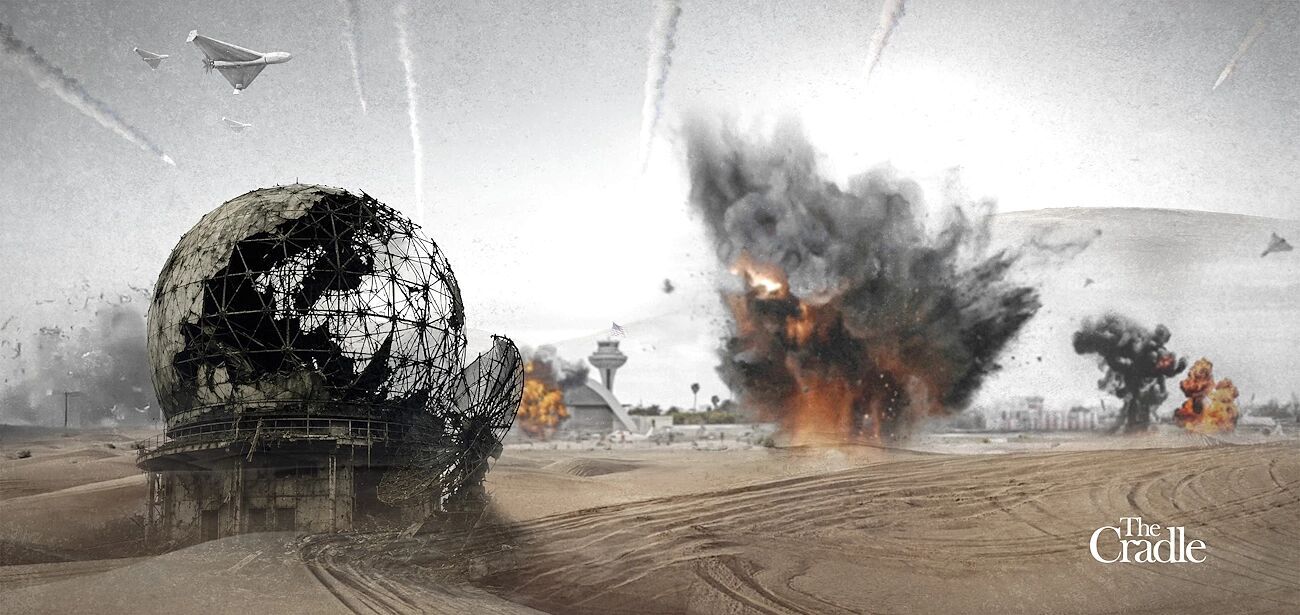
To riff on Bruce Springsteen's My Hometown: "Tehran says 'These bases are going, boys / And they ain't coming back / To your hometown'."
The Washington Post's 6 May 2026 article, 'Iran has hit far more US military assets than reported, satellite images show,' was an overdue admission - based on leaks from the US Department of Defense (DOD) and Washington's intelligence community - that Iran had inflicted significant damage to US assets. However, The Post only tells part of the story.
The Post examined 109 of the hundreds of satellite images published by Iranian media, whose authenticity could be verified "by comparing them with lower-resolution imagery from the European Union's satellite system, Copernicus, as well as high-resolution images from Planet where available."
The story was curated to reveal damage to 217 structures and 11 pieces of equipment, highlighting the vulnerability of US bases, while at the same time obscuring the magnitude of the losses and ramifications for the US military presence in West Asia.
It did not address the implications of the destruction of radars, the failure of longstanding US doctrine, or strikes against bases in Iraq - more than 600 - that effectively ejected US bases from the country.
The larger story is that these bases may not be rebuilt at all. They are exposed, ruinously expensive, and now sit inside Iran's demonstrated strike envelope.
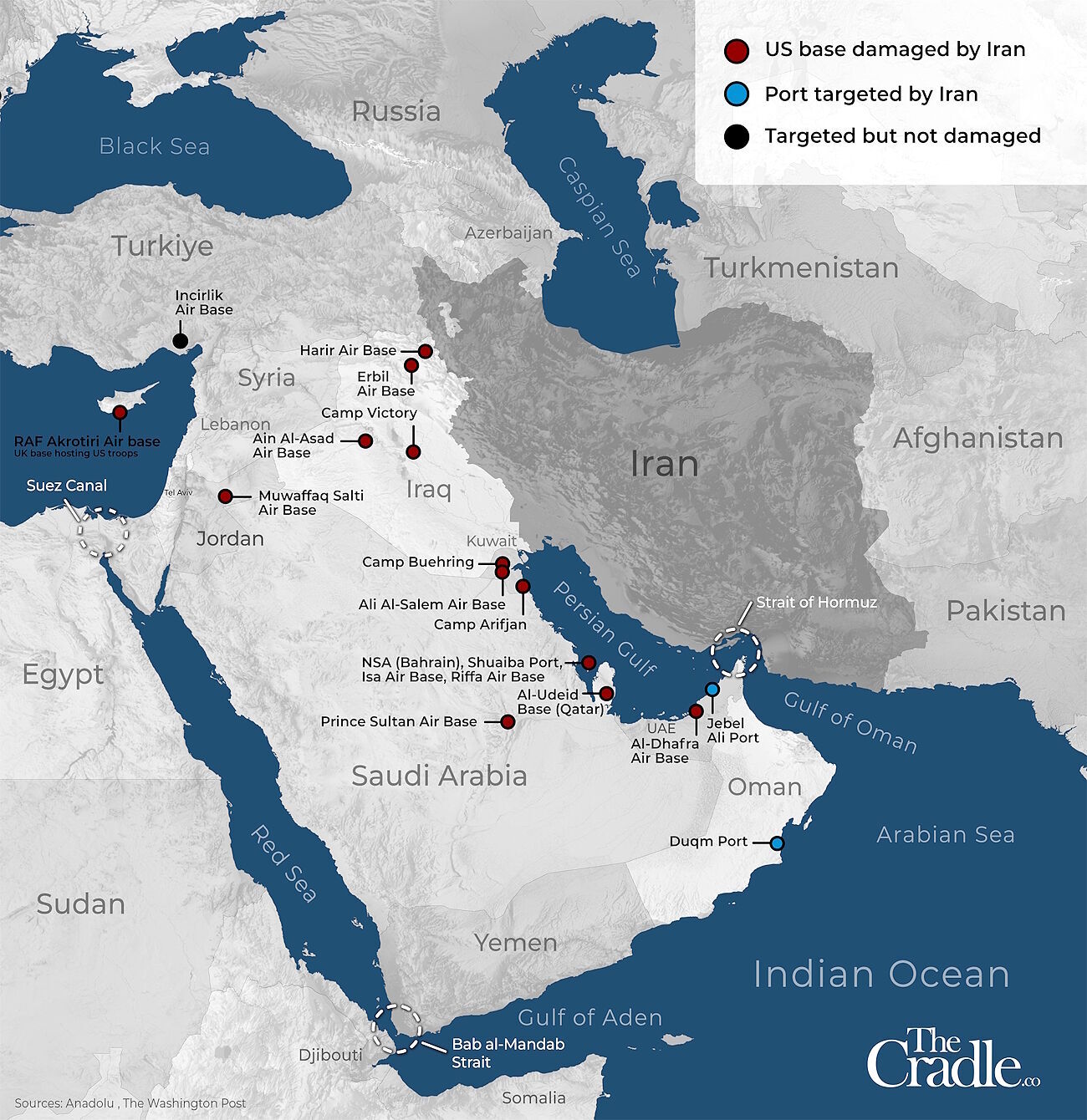
© Anadolu, Washington PostMap showing the US bases and ports in West Asia that were targeted by Iran.
"Force protection" is a military doctrine and is enshrined in the Joint Chiefs of Staff Joint Publication 3-10 that binds the uniformed services. US Army Field Manual 3-19.1 clarifies the doctrine:
"Force protection consists of those actions that prevent or mitigate hostile actions against DOD personnel (to include family members), resources, facilities, and critical information. It coordinates and synchronizes offensive and defensive measures to enable the joint force to perform while degrading opportunities for the enemy. It includes air, space, and missile defense; NBC [Nuclear, Biological, and Chemical] defense; antiterrorism; defensive information operations; and security to operational forces and means."Casualties lead to public scrutiny and dissent within the Armed Forces. Hence, the inordinate weight accorded to force protection in the early phases of the wars in Iraq and Afghanistan.
Iran's Former Islamic Revolutionary Guard Corps (IRGC) commander Mohsen Rezaei has pressed directly on that vulnerability, warning that renewed US aggression could see American vessels sunk, soldiers killed, and large numbers of forces taken captive.
The takeaway is the imperative to protect personnel and families, on or off base. The US was unable to protect either. US Central Command (CENTCOM) is credited with saving service members' lives by moving personnel off bases and into hotels, but this did not provide much safety. CIA and military were tracked to hotels; Shahid-136 drones made "room service" deliveries in the UAE, Iraq, Kuwait, and Bahrain - as evinced by myriad videos on Telegram.
Base protection
Base protection is a subset of force protection. This involves, inter alia, defending bases against missiles and drones - but this cannot be done. West Asian bases developed over decades; the bulk of the expansion came after 2001 to support the post-9/11 Global War on Terror (GWOT). An expressed purpose for the bases - and their post-GWOT retention - was to "contain Iran."
Iranian missile and drone programs were unsophisticated on 9/11, but consequent to former US President George Bush's "Axis of Evil" speech (29 January 2002), research and development expanded. Since 2002-2003, numerous subterranean missile bases - proven in the Ramadan War to be impenetrable by "bunker buster" bombs - were excavated and constructed.
Iranian technologies in 2026 crushed defensive doctrines and technologies dating back to 2001-2002. How can the US retain bases knowing that Iran's arsenal is superior? Air defense batteries cannot defend US bases, and the USAF's firepower cannot suppress Iranian launches.
Iran's plan of attack
@DefenceMat analyzed the plan of attack, showing how Iranian generals utilized an ingenious and multi-layered saturation campaign that blended electronic warfare, drones, and cruise and ballistic missiles to overload and degrade the US's "detect-decide-engage" defense networks. This "network-centric" suppression strategy surpassed traditional SEAD or DEAD (Suppression or Destruction of Enemy Air Defenses).
In non-jargon, this means that Iran first blinded the US by destroying its region-wide network of radars, radomes (satellite dishes covered by protective material), and command-and-control systems. Bases were left virtually defenseless.
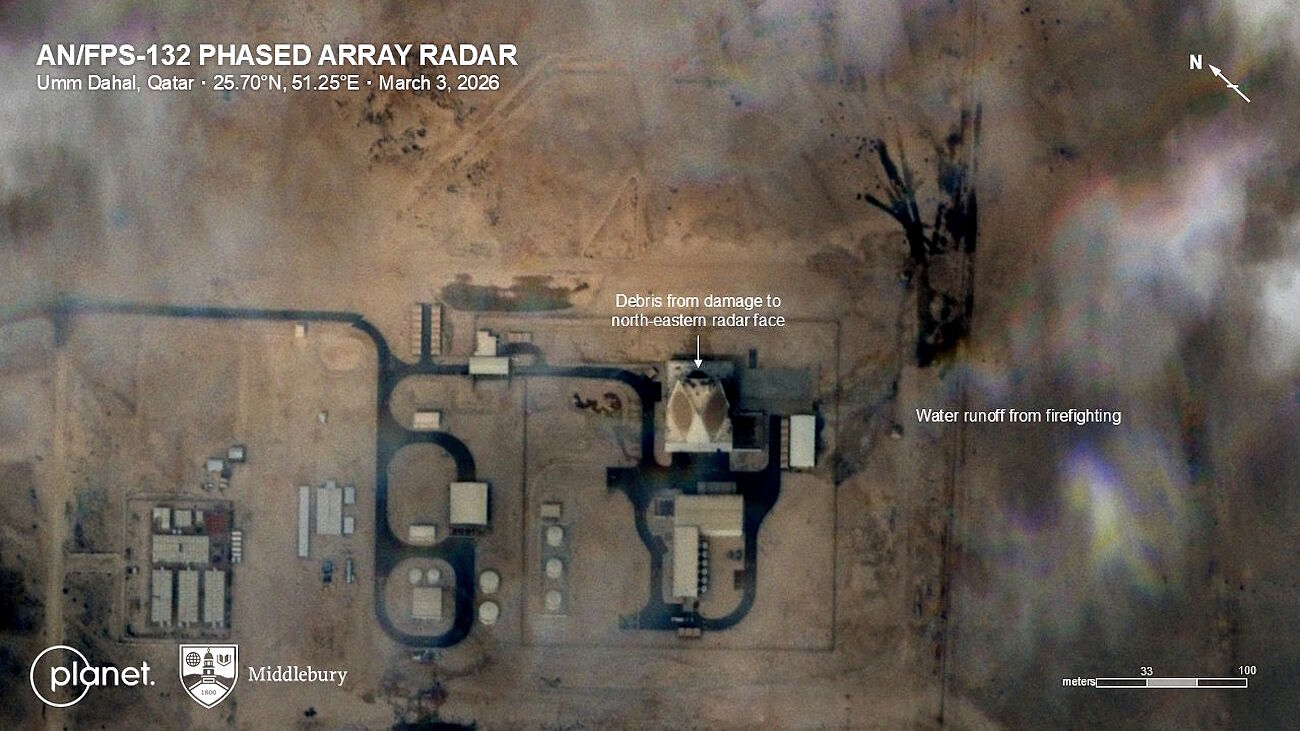
Fig. 1: Satellite imagery of the damaged AN/FPS-132 radar at Umm Dahal, Qatar, after it was targeted by Iran.
A Thermal High-Altitude Air Defense (THAAD) interceptor battery minus its AN/TPY-2 radar is an expensive ornament - unless linked to a fresh AN/TPY-2 radar. There were seven AN/TPY-2 radars across West Asia; two, possibly three, survive. Multiple Patriot radars (AN/MPQ-53/65) were destroyed or damaged.
Iran's sophisticated tech
Western media fixates on satellite imagery. However, satellite types are diverse; for example, models designed for 3D terrain mapping (TERCOM), electronic intelligence (ELINT), or data relay.
TERCOM guides Iranian cruise missiles. ELINT harvests electronic signals and geolocates sources of radio-frequency (RF) emissions by triangulating them with other satellites. Relay satellites rapidly transmit to ground stations; hence, "real-time" data.
Figure 2 illustrates the technology used by Iran. Note the yellow rectangle: this, an analyst claims, is a decoy AN/TPY-2. If Iranian intelligence officers relied solely on imagery for targeting, they may have been deceived. But the decoy was ignored, and the camouflaged radar (hangar; top) and other buildings were targeted.
Iran evidently has access to advanced space-based detection technologies that identified the concealed radar's RF signature. The AN/TPY-2 radar's electronic fingerprint was geolocated by satellites, and the target's coordinates were programmed into the projectile's onboard computer.
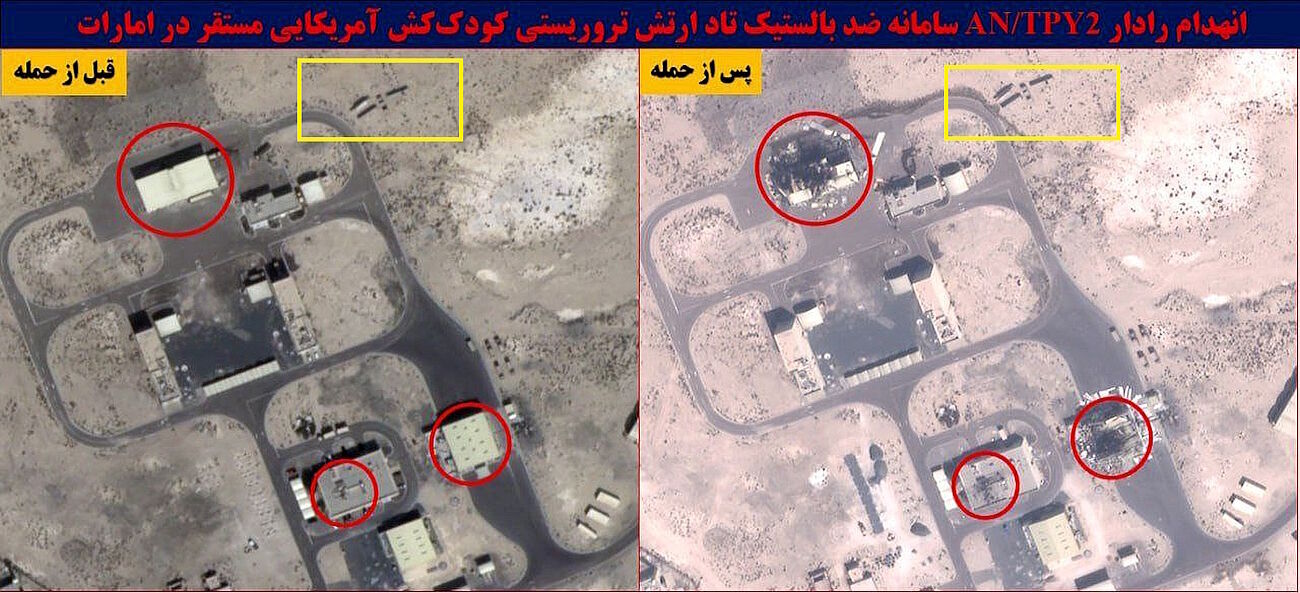
Fig. 2: Satellite imagery of the AN/TPY-2 radar site in the UAE before and after it was struck by Iran, showing the resulting damage.
In Figure 3, we can see the runway (strip blackened by rubber); the E-3 is on the cross taxiway - presumably after landing - heading to the parallel taxiway.
This reveals aspects about Iranian capabilities that assuredly unsettled US intelligence officers: an Iranian drone (possibly Arash-2) penetrated deep into KSA (undetected? but obviously not downed); it received real-time data from a satellite on the moving E-3; then the kamikaze drone - probably using an electro-optical seeker for visual identification and lock - dove and accurately hit the rotodome "on the nose." It was quite the feat. No margin for error.
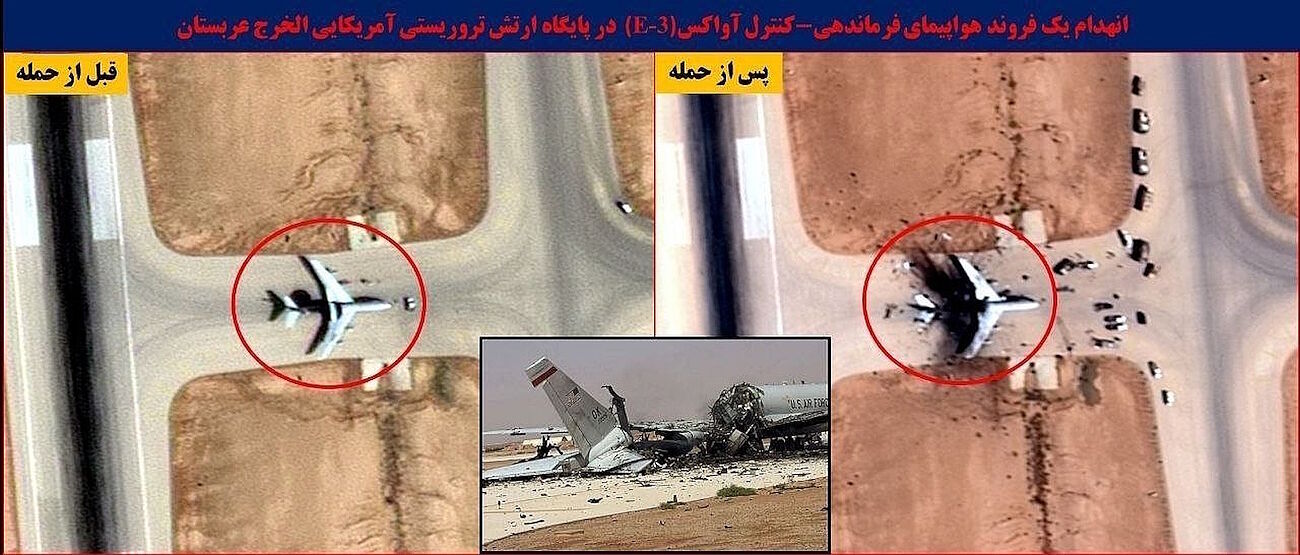
Fig. 2: Satellite imagery of the AN/TPY-2 radar site in the UAE before and after it was struck by Iran, showing the resulting damage.
Rebuilding may be the bigger defeat
There are too many unknowns to estimate reconstruction costs for 16 bases, especially since the extent of impairments is unclear. Host nations and the US contributed billions over the decades. Most US expenditures are classified. Cumulatively, hundreds of billions were spent, which, in 2026 dollars, would be astronomical.
Can the US afford huge outlays? Host nations may struggle to pay, given their recent revenue losses. One ruined item is instructive of the impediments to reconstruction: the radar at Umm Dahal cost Qatar $1.1 billion in 2013.
The replacement cost is possibly double; estimates suggest 5-7 years to build the new AN/FPS-132 radar - assuming China sells the Rare Earth Elements (RREs) critical to the entire US defense ecosystem. This is why US President Donald Trump carps about RREs.
The pressing question is, will host nations want the US to return? The bases have not delivered security - quite the opposite. "Security for all or security for none" has been Iran's mantra since the war commenced.
Force protection is critical to the US military doctrine. Reconstruction of bases is not expected until after DOD devises technologies to safeguard bases and personnel from Iranian weapons. DOD had labored under the chauvinistic view that the US possessed "technological superiority" over its adversaries, but the "best" US systems - X-band radars, THAAD, Patriot - were defeated by Iranian intellectual and technological superiority.
US bases in West Asia cannot return to the status quo ante bellum without meaningful debates in Congress and DOD on weaknesses of air defenses, vulnerabilities of radar networks, and the exposure of US personnel to casualties. This debate is not limited to West Asia, but implicates US bases constructed to "contain Russia" and "contain China."
Representative Ted Lieu said as much: "I cannot support more money for [DOD] until they come up with a new strategy based on the lessons we've already learned from the Iran War. Because when we're dealing with peer adversaries like China and Russia, the US is going to face some major problems."






REMs were mentioned, but those are minor for the war machine, compared to what's needed to supply and support these stupid data centre's popping up all over the place.
Why is it Iran has hit bases in all these countries and there's no grand melt downs, super outrage?
Meanwhile Russia still holds back from popping that bad little pseudo comedian in Uke.
Not all is as it appears, peal away the msm bs and other narratives, things start to take shape.