

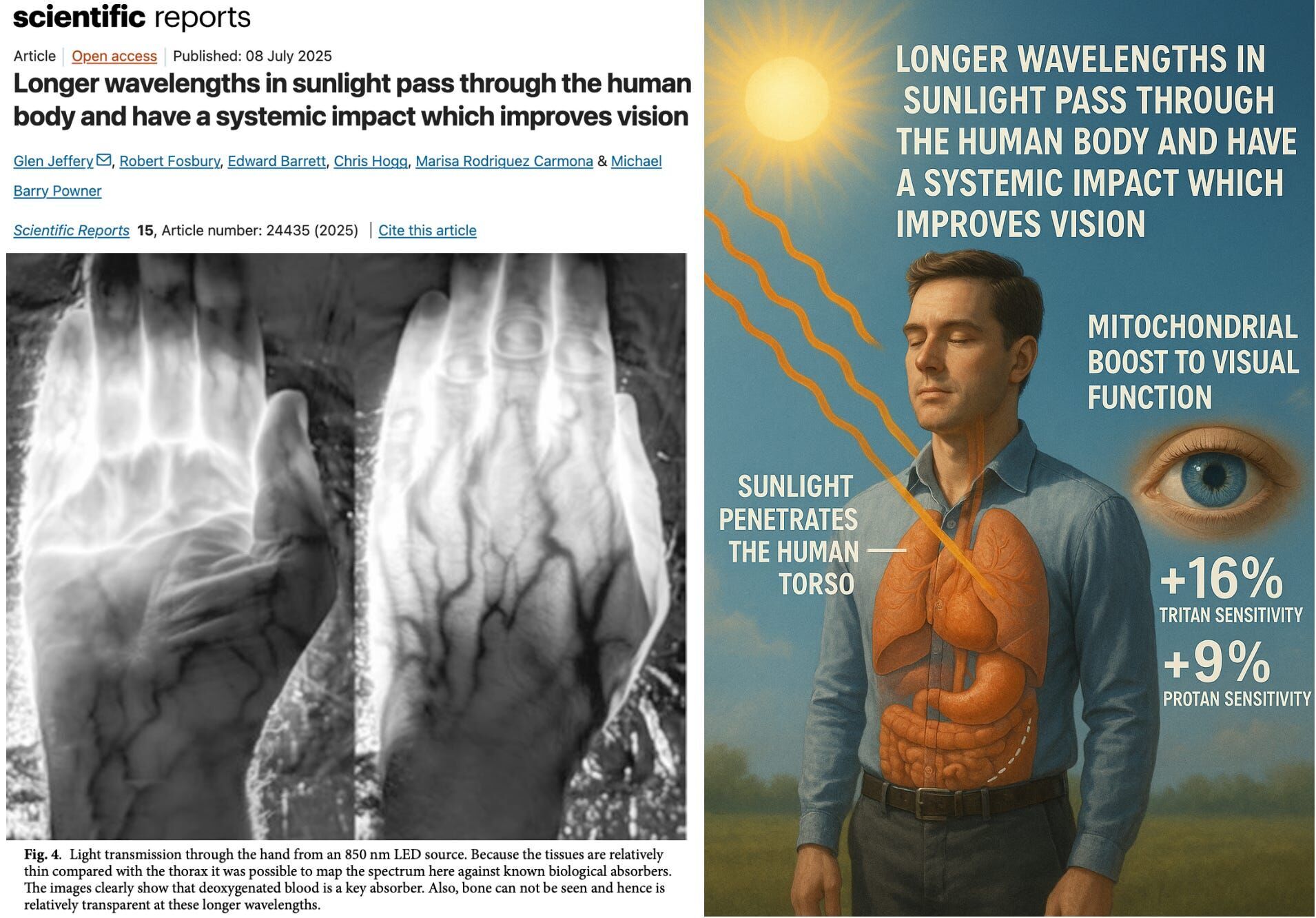
40 adults (ages 25-63) participated in the study. Researchers first measured sunlight transmission by placing a radiometer against the chest of shirtless participants standing in direct midday sunlight. In a controlled lab setting, subjects were then exposed to 15 minutes of 850 nm near-infrared (NIR) LED light directed at their backs. Visual performance was evaluated before and 24 hours after exposure using color contrast sensitivity tests. To isolate systemic effects from direct eye exposure, a subgroup wore foil-wrapped head coverings to fully block light from reaching the eyes.
© Focal Point
- Sunlight penetrates the human torso. Infrared wavelengths (especially 850 nm) passed through the chest and back, reaching internal tissues. Peak transmission was observed between 800-875 nm.
- Mitochondrial boost to visual function. A single 15-minute exposure to 850 nm light led to a 16% improvement in tritan (blue-yellow) contrast sensitivity and a 9% improvement in protan (red-green) sensitivity 24 hours later — even in dim lighting conditions.
- Systemic effect confirmed. In participants whose heads were completely covered with foil (blocking all ocular exposure), tritan sensitivity still improved by 7%, proving that long-wavelength light acts systemically — likely via mitochondrial and cytokine signaling pathways.
- Clothing is not a barrier. Even six layers of common garments (T-shirt, shirt, wool sweater) were nearly 100 times more transparent to 850 nm light than to visible light, allowing infrared to reach the skin and tissues underneath.
- Built environment warning. Most indoor LED lighting lacks infrared and instead emits sharp peaks in the blue spectrum (400-450 nm), which are known to impair mitochondrial function and elevate oxidative stress, especially in the absence of balancing long wavelengths.








Comment: How could the human body not optimize the most important part of its environment?