
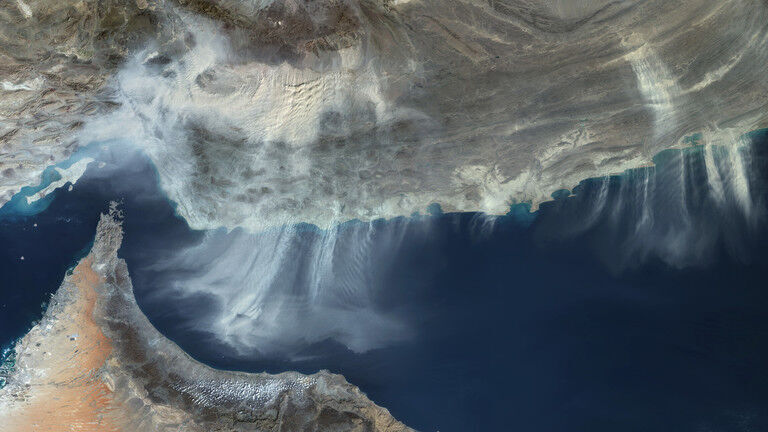
Strait of Hormuz, Gulf of Oman
Countries that receive oil through the Strait of Hormuz "must take care" of securing it, US President Donald Trump said in a post on Truth Social late on Saturday, adding that Washington "will help - A LOT!"
The US and Israel began coordinated strikes on the Islamic Republic in late February, triggering Iranian retaliatory attacks across the region. The escalating crisis has effectively shut down the Strait of Hormuz, which carries about one-fifth of the world's daily oil and gas supply, after Tehran barred vessels from countries it considers hostile, sending global crude prices up nearly 50% to about $120 a barrel.
In an earlier post the same day, Donald Trump said he hoped "China, France, Japan, South Korea, the UK and others affected by this artificial constraint will send ships to the area."
"In the meantime, the United States will be bombing the hell out of the shoreline, and continually shooting Iranian Boats and Ships out of the water," he wrote.
Comment: One wonders why Trump mentions China as it is still getting oil through.
Western nations have begun bolstering their military presence in the region. Britain is considering additional deployments to the Gulf after Iran stepped up attacks on vessels, Defense Secretary John Healey said, adding that the UK already has autonomous mine-hunting systems in the area.
The French Navy is reportedly deploying about a dozen vessels, including an aircraft carrier strike group, to the Mediterranean, the Red Sea and potentially the Strait of Hormuz as part of defensive support for allies threatened by the conflict.
Iranian Foreign Minister Abbas Araghchi said on Saturday that the strategically vital strait remains operational for international shipping, but vessels linked to the US and Israel are not permitted to pass through the waterway. He emphasized that other nations remain free to navigate the passage.
Comment: In other words, the Hormuz is not closed, just blocked from the the countries which are waging war on Iran. That doesn't sound unreasonable.
Last week, an India-bound oil tanker sailing under a Liberian flag passed through the Strait of Hormuz and berthed in Mumbai.
US President Donald Trump is weighing the seizure of Iran's Kharg Island offshore oil hub, Axios has reported, citing American officials familiar with the discussions. Such a move would likely require a ground operation, teh outlet added.
Kharg Island lies in the northern part of the Persian Gulf, off Iran's coast and covers an area of some 20 square kilometers. It hosts a major oil storage facility with an estimated capacity of about 30 million barrels and is responsible for processing some 90% of the Iran's crude exports.
On Saturday night, Trump said that US forces had "obliterated every military target" on the island, claiming that all of them had been destroyed. The IRGC said that none of the oil infrastructure facilities on the island had been damaged.
If oil tankers remain effectively blocked in the Persian Gulf the option of attempting to seize Kharg Island is being considered according to Axios sources.
One source told the outlet that as long as the blockade remains in place and shipments from the region are constrained, Trump "won't be able to end the war, even if he wants to."
Trump has not made a final decision on the seizure of Kharg Island, a senior White House official told Axios, adding that the president is weighing both the potential "big risks" and "big rewards." The official stressed, however, that Trump "is not going to wait around and let the Iranians dictate the pace of the conflict."
Sources also told Axios that Trump is currently working on forming a coalition to unblock the Strait of Hormuz, with an announcement expected in the coming days. Over the weekend, the US president and senior administration officials reportedly held related discussions on the issue.
US-Israelis attacks on Iran, that have reportedly killed over 1,000 Iranian civilians, triggering retaliatory attacks across tMiddle East, effectively closing the Strait of Hormuz, which carries about one-fifth of the world's daily oil and gas supply.
Iran's Islamic Revolutionary Guard Corps (IRGC) has warned that vessels from countries it considers hostile would not be allowed to transit the strait. The developments have sent global crude prices up nearly 50% to about $120 a barrel.



















Comment: Some countries might feel slightly puzzled why Trump now thinks it should be a team effort to open it, as there wasn't much consulting the rest of the world about starting the conflict. Then again, the US didn't actually start it, but was pushed by Israel as Rubio said shortly after.
See also: NewsReal: USA & Israel Confident of 'Victory' Despite Strong Iranian Resistance