
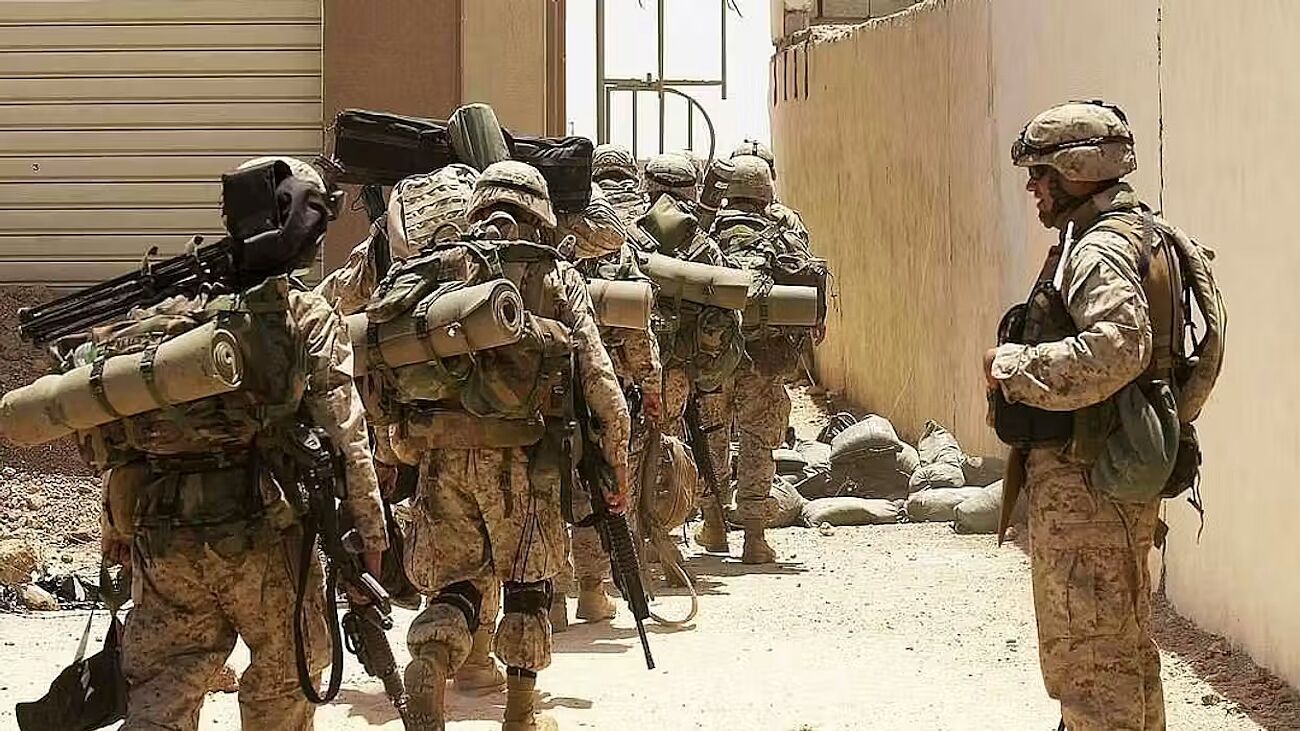
© Scott Peterson/Getty ImagesUnited States Marines during the Iraq War
With those words, the administration cracked open a door most American strategists hoped was bolted shut by half a century of hard lessons.
Modern American military history is a graveyard of campaigns that began with overwhelming tactical success and ended in strategic failure.
Operation Epic Fury, the joint U.S.-Israeli campaign, has already delivered what hawks in Washington have wanted for decades: the decapitation of Iran's top leadership. The strikes that killed Ali Khamenei were meant to trigger a rapid collapse of the Islamic Republic. Early evidence points to something messier — and more dangerous.
The fundamental flaw in the administration's logic is simple: Removing a leader does not remove a regime.
Khamenei is dead, but the Iranian state remains. A temporary leadership council has already formed. The Islamic Revolutionary Guard Corps still holds the monopoly on force. Worse, strikes that reportedly killed hundreds of civilians — including more than 100 children in Minab — handed the regime a fresh narrative. Instead of a unified, pro-Western uprising, many Iranians are responding with nationalist anger and a predictable desire for revenge.
That reality should end any talk of "finishing the job" with a ground invasion.
Modern American military history is a graveyard of campaigns that began with overwhelming tactical success and ended in strategic failure. Vietnam. Afghanistan. Iraq. In each, the "mission accomplished" moment became the prologue to years of insurgency, political collapse, and sunk costs.
In Vietnam, the U.S. won battles and lost the country because it could not produce a legitimate political alternative.
In Iraq and Afghanistan, trillion-dollar investments in nation-building crumbled once American security guarantees lifted.
If the United States shifts from air strikes to a ground presence in Iran, it will collide with problems it cannot solve.
Start with geography and scale. Iran is a country of nearly 90 million people, with mountainous terrain that functions as a natural fortress. A serious occupation would require a troop commitment the American public will not support — and it would likely exceed anything seen in Iraq.

© Brendan Smialowski / AFP via Getty ImagesU.S. Secretary of War Pete Hegseth takes questions during a press conference on U.S. military action in Iran on Monday at the Pentagon in Washington, D.C.
Escalating to a ground war on such a foundation invites a domestic political firestorm, fracturing the country at the very moment unity matters most. Disregard for constitutional norms does not merely weaken the rule of law; it undermines the legitimacy of the mission.
Next, look at the internal politics of Iran. The administration appears to hope Iran's grievances can be leveraged against the regime. History suggests the opposite. Foreign boots on the ground almost always unify a population against the invader. An invasion would turn a struggle for internal reform into a war of national liberation and hand hardliners their best recruiting tool.
The anger in Tehran is not necessarily pro-regime. It is a primal response to foreign violation.
Finally, consider the regional fallout. The "Axis of Resistance" has already begun responding — drone activity, base attacks, threats to shipping and energy flows through the Strait of Hormuz. Six U.S. service members have already died in retaliatory strikes. A ground invasion would expand the conflict into a full regional war, drawing in proxies and potentially major powers into a fight Washington cannot afford and cannot control.
A ground invasion would not be brief, as Pete Hegseth has suggested. It would become a generational entanglement.
Washington can destroy targets. It cannot manufacture a stable, pro-Western political order at the point of a bayonet. Ignore the failures of the past and you guarantee a disaster in the future.




Reader Comments
BTW surely you know why they won't admit to the actual death toll, American's can't handle their boy's coming home in a body bag, I don't blame them, but Note it's never the son of say a Trump that pay's the ultimate price.
See how Pat Tilman, whose heart was in the right place but when he realised it was all a scam, he pushed back and for his trouble the monsters killed him.
All they know is medium- to high-intensity policing operations against goat herders with AKs or corrupt third-rate militaries.
This will be quite and experience and a lesson they don't forget for decades. The Afghanistan veterans that went to the Ukraine on safari to "kill Russians" could have told them - at least those that made it back.
It's past time they learned that they are not the best or the brightest. The bullying must stop.
They never went against an adversary that could see and track them 24/7, and who could hit them 24/7 whereever they are. And they never went against an adversary without heavy reliance of air supremacy and air support. No such thing exists against Iran.
Taking the Ukrainian numbers into account, I expect between 1500 and 3000 casualties on US side per day. This illusion of a ground invasion will stop very quickly, I believe.
And then, we will see how much of a nuclear weapons biased nation the US actually is. This would not end well, though.
Albeit unintentionally from US side. All the influence and grift will be gone.
And I fear our home countries are on the list ...