
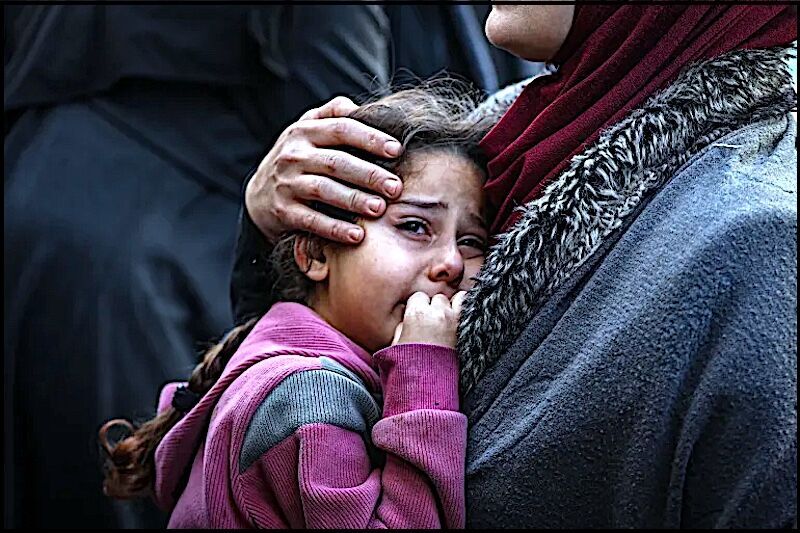
© Khames Alrefi/Anadolu Agency]Palestinians mourn as the bodies of seven people, including children, who were killed in an Israeli attack, are transferred for burial
Since its genocidal war on Gaza began in October 2023, Israel has expended vast amounts of money and manpower on leveling the Palestinian territory and destroying its institutions.
It has killed more than 72,000 people in achieving this end, including tens of thousands of children and women — with some independent researchers suggesting that the death toll is higher than 75,000.
Of those who are still alive, many have suffered the effects of deliberately imposed starvation: first during Israel's siege of northern Gaza in late 2024, which United Nations officials described as "apocalyptic", and later during the man-made famine Israeli policies created in August 2025, when images of malnourished and starving children became commonplace on news bulletins around the world.
None of this has come cheaply. Israel - backed by its principal ally, the United States - has poured billions of dollars into waging its war on Gaza. So, how much does the killing of more than 72,000 Palestinians cost? How much do you need to spend on munitions to commit a genocide? And what is the impact of industrialised mass killing on an economy?
Here's what we know:
How much money has Israel spent on the Gaza war?
The Bank of Israel put the overall economic toll of the war at about 352 billion shekels ($112bn). That total includes roughly 243 billion shekels ($77bn) in direct defence costs, 33 billion shekels ($10.5bn) for the property tax compensation fund, civilian outlays of 57 billion shekels ($18bn) and interest payments of 19 billion shekels ($6bn).
In early 2025, taking the Gaza war in isolation, Israel's former chief military economic adviser, Gil Pinchas, estimated that the cost to Israel had been 150 billion shekels ($48bn), running at an average cost of 300 million shekels ($96m) per day. On average, 100 Palestinians were killed in Gaza every day, according to Philippe Lazzarini, commissioner-general of the United Nations Relief and Works Agency for Palestine Refugees (UNRWA).
"Every item the [Israeli army] uses in combat has a price tag in shekels, detailed in a special, highly specific price book," Pinchas told journalists, referring to the price paid by the Israeli army, and not Palestinians, for every combat ration, litre of fuel, vehicle, bullet and missile launched against Gaza. "The book is updated constantly, including during the war ... We keep our finger on the pulse."
How much of the war's expenditure was spent on munitions?
We don't know for sure.
Pinchas did say that Israel had spent 340 billion shekels ($108bn) on munitions since the war began, but nowhere near all of that has been used. A significant proportion of that money has also been spent on purchasing arms from Israeli manufacturers, which has helped to offset the wider impact of the war on the Israeli economy.
Line-by-line details for most military budgets are rarely available. But some insights can be gleaned from Israel's other wars in the region.
According to an estimate midway through the war by The Wall Street Journal, Israel's war on Iran was costing it $200m per day, with the missiles used to intercept Iranian rockets, sometimes reaching 400 a day, estimated at anywhere between $700,000 and $4m each.
In addition, Israel's September 2024 attack on the Lebanese group Hezbollah's communication devices, which relied on a plan that had been set into motion years earlier, is reported to have set the Israeli treasury back some one billion shekels ($318m).
What has been the overall cost to the wider Israeli economy?
Considerable, and much of that is down to manpower.
Of Israel's 465,000 military reservists, upwards of 300,000 were deployed to Gaza during the first year of the war. This is in addition to 170,000 active-duty personnel. The cost of maintaining that number of active soldiers, as well as the impact on the wider economy due to the loss of workers called up as reservists, is astronomical.
According to Israel's treasury, some 70 billion shekels ($22.3bn) has been spent on its reserve forces alone during the course of the war, while the cost of maintaining its standing army in 2025 was estimated to be 15.37 billion shekels ($4.9bn).
The Bank of Israel estimates that the cost of one month of service for a military reservist is about 38,000 shekels ($12,100) in lost production.
With military budgets unlikely to recede in the wake of the genocide and other wars that Israel has engaged in over the past two years, a column in the Israeli liberal daily Haaretz suggested that over the next decade, the cost of the war could run to, at a minimum, 500 billion shekels ($159bn).
How much has Israel's genocide cost the US?
More than many US voters might suppose.
According to Brown University's 2025 Costs of War report, since October 7, 2023, the US has provided Israel with some $21.7bn in military aid.
In addition to that, the American taxpayer has funded US operations in support of Israel in Yemen, Iran and the wider Middle East at a cost of $9.65bn to $12.07bn, meaning a total US investment of somewhere between $31.35bn and $33.77bn on Israel's wars since 2023.
How much will it cost to rebuild Gaza?
According to the United Nations, rebuilding Gaza - where Israel has destroyed the majority of buildings - would take decades and cost somewhere in the region of $70bn.
In a report, the UN noted that Israel's military operations had "significantly undermined every pillar of survival" within the enclave and that the entire population of 2.3 million people faced "extreme, multidimensional impoverishment" - the term for poverty extending beyond financial duress, in areas such as a lack of clean water, proper sanitation and education.




Now to this:
The Pentagon is about to give an American AI company the Huawei treatment. Not because it’s Chinese. Not because it’s a spy risk. Because it refuses to let the military use its AI for mass surveillance of Americans and fully autonomous weapons. This morning, Defense Secretary Pete Hegseth summoned Anthropic CEO Dario Amodei to the Pentagon.
A senior Defense official told Axios: “This is not a friendly meeting. This is a sh*t-or-get-off-the-pot meeting.”
Here’s what’s actually happening:
Claude is the only AI model running inside the Pentagon’s classified systems. The most capable model for sensitive defense and intelligence work. It was used in the Maduro raid in January through Palantir, the first confirmed use of a commercial AI in a classified military operation. Now the Pentagon wants all restrictions removed. “All lawful purposes.” Including capabilities that would let the military continuously monitor the social media posts, voter registration, concealed carry permits, and demonstration records of every American citizen using AI at scale.
Anthropic said no to two things: mass surveillance of Americans and fully autonomous weaponry. The Pentagon’s response: threatening to designate Anthropic a “supply chain risk.” That designation is reserved for foreign adversaries. The last company to receive it was Huawei. It would force every defense contractor in America to certify they don’t use Claude in their workflows. Given that 8 of the Fortune 10 use Claude, this would cascade through the entire defense industrial base.
A senior Pentagon official told Axios: “It will be an enormous pain in the ass to disentangle, and we are going to make sure they pay a price for forcing our hand like this.” Another official: “The problem with Dario is, with him, it’s ideological. We know who we’re dealing with.”
Meanwhile:
OpenAI, Google, and xAI have already agreed to remove their safeguards for military use. OpenAI deployed ChatGPT to all 3 million DoD personnel through GenAI. mil. xAI holds a separate $200M contract backed by Musk’s political proximity to the administration.
Anthropic is the only one that said no. Think about what’s being asked. The company whose own safety chief resigned two weeks ago warning “the world is in peril.” The company that just published a report showing its most advanced model “knowingly assisted with chemical weapons research” in testing. That company is being punished for refusing to hand the U.S. military unrestricted access to that same technology.
The Pentagon admits competing models “are just behind” for classified work. They need Claude. But they’re willing to blow up the relationship rather than accept two restrictions that protect American citizens from their own government. This is the most important story in AI right now and almost nobody is framing it correctly. It’s not about one $200M contract. It’s about whether the U.S. military can compel a private company to remove safety restrictions on technology its own developers have demonstrated is dangerous, under threat of receiving the same designation as a Chinese national security threat. Dario Amodei walks into that meeting this morning with $380 billion in enterprise value, $14 billion in revenue, and a principle that may cost him both.