
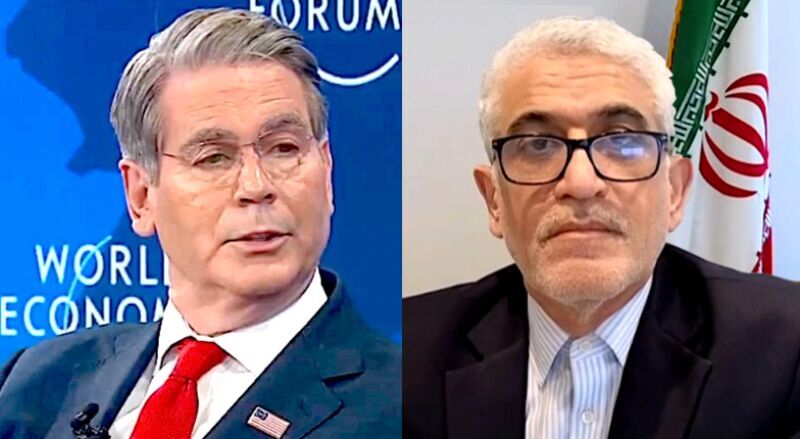
© World Economic Forum/CBS News.comUS Treasury Secretary Scott Bessent • Iranian Diplomat Amir-Saeld Iravani
On the orders of my Government and further to our previous letters dated December 30, 2025, and January 2, 9, and 13, 2026, concerning the deliberate interference of the United States of America in the internal affairs of the Islamic Republic of Iran and their sustained campaign of coercion, destabilization, and incitement, I am once again obliged to draw your urgent attention to a new explicit and public admission by a senior U.S. official, who openly acknowledges that the economic measures taken by the United States against Iran were deliberately designed to cripple the Iranian economy in order to provoke unrest in the country.
On January 21, 2026, at the World Economic Forum in Davos, Switzerland, U.S. Treasury Secretary Scott Bessent stated the following in an interview: "It worked because in December, their economy collapsed. We saw a major bank fail. The central bank has started printing money. There's a dollar shortage. They can't import, and that's why people have taken to the streets."
This admission constitutes undeniable and irrefutable proof of the direct and deliberate role played by the United States in destabilizing the Islamic Republic of Iran, notably by transforming peaceful protests into violent unrest through a calculated economic war targeting ordinary, innocent civilians — a policy and course of action that constitute a crime against humanity. Furthermore, such an inflammatory and irresponsible statement flagrantly violates the principles of sovereignty, non-interference, and political independence enshrined in the Charter of the United Nations, as well as fundamental norms of international law that prohibit coercive measures aimed at destabilizing states. The deliberate use of economic pressure to incite unrest and violence against civilians is both illegal and criminal, thereby engaging the international responsibility of the United States.
We further emphasize that this interventionist statement by the US Treasury Secretary is part of a broader US-led policy of destabilization and so-called "regime change" agenda. In recent weeks, the US President has repeatedly threatened the use of military force against the Islamic Republic of Iran, explicitly called for regime change and acts of violence, and incited protesters to seize control of government institutions.
The direct human costs and consequences of the United States' illegal and interventionist policies are particularly grave. Between January 8 and 12, innocent Iranian citizens lost their lives as a result of violence that was neither spontaneous nor internal, but rather fueled and exacerbated by armed and terrorist groups supported by the United States and the Israeli regime, as part of a strategy of political destabilization. The United States bears full legal and moral responsibility for the foreseeable consequences of its destabilizing actions, including the loss of life and physical harm to the civilian population, the undermining of Iran's stability and security, and the destruction of public and private property.
In view of the grave, systematic and continuous violations by the United States of the Charter of the United Nations and international law, the Islamic Republic of Iran reiterates its appeal to the Secretary-General, acting within his mandate under the Charter, to duly take note of this explicit admission and remind the United States of its statutory obligations to cease threats, coercive measures and unlawful interference in the internal affairs of other States, which constitute flagrant and continuous violations of the purposes and principles enshrined in the Charter.
I would be grateful if you would distribute the text of this letter as a Security Council document.
Amir Saeid Iravani
Amir-Saeid Iravani is an Iranian diplomat who has been the permanent representative of Iran to the United Nations since 7 September 2022. Prior to this role, he held several positions, including Deputy Secretary for Foreign Policy and International Security on Iran's Supreme National Security Council from 2013 to 2021, and Iran's ambassador to Iraq from 1998 to 2001.



He considered attending the United States Naval Academy but decided not to as he was unwilling to lie about his sexual orientation, shame this turd couldn’t have applied his integrity when working for Soro’s with another fine example by the name of Joe Lewis, where his/their work was instrumental in causing chaos around the world betting against the English Pound as well as the Japanese yen and arguably the most damaging one where they bet against the Mexican Peso, this unsettled not just Mexico but all of latin America including Argentina where the rape of its wealth continues today in large part by your criminal small hat community, the afore mentioned Joe Lewis being a fine example, constructing amongst other things an illegal private airport for flights in and out with no Government oversight whatsoever.
Back to Bessant,
His mom must have had premonitions of his orientation for one of his middle names being Homer (sexual)
Anyhow what was the big deal, to my knowledge the US navy is full of his orientation.
See this Sott article for Patagonia and Joe Lewis.
Flashback The Dark Secret Behind a British Billionaire's "Parallel State" In Argentina's Patagonia
EL BOLSÓN, ARGENTINA - At the "end of the world," spanning the southernmost regions of Argentina and Chile, lies the land of Patagonia, much of which remains a pristine wilderness that has...