
To understand the operations that reshaped the Middle East — and would one day touch America itself — you must begin with the men in this photograph:
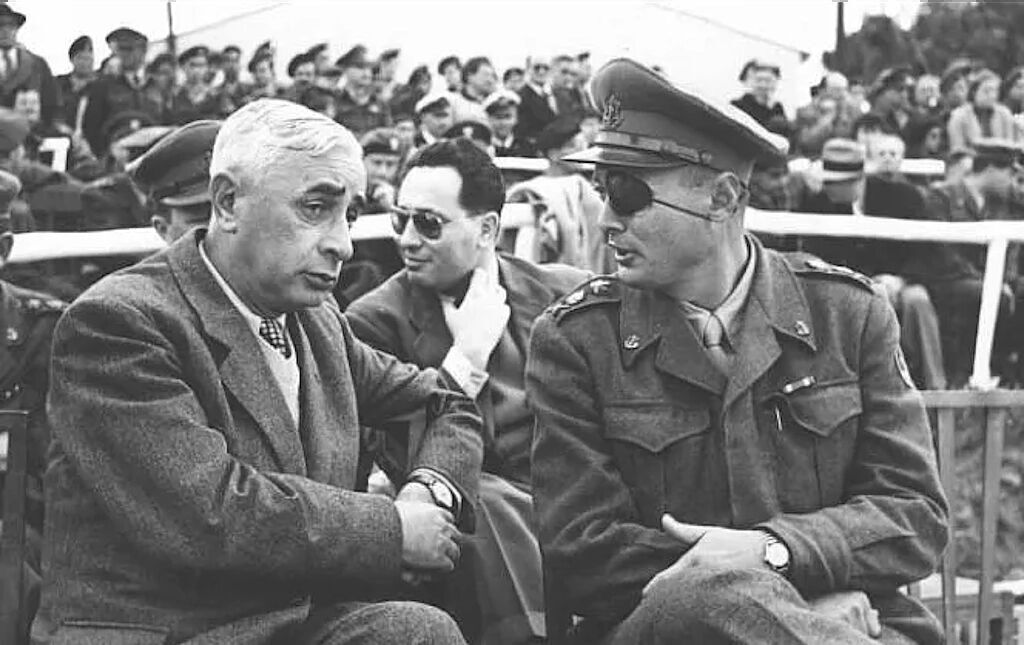
Pinchas Lavon (left) — Israel’s Minister of Defense — sits beside Chief of Staff Moshe Dayan (right), two of the central architects behind Unit 131, the covert cell responsible for the 1954 Lavon Affair. Their decisions triggered Israel’s first state-run false-flag operation, targeting Western sites in Egypt to frame Egyptian nationalists and reshape regional politics.
The Philosophy Behind Modern State Terrorism
Benjamin Netanyahu once revealed far more than he intended when he told Oliver Stone, in Persona Non Grata:
"You must shock people — then you can disregard all the normal rules of morality."
Most viewers heard provocation.
Students of covert history heard a blueprint.
Netanyahu wasn't speaking in metaphor.
He was summarizing the core operational logic of a system that learned — long before it had tanks, embassies, or formal intelligence units — how to weaponize chaos, seize the narrative in the first minutes, and turn crisis into political advantage.
What he describes is the opening move of an operational tradition that runs through every case in this investigation:
shock first → control the story → extract power before facts can surface.And as you'll see in the clip below, Netanyahu states this logic openly, cleanly, almost casually — the kind of admission that only makes sense once you understand the architecture behind it.
Watch the clip next. It explains more in less than thirty seconds than most governments admit in 70 years since the Birth of Modern State Terrorism:
This is the architecture:
Engineered shock → narrative capture → political extraction.What happened on October 7 — the hours-long stand-down, the forewarning from Egypt, Netanyahu still refuses an independent investigation. — was not an aberration.
It is not new. It did not begin in Gaza.
And it did not emerge on October 7.
It was the latest iteration of a method refined over eight decades.
When Charlie Kirk said publicly that Israel "allowed it to happen," he wasn't speculating.
He was identifying the pattern.
Months later, an IDF soldier confirmed what Kirk sensed: the IDF soldier's unit received a stand-down order that left the border unwatched for six critical hours.
That silence is not confusion.It is the playbook of a statecraft rooted in misdirection, refined by underground militias, perfected by intelligence services, and exported into global politics.
Recognize the pattern, and the map becomes unmistakable:
- Irgun's disguises — the underground militia that bombed the King David Hotel while dressed as Arabs to redirect blame onto Palestinians, establishing misdirection as a foundational tactic.
- The Lavon Affair — a failed Israeli military intelligence operation in Egypt that planted bombs in American and British civilian sites (libraries, cinemas, offices) to frame local Arabs and trigger Western intervention.
- The Baghdad synagogue bombings — coordinated explosions targeting Iraqi Jews in 1950-51, carried out by Zionist underground cells to manufacture fear and accelerate mass emigration to Israel.
- The London Embassy attack — a 1994 car bombing initially blamed on Palestinians, later revealed by MI5 insiders to bear the hallmarks of a Mossad false-flag operation.
- The Mexico Congress infiltration — two Israelis caught inside the Mexican legislature in 2001 with explosives, weapons, and false Pakistani passports — an operation quietly erased after diplomatic intervention.
- The burning and silencing of the USS Liberty — a U.S. Navy ship attacked for hours in 1967, its survivors muzzled while Washington buried the evidence to protect a foreign ally.
- Who knows what other chapters remain unspoken — where an ordinary blue sky in an American city became a drifting cloud of ash?
Different decades. Different theaters.What follows is the first forensic reconstruction of that architecture:
One architecture — many operators.
its lineage, its method, its political function, and the operational tradition that grew from the alleys of Mandatory Palestine into the bloodstream of the American security state.
It is a state-level evolution of the tactic — covert violence deployed with the express purpose of controlling political outcomes.
This is not a catalog of scandals. This is a systemOrigin: Mandatory Palestine
Where the Operational Tradition of Modern State Terrorism Was Born
Before Israel had ministries or an intelligence service, it had Irgun and Lehi — underground militias that treated disguise, staged violence, and narrative control as strategic tools. Mandatory Palestine became a laboratory where a repeatable operational tradition was forged: strike while wearing another identity, assign blame to the chosen target population, exploit the confusion, and seize the narrative before facts can surface. This was not improvisation. It was the foundation of a playbook that would echo across continents.
The King David Hotel Bombing (1946): The Prototype
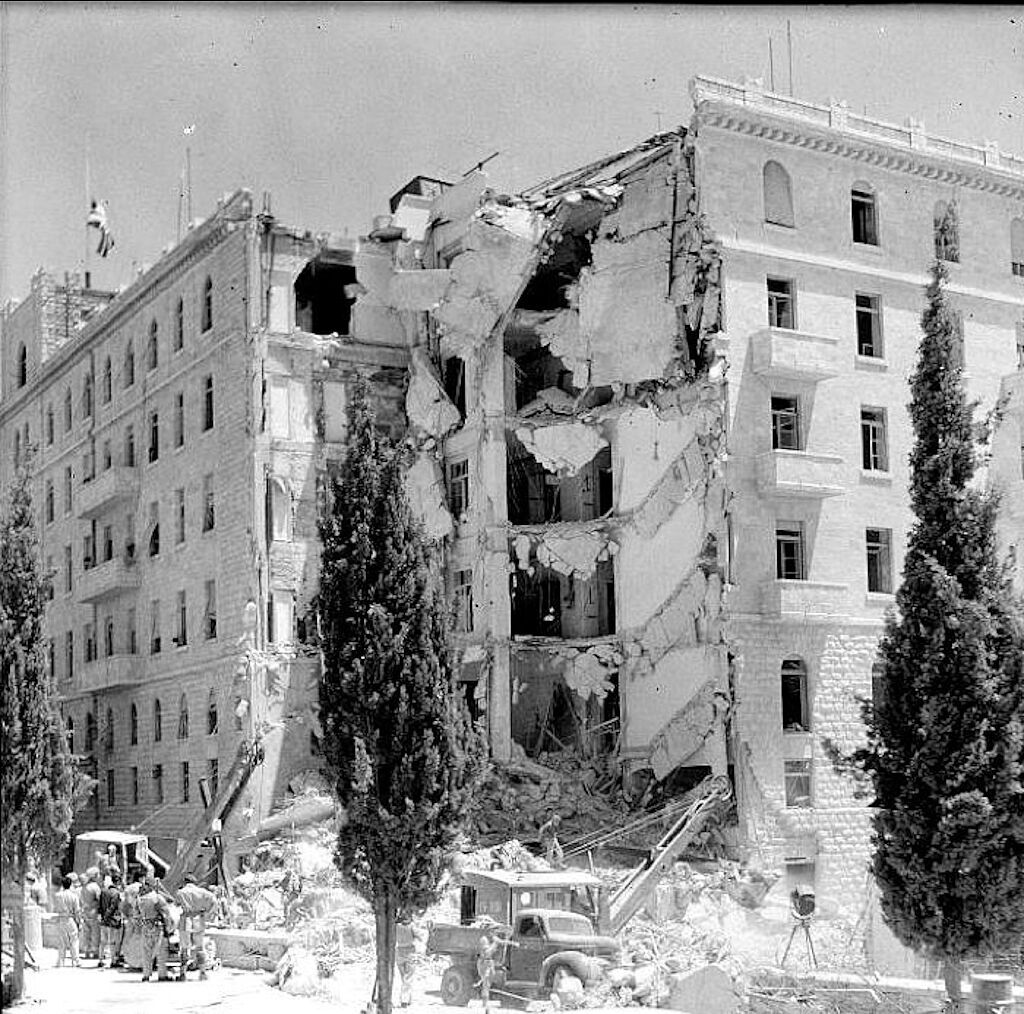
Ruins of the King David Hotel, 1946 — destroyed by Irgun operatives who entered in Arab disguise to blame the Palestinians.
The Sergeants Affair: Terror Without Disguise
While not a false flag, the Sergeants Affair revealed the other half of Irgun's operational instinct: terror deployed openly, surgically, and symbolically to shape political outcomes. In July 1947, after the British executed three Irgun militants captured during the Acre Prison break, Irgun retaliated by abducting two British Army sergeants — Clifford Martin and Mervyn Paice — hanging their bodies in a eucalyptus grove, and booby-trapping the corpses so the first responders would be maimed.
The message was unmistakable: Irgun would match the British state not only in subterfuge but in brutality, and it would escalate until Britain chose withdrawal over confrontation. This was terrorism not disguised as someone else's act — but terrorism as political theater, a demonstration that Irgun possessed both faces of modern covert violence: the mask and the naked blade.
Irgun understood that if disguise controlled the story, terror controlled the outcome. The Sergeants Affair proved they could wield both.
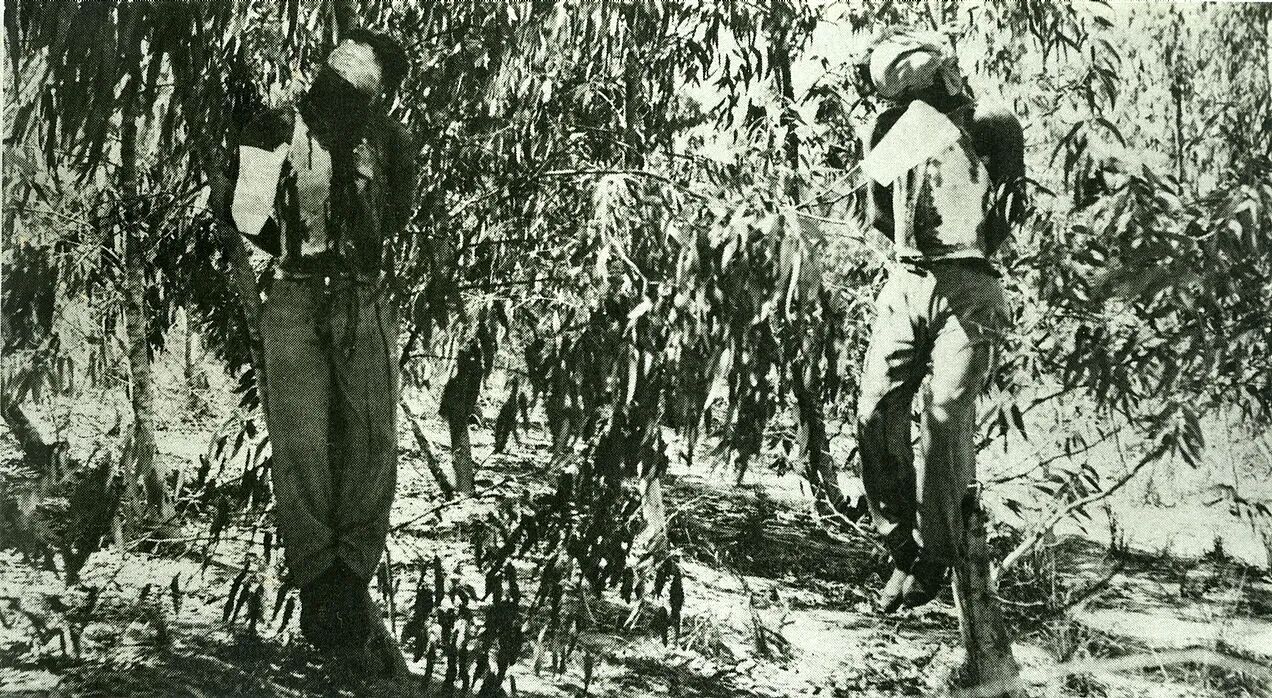
Clifford Martin and Mervyn Paice, the two British sergeants kidnapped and hanged by the Irgun in 1947.
Menachem Begin, Irgun commander and later prime minister, openly embraced the deception. In The Revolt, he wrote: "There are times when you must act as though you are guilty." The line reveals the logic that guided early operations: perception is the weapon, guilt is a tool, and narrative is the battlefield. This was calculated political violence designed to engineer outcomes, not chaos for chaos's sake. It became the intellectual engine powering future covert actions.
Begin didn't just lead a militia — he founded Likud, the ruling lineage that shaped Netanyahu and quietly threaded itself into America's intelligence system and the Oval Office after LBJ.
The full genealogy appears in my investigative report, Israel's Doctrine of Succession.
The Four Principles Born in Mandatory Palestine
From Irgun and Lehi's repeated operations emerged a structured playbook — one recognizable later in Cairo, Baghdad, London, Mexico City, and the USS Liberty:
- Strike in a borrowed identity — weaponize the reputation of the enemy.
- Exploit the fog of crisis — confusion is not collateral; it is the objective.
- Control the early narrative — the first story becomes the official story.
- Erase or override the forensic trail — the operation ends only when the preferred version of events prevails.
When the Underground Became the State
The transition from militias to government was not a break but an absorption of methods. Irgun and Lehi veterans became prime ministers (Begin, Shamir), intelligence chiefs (Rafael Eitan), policy strategists, and diaspora network architects. The underground did not dissolve in 1948; it entered the state intact. The same tactics once tested in Jerusalem's alleys became embedded in the architecture of national power.
The Crucial Insight
A false flag is never about the explosive — it is about the story detonated around it. In Mandatory Palestine, this tactic became a discipline, exported across continents and finally tested against the United States with the USS Liberty.
But that was only the prologue.
The real lesson emerged decades later, when a nation discovered how easily its memory could be steered by a Falling Man, how swiftly truth could vanish inside a Dust Cloud, how quickly doubt could hide between two missing shadows, and how effortlessly the Big Apple could be rewritten into Paper Rain.This is where the architecture began.
This is where Modern State Terrorism learned to choreograph history.
When the Underground Became the State
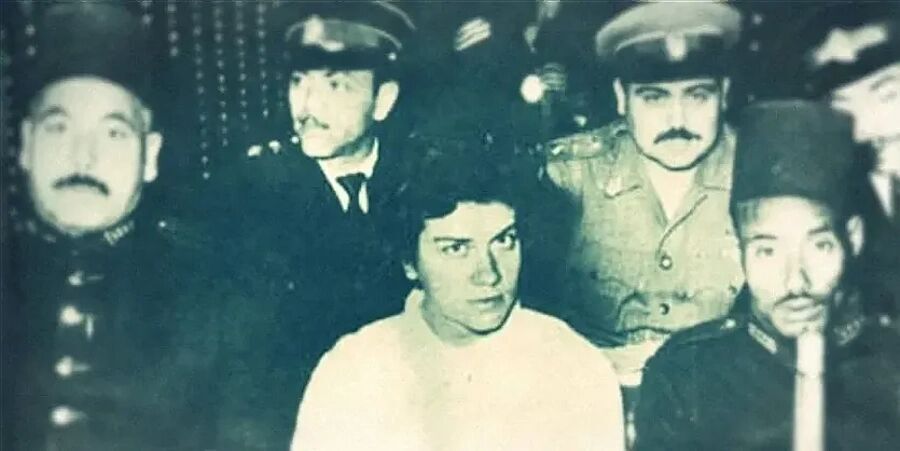
Israeli Mossad spy Marcelle Nino. As per the Egyptian court, she was the link between the group in Egypt and the high command in Paris.
The King David Hotel bombing proved the method worked.
The Lavon Affair proved something far more consequential: the underground never abandoned its philosophy when it became a government — it simply gained offices, titles, and budgets. By the early 1950s, the operational tradition born in Mandatory Palestine had moved into the heart of Israel's state institutions. False flags were no longer the improvisations of militias; they were becoming instruments of national policy.
Unit 131: The Underground Reborn Inside the State
In 1954, Israeli military intelligence activated a clandestine network inside Egypt known as Unit 131. Its mission was not espionage but terrorism designed to look like someone else's terrorism. The chosen targets reveal the intent: U.S. Information Agency libraries, British cultural centers, movie theaters, and offices associated with Western diplomats. The goal was simple and staggering — bomb American and British civilian sites, frame Egyptian nationalists, and force Washington and London to turn against Nasser.
The operation, codenamed Operation Susannah, reported directly to the Minister of Defense. This was the first fully state-run false-flag operation in Israeli history — the moment when Irgun's method officially became government practice.
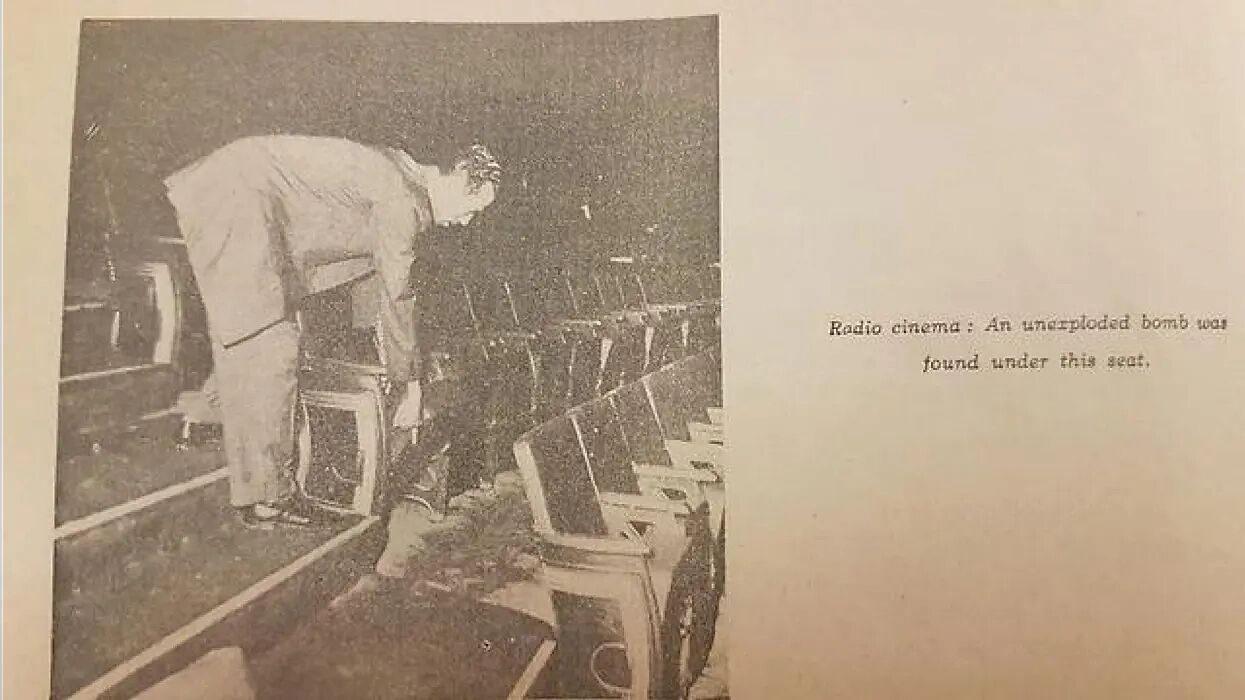
An undetonated bomb in Rio cinemas in Alexandria, Egypt.
Unit 131 employed a full suite of covert techniques previously used only by underground cells. These included forged Muslim Brotherhood signatures, pre-staged explosives, acid capsules for document destruction, and carefully crafted cover identities. Coordinated messaging was prepared so that Western embassies would immediately blame Egyptian radicals. This was Irgun's old operational tradition — but now executed with state resources, military structure, and diplomatic planning. It demonstrated that the tactic had been formalized, not abandoned.
The Collapse: Caught in the Act
The operation unraveled when operative Philip Natanson accidentally detonated a device in his pocket, leading Egyptian police to uncover the network. The arrests triggered a public trial, internal Israeli infighting, and the eventual resignation of Defense Minister Pinchas Lavon. Officially, Israel denied involvement for decades, claiming the story was fabrication or Cold War misinformation. Privately, however, the state understood exactly what had occurred: a government-sanctioned false flag designed to kill Western civilians for geopolitical gain. The scandal was buried, but the method endured.
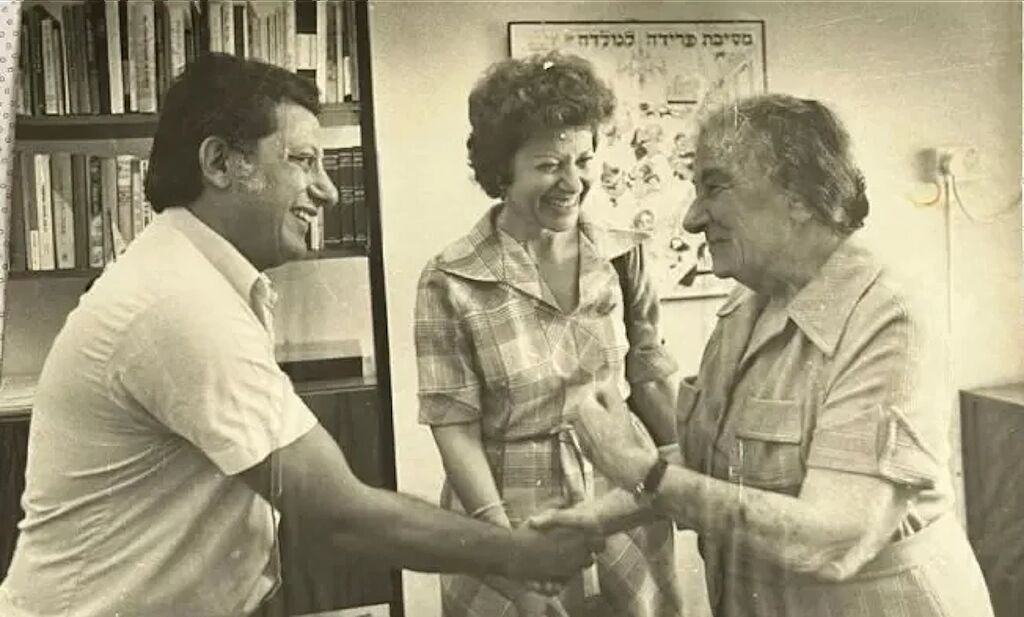
Israeli Spy Robert Dessa shakes hands with then-Prime Minister of Israel Golda Meir. Born in Alexandria in northern Egypt, Dessa and his associates in Cairo and Alexandria were recruited by Israeli intelligence in 1951 to establish an espionage network. After spending 14 years behind bars, Dessa was eventually released as part of a negotiated settlement.
Half a century later, the truth emerged in a single gesture.
In 2005, the Israeli government formally honored the surviving members of the Unit 131 cell, awarding medals and certificates to the operatives once disavowed. With that ceremony, Israel silently acknowledged what it had denied for fifty years: the bombings in Egypt werean Israeli state operation, not the work of rogue militants or local nationalists. The admission came without apology, inquiry, or international reckoning — because by then, the architecture had already evolved beyond Lavon.
Why Lavon Matters
The Lavon Affair was not just an intelligence scandal — it was the moment Israel crossed a moral and strategic threshold. It showed that the operational tradition of Irgun had survived statehood untouched, migrated into military intelligence, and was now being deployed not only against political enemies but against the very fabric of Jewish life in the Arab world. By targeting Western civilians and framing Egyptians, Israeli operatives helped ignite suspicion, destabilize coexistence, and fracture communities that had lived in peace for centuries.
The photo you see — Jewish families in Egypt dressed in Western clothes, running businesses, raising children, and living as fully integrated members of society — is the world that was destroyed. Not by Arab hatred. Not by ancient tensions. But by engineered fear. A manufactured crisis. A state-directed act of deception that seeded panic, ruptured trust, and began the mass displacement Israel later weaponized as political currency.
Israel would eventually recast this tragedy as "proof" that Arabs expelled Jews — a narrative that erases the fact that it was Israel's own covert actions that destabilized these communities in the first place.
The Arab world didn't expel its Jews — Israel detonated the ground beneath their feet, then claimed their flight as evidence.
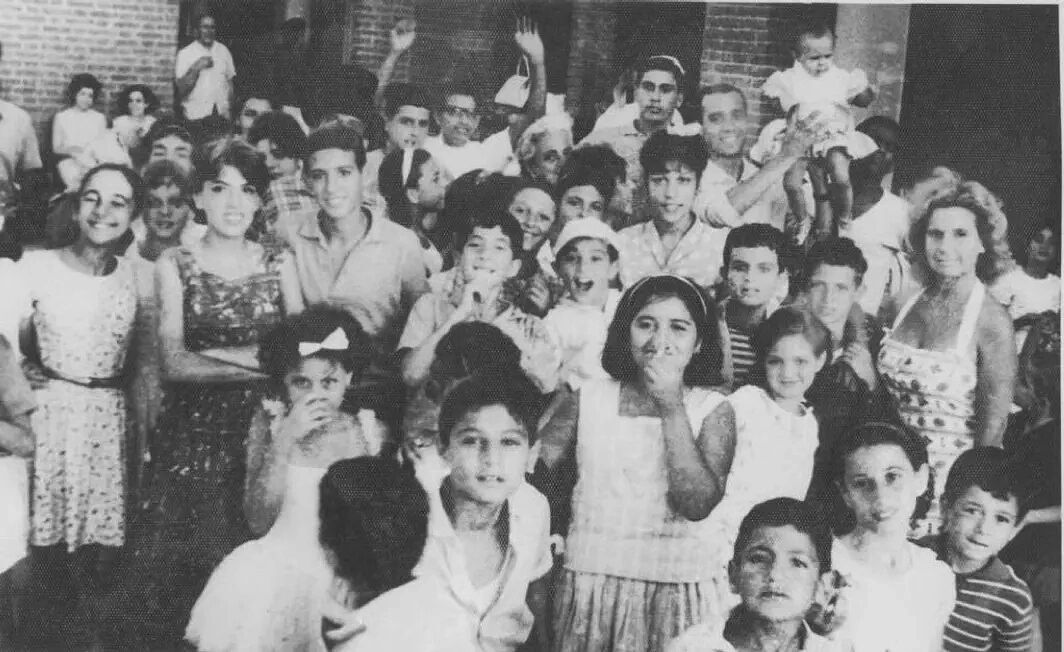
Children in Jewish summer camp in Alexandria, 1965
(Photo: Fortuna Asher Collection, the Digital Archive for the Preservation of the Heritage of Egyptian Jewry, Younes and Soraya Nazarian Library, University of Haifa, in collaboration with the Joseph and Racheline Barda Chair for the Study and Research of Jewish Heritage in Egypt)
(Photo: Fortuna Asher Collection, the Digital Archive for the Preservation of the Heritage of Egyptian Jewry, Younes and Soraya Nazarian Library, University of Haifa, in collaboration with the Joseph and Racheline Barda Chair for the Study and Research of Jewish Heritage in Egypt)
Once Israel confirmed — both internally and through its experience — that such operations were survivable and politically useful, the playbook expanded outward. The same architecture would appear in the Baghdad bombings, the London Embassy attack, the Mexico Congress infiltration, and later in the assault on the USS Liberty. Lavon is the hinge between the underground and the global stage. From this point forward, the operational tradition was no longer local. It was international.
When the Operational Tradition Turned Inward: The Baghdad Bombings (1950-51)
Terror as a Tool of Demographic Engineering
If the Lavon Affair showed that Israel was willing to bomb Western civilian sites to shape geopolitics, the Baghdad bombings revealed something even more unsettling: the architecture would target Jews themselves if the strategic objective required it. This is the chapter that historians tread around, Israeli officials deny, and survivors remember with quiet devastation. It marks the moment the operational tradition evolved from political sabotage into state-directed population engineering. Fear became a tool — not to defeat an enemy, but to move entire communities like assets on a demographic board.
The Oldest Jews on Earth, and the Nation That Needed Them Gone
The Jewish story begins in Iraq — literally. Abraham's home, Ur, sits in today's southern Iraq, and from that beginning rose one of the world's oldest Jewish civilizations: the Jews of Baghdad. For 2,500 years they lived among Muslims and Christians as neighbors, parliamentarians, traders, and thinkers. They were pillars of Iraqi society, not a people longing to escape.
But to Israel's early leadership, this stability was a strategic obstacle. The state needed rapid population growth and crafted a narrative that Jews everywhere were unsafe and must "return." Iraqi Jews contradicted that story simply by living peacefully. So the operational tradition evolved: if the community would not leave, fear would be delivered to their doorstep.
No image captures this betrayal more than that of Sir Sassoon Eskell, Iraq's first finance minister — a Jewish statesman revered by Muslim kings. His life showed what coexistence looked like. His community's destruction showed what geopolitical engineering can erase.
Israel didn't just empty Iraq of its Jews, it severed the oldest living branch of Jewish civilization.
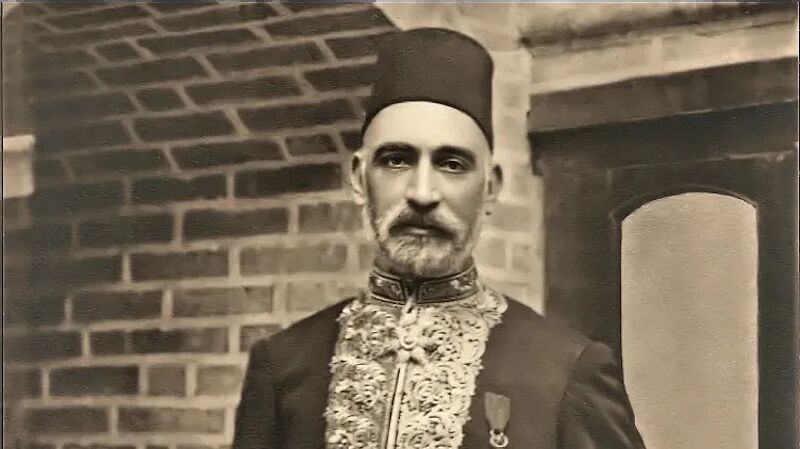
Sir Sassoon Eskell, a Baghdadi Jew, who served as Iraq's first finance minister and was a key player in the founding of the early kingdom.
Between 1950 and 1951, explosions tore through Jewish spaces in Baghdad — synagogues, cafés, schools, and community offices. The devices were small, not designed for mass death but for maximum psychological impact. Iraqi Jews did not blame their Muslim neighbors. Instead, suspicion turned inward as whispers spread that Zionist underground cells were staging attacks to frighten the community into fleeing. Israel denied everything, but the truth would emerge from those who lived through the operation itself.
Between March 1950 and June 1951, five explosions struck Jewish spaces in Baghdad — the Mas'uda Shemtov synagogue, Beit-Lawi's café, the Jewish community offices, and other communal sites. The bombs were small and deliberately non-lethal, built to terrify, not to massacre. As Avi Shlaim documents in Three Worlds, Baghdad's Jews did not blame Muslims because no Muslim political faction had a history of attacking Jews in this pattern.
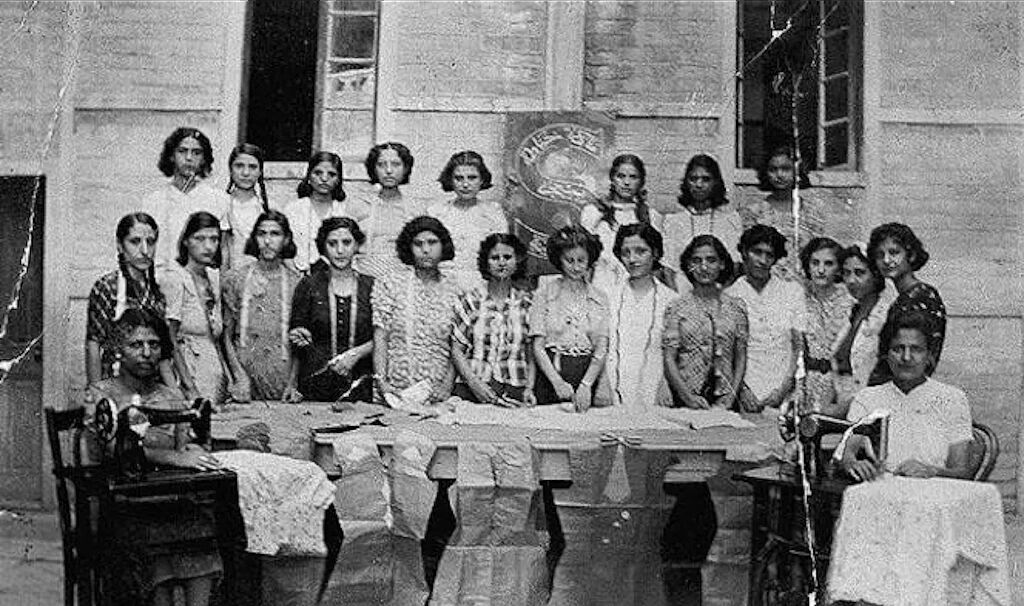
Jewish Girls learning to sew in the workshop at the Alliance School in Basra, Iraq, 1939
Rumors rapidly spread — not of Arab mobs, but of Zionist underground operatives staging violence to push the community toward emigration. Israel denied involvement, but the truth would come from those inside the clandestine cells themselves.
"These bombings were not random acts. They formed part of a pattern... The evidence of Zionist involvement is incontrovertible." (Avi Shlaim, Three Worlds, p. 266)
Naeim Giladi — The Insider Who Exposed the Mechanism
Naeim Giladi — born Naeim Khalaschi in Baghdad — joined the Zionist underground as a young operative before defecting in moral outrage. His memoir is the most detailed insider account of the bombings. Giladi explained that Zionist operatives smuggled hand grenades into Baghdad, used safehouses to coordinate operations, and planted rumors to provoke a mass exodus.
In Ben-Gurion's Scandals, he wrote the now-famous line:
"We were bombed by Zionist agents — not Arabs — to force us to leave Iraq."He recorded the names of operatives, described the chain of command, and detailed how each bombing was intended to simulate growing anti-Jewish hostility and make departure seem like the only safe option.
(Giladi, Ben-Gurion's Scandals, pp. 62-68)
To Giladi, what Israel later called a "rescue" was instead a coordinated psychological operation designed to create refugees Israel needed for demographic growth.
"The Jewish exodus from Iraq was not a rescue operation; it was a ruthlessly planned political operation."In his account, the strategy was brutally simple: sow fear, blame Arabs, then funnel the terrified community into Operation Ezra & Nehemiah, the mass airlift to Israel. This was not rescue. It was deliberate engineering.
(Ben-Gurion's Scandals, p. 66)
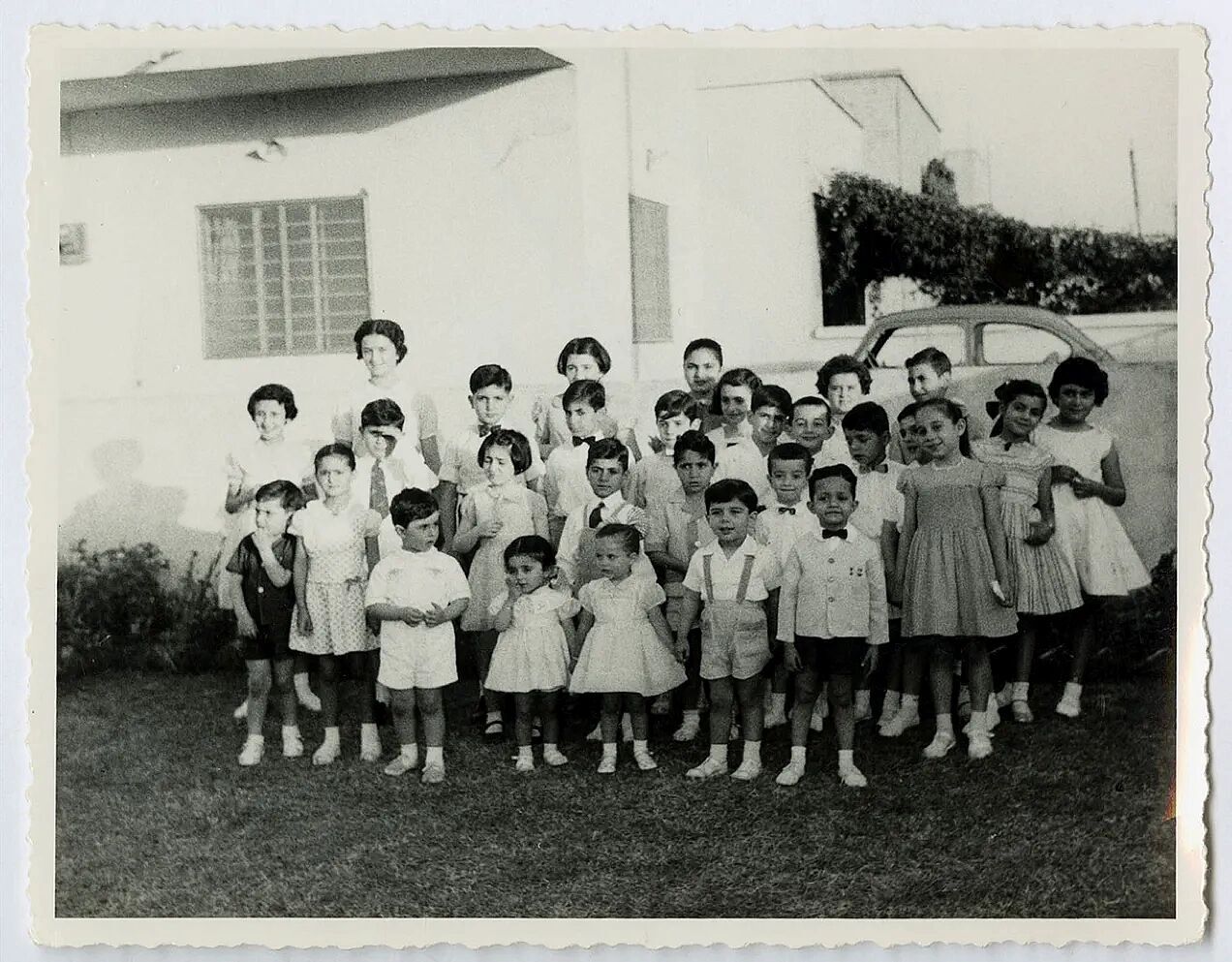
Children in the Jewish Maurice shohet School - The Iraqi Jewish archive - taken in Baghdad Iraq in 1959.
Avi Shlaim is not a distant scholar studying Iraq from an ivory tower. He was born in Baghdad, into the ancient Jewish community that lived there for 2,500 years. As a child, he was airlifted out of Iraq during Operation Ezra & Nehemiah — the very operation whose origins he would later investigate. Shlaim became an Israeli citizen, served in the IDF, and later built one of the most respected academic careers in the world as a Professor of International Relations at Oxford University and one of the founding figures of Israel's "New Historians."
For decades, he fully accepted the Zionist version of events: that Arab nationalists bombed Baghdad's Jews. It was part of his upbringing, his education, his identity.Then he opened the archives.
When he examined Iraqi police files, intelligence reports, survivor testimonies, and the previously concealed evidence, he reached a conclusion he never expected — one that overturned his own childhood narrative and stunned the historical community.
His verdict could not be more direct:
"The bombings were carried out by Zionist activists in Baghdad with the aim of creating fear among the Jews and triggering their exodus to Israel." — Avi Shlaim, Three Worlds, p. 266Shlaim's reversal matters because he is the single most credentialed living witness-scholar of this history — Iraqi-born, Israeli-raised, British-educated, and internationally respected.
Shlaim identifies:
- Zionist militants such as Yosef Basri and Shalom Salah
- Smuggled British-made grenades
- Zionist networks inside Iraqi institutions
- Forensic inconsistencies in the official Iraqi trial
- Internal Israeli documents acknowledging operations to "encourage" Iraqi Jewish migration
"The weight of the evidence points relentlessly to Zionist involvement in the Baghdad bombings." — Avi Shlaim, Three Worlds, p. 266What does it say about "free media" in the U.S. and U.K. when Avi Shlaim — eyewitness, survivor, and Oxford professor — can publish evidence of Zionist bombings against Iraqi Jews, but is barred from every major network, including the British government's own BBC?
Sit with that for a moment.
How the Operation Worked — The Playbook of Manufactured Fear
Across oral histories and archival records, the same pattern repeats: rumors of fictional pogroms were planted inside synagogues; staged weapons caches appeared in Jewish homes; bombs were timed for visibility, not carnage; and propaganda warned that Arabs would soon turn murderous. These were the tools of psychological warfare, not communal defense. The objective was a controlled stampede — a fear-induced exodus that diplomacy could never achieve. Terror was not the byproduct. It was the mechanism.
The Manufactured Exodus
Within months, nearly 120,000 Iraqi Jews registered for departure. A 2,500-year-old community vanished almost overnight, its homes seized and its institutions absorbed into an Iraq suddenly stripped of one of its cultural pillars. Israel celebrated the influx as a "miracle" of ingathering. The survivors understood the reality: they had been terrorized into abandoning their birthplace by the very movement that claimed to save them. The operational tradition had crossed a moral line — targeting its own people to fulfill demographic objectives.
Why Baghdad Matters for the Global Architecture
The Baghdad bombings established precedents that would shape every false-flag operation that followed. First, terror could be used as a tool of population transfer, expanding the operational tradition beyond political manipulation into demographic engineering. Second, Israel could conduct covert operations inside sovereign states with minimal international accountability. Third, the world would accept the preferred narrative — if it arrived early and forcefully enough. Baghdad proved that the architecture was not only effective; it was exportable.
This success opened the path to the next phase:
operations targeting embassies in London, legislative chambers in Mexico City, and ultimately a U.S. Navy vessel in international waters.
The operational tradition was no longer regional.When the Operational Tradition Crossed Oceans
It was global.
London (1994) & Mexico City (2001): The Playbook Goes Global
By the 1990s, the operational tradition that began in Mandatory Palestine and evolved through Egypt and Iraq had become fully exportable. What started as regional sabotage now functioned as a portable system — capable of entering foreign democracies, shaping Western security narratives, and manipulating international politics with precision. This was the moment the architecture ceased to be confined to the Middle East. It became global, and the clearest evidence of this shift appears in two cases: London in 1994 and Mexico City in 2001. Different continents, different stakes, but unmistakably the same signature.
London, 1994 — When MI5 Saw the Signature and the Courts Buried It
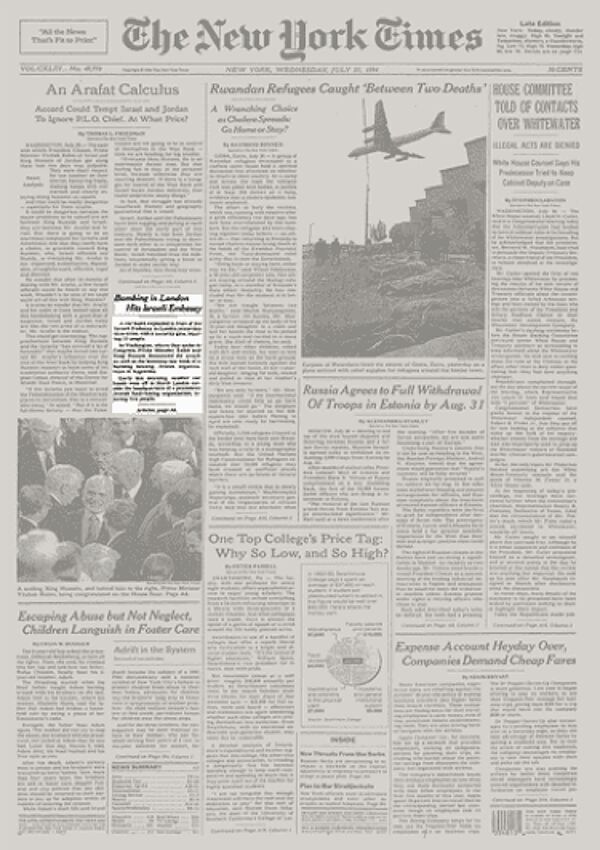
New York Times, July 27, 1994: The bombing that was publicly blamed on Palestinians — even as MI5 officers later testified the evidence pointed to Mossad.
Inside MI5, however, analysts reached a different conclusion. Former MI5 officer Annie Machon later revealed that internal assessments pointed not to Palestinian groups but to Mossad, based on the bomb's construction, the intelligence footprint before the attack, and the political utility the incident provided Israel at a sensitive stage of the Oslo process.
This divergence between intelligence findings and courtroom outcomes is the defining feature of the playbook. The public receives a streamlined story, while conflicting evidence is sealed away in official archives. MI5 warnings were ignored, alternative explanations were suppressed, and Botmeh and Alami became placeholders for a crime the internal analysts believed they did not commit. London marked the first major demonstration that the operational tradition could penetrate a Western capital and shape its narrative landscape. It also proved that once the wrong story is cemented, correcting it becomes nearly impossible.
Mexico City, 2001 — The Operation That Almost Broke Cover
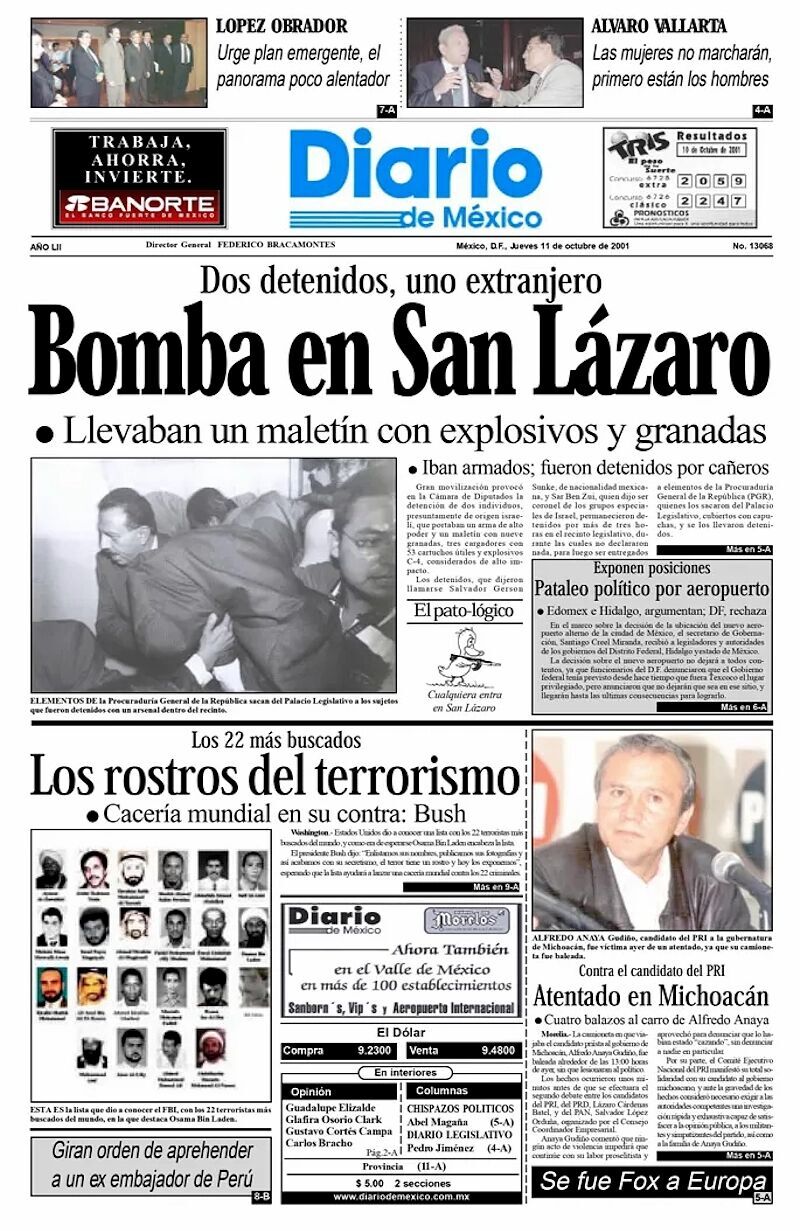
"Bomba en San Lázaro": Two Israelis — Saar Noam Ben Zvi and Salvador Gersson Smeck — caught in Mexico with explosives and weapons under Pakistani passports, a month after 9/11. The Diario de México report, October 11, 2001, confirms the incident at the Mexican Chamber of Deputies on October 10. False flag attempts exposed.
The implication was explosive: an Israeli staged terror attack inside a national legislature that could be blamed on Pakistani suspects in the immediate aftermath of 9/11.Had the operation succeeded, Mexico's political alignment would have shifted dramatically. A bombing pinned on "Pakistani terrorists" inside Congress could have pushed Mexico into the U.S. War on Terror, strengthened Israeli counterterrorism ties, and reshaped domestic politics overnight. But the playbook faltered because the operatives were caught too early. Within hours, Israeli diplomats rushed to intervene, U.S.-linked intermediaries appeared, and Mexican officials abruptly stopped speaking to the press. The suspects were quietly released, and the story disappeared internationally. The failure was not in the plan, but in its premature exposure — the operational tradition's fallback mechanism was activated: erase everything before the narrative hardens.
Déjà Vu
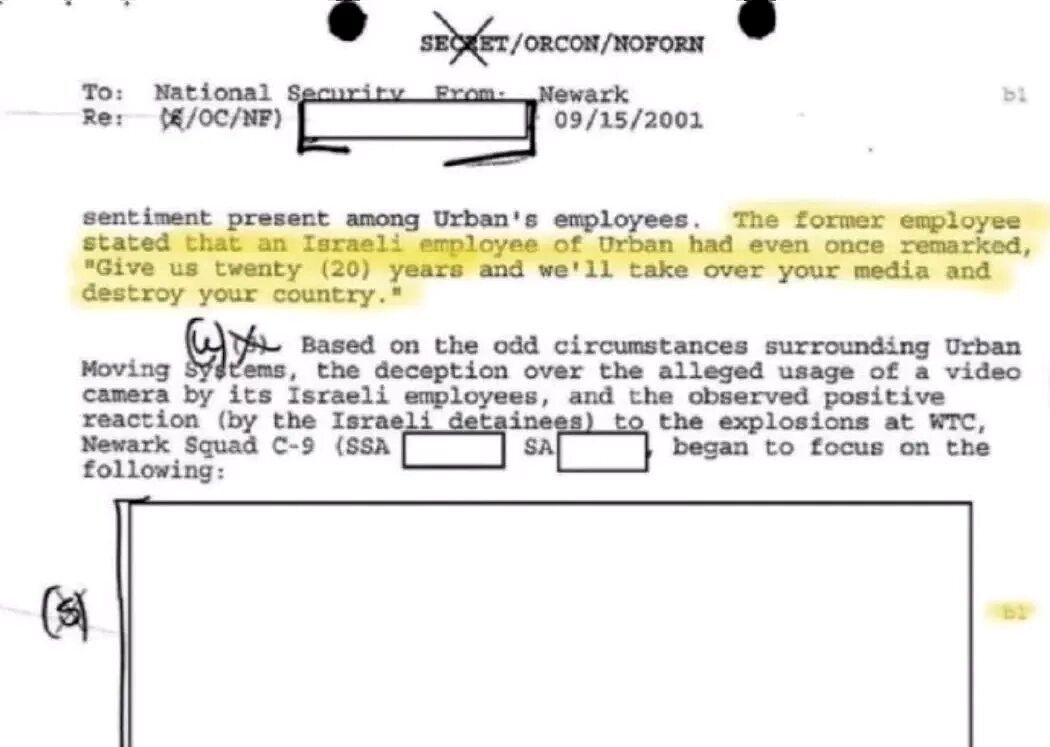
Federal Bureau of Investigation (FBI) — Newark Field Office. Detention & Interview Log, 15 September 2001. Case No. 203A-NY-280350. Record of five Israeli nationals apprehended after witnesses reported them "celebrating" as the towers fell; narrative redacted in multiple places for national security.
Same rhythm.
Same props.
Same disappearing ink.
Almost as if, just weeks before the Mexico incident, another operation had already rehearsed the scene:
- a foreign woman smiling as if the catastrophe were an inside joke,
- "students" who were not students surveilling federal buildings,
- art-cargo networks that doubled as intelligence fronts,
- a Saudi passport surviving an inferno no steel could endure,
- vans testing positive for explosives before the story evaporated,
- early news reports — FOX, ABC, local affiliates — that vanished as fast as they appeared.
"It's very good."And this was only hours after foreign operatives were seen dancing as the morning turned to ash, a detail frozen in an FBI 302 summary dated 09/15/2001 (NFO, Ref. Code [BLK-20]), where one detainee remarked:
"Give us 20 years and we'll control your media and destroy your country."Patterns don't lie.
People do.
Still... let's pretend it's only Déjà Vu.
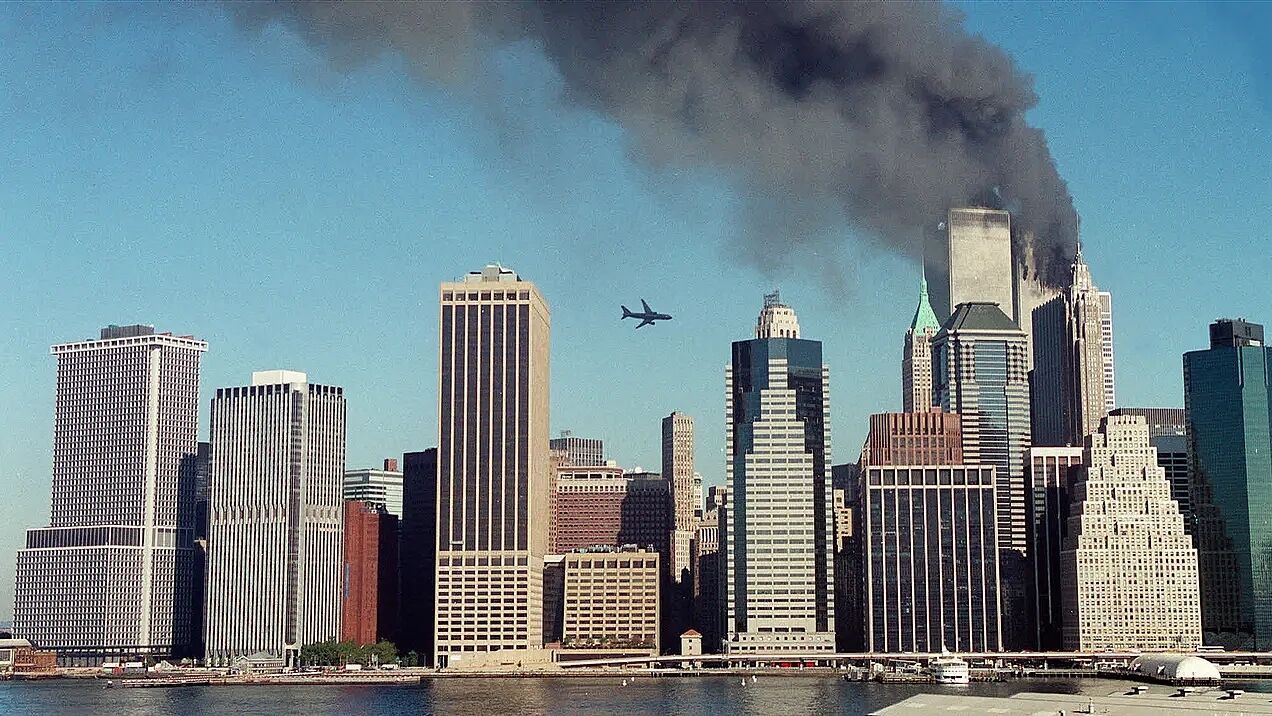
A single frame that changed the world. A morning when the sky tore open, and an entire nation felt its heartbeat stop. We will never forget — not the lives lost, not the silence that followed, and not the duty we carry to seek truth, justice, and peace in their name.
The Connecting Thread — One Architecture, Two Continents
London and Mexico City expose the same operational pattern: borrowed identities, perfect timing, rapid diplomatic interference, and narratives locked into place before facts could breathe. And when you quietly place these events beside a certain other episode — celebrating operatives, explosive-positive vans, "art students," and a miracle passport — the resemblance becomes hard to ignore.
But forget it. Patterns are only patterns until you admit you see them.Next stop: June 8, 1967 — the USS Liberty.
The Attack That Never Should Have Been Survived — The USS Liberty
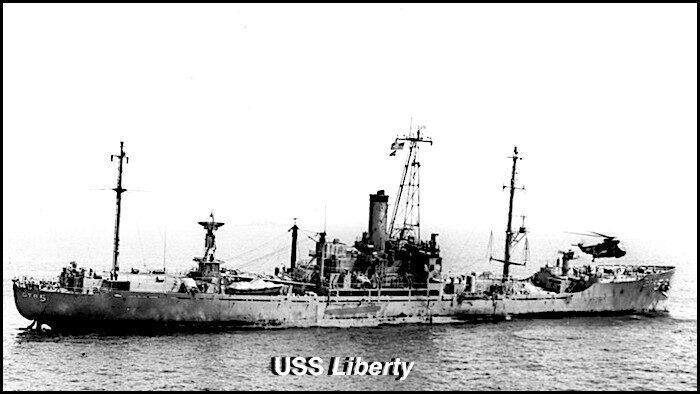
© WikipediaThe seriously damaged USS Liberty en route to the port of Valletta, Malta, for repairs following the attack by Israeli torpedo boats and aircraft, June 8, 1967. The helicopter hovering over the bow of the ship is removing the dead and wounded to the aircraft carrier USS America.
A Deliberate Strike — Not a Mistake
Survivors described aircraft circling the USS Liberty, clearly identifying the American flag, and attacking anyway. Torpedo boats fired on life rafts — a war crime under every code of the sea. Rescue aircraft were scrambled, then mysteriously ordered back by Washington, not by commanders on scene.
Years later, declassified Israeli cockpit recordings confirmed what the crew had testified from day one:
the attackers knew it was an American ship. they said it out loud.Watch the False Flag short documentary above to hear the leaked cockpit audio and the survivors' own testimony — or click here (link).
"It was no mistake. We were betrayed." — James Ennes, USS Liberty survivor
The LBJ-Krim Axis — The Proximity That Explains the Silence
Two days before the attack, President Lyndon Johnson personally instructed the White House operator to reach Mathilde Krim — a former Irgun operative with deep ideological lineage and intimate access to Johnson's private circle.
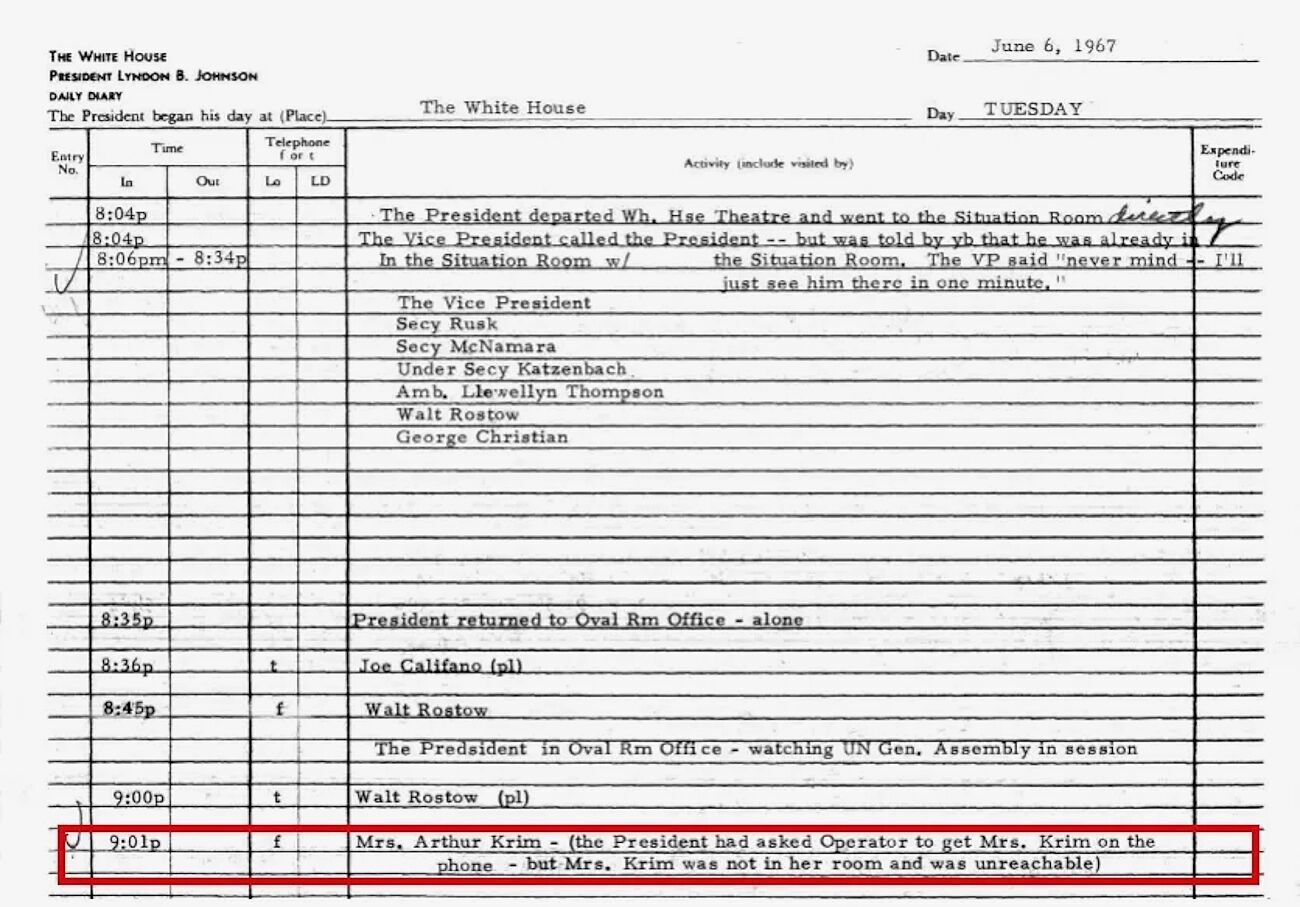
June 6, 1967 — LBJ's Daily Diary President LBJ personally instructs the White House operator to reach Mathilde Krim — on the eve of the USS Liberty attack.
A woman linked to the very underground tradition that pioneered these operations was in the President's private rooms during the aftermath of an attack by the same state.
Survivors received silence.
Mathilde Krim received access.
The Nuclear Angle — A Strike Waiting for a Story
Declassified testimony later revealed that SAC nuclear bombers were already airborne, prepared to strike Egypt once the Liberty sank and no witnesses remained. The plan required a single missing piece: blame Egypt.
Only the Liberty's refusal to go under prevented the chain reaction.
"LBJ is not going to embarrass an ally."
— Admiral Lawrence Geis, relaying the stand-down order
Phase Two: Silence as Policy
Upon returning home, sailors were threatened with court-martial if they spoke. Families were discouraged from asking questions. Journalists were blocked. Congressional inquiries were neutered. CIA and NSA records disappeared into classification vaults.
This was not damage control.
It was the same architecture that followed every operation from Cairo to Mexico:
the explosion is Phase One. The silence is Phase Two.
Why This Moment Matters
The USS Liberty is not a historical dispute.
It is the single moment that proves the operational tradition had penetrated the highest levels of American political decision-making. In one afternoon, the full pattern appeared:
- clear foreknowledge
- communications jamming
- precision attack
- narrative suppression
- diplomatic pressure
- political protection for the attacker
- ordered silence for the victims
It reached into the Oval Office.
It shaped the President's response.
"I don't give a damn if every man drowns and the ship sinks. I will not embarrass our ally."The USS Liberty was the moment the pattern stopped being distant, foreign, or theoretical.
— President Lyndon B. Johnson, during the Liberty attack response.
It arrived on an American hull, under an American flag, dripping with American blood — and Washington still chose silence.
No investigation.
No accountability.
No justice.
Just a rapid rush to protect the architecture.
"This is our country. The politicians sold their souls to Israel. Liberty was the most egregious."The lesson was brutal in its clarity:
— Phil Tourney, USS Liberty survivor
In the halls of power, allegiance is not measured by who bleeds —
but by who must never be blamed.
And what America learned that day, before it tried to bury the memory forever, was this:
The Liberty did not expose an accident, it exposed a government willing to sacrifice its own men to protect a story it needed more than their lives.
The Real Operation Begins After the Smoke Clears
The pattern never changes: shock the world, assign the culprit instantly, erase the trail, pressure governments into silence, and bury the truth beneath "official history". From Milk Churns in Jerusalem to the Embassy in London to the grenade-laden operatives in Mexico City, the continuity is undeniable once you stop viewing events as isolated incidents. They are steps in the same choreography — a choreography built to survive scrutiny, outlast memory, and repeat.
And by the time this architecture reached the early 2000s, it had already tested its strength across borders. The next test would measure whether it could confront a superpower head-on.
When the cover-up becomes habit, the truth becomes collateral damage.
The Day the Script Failed to Hide Itself
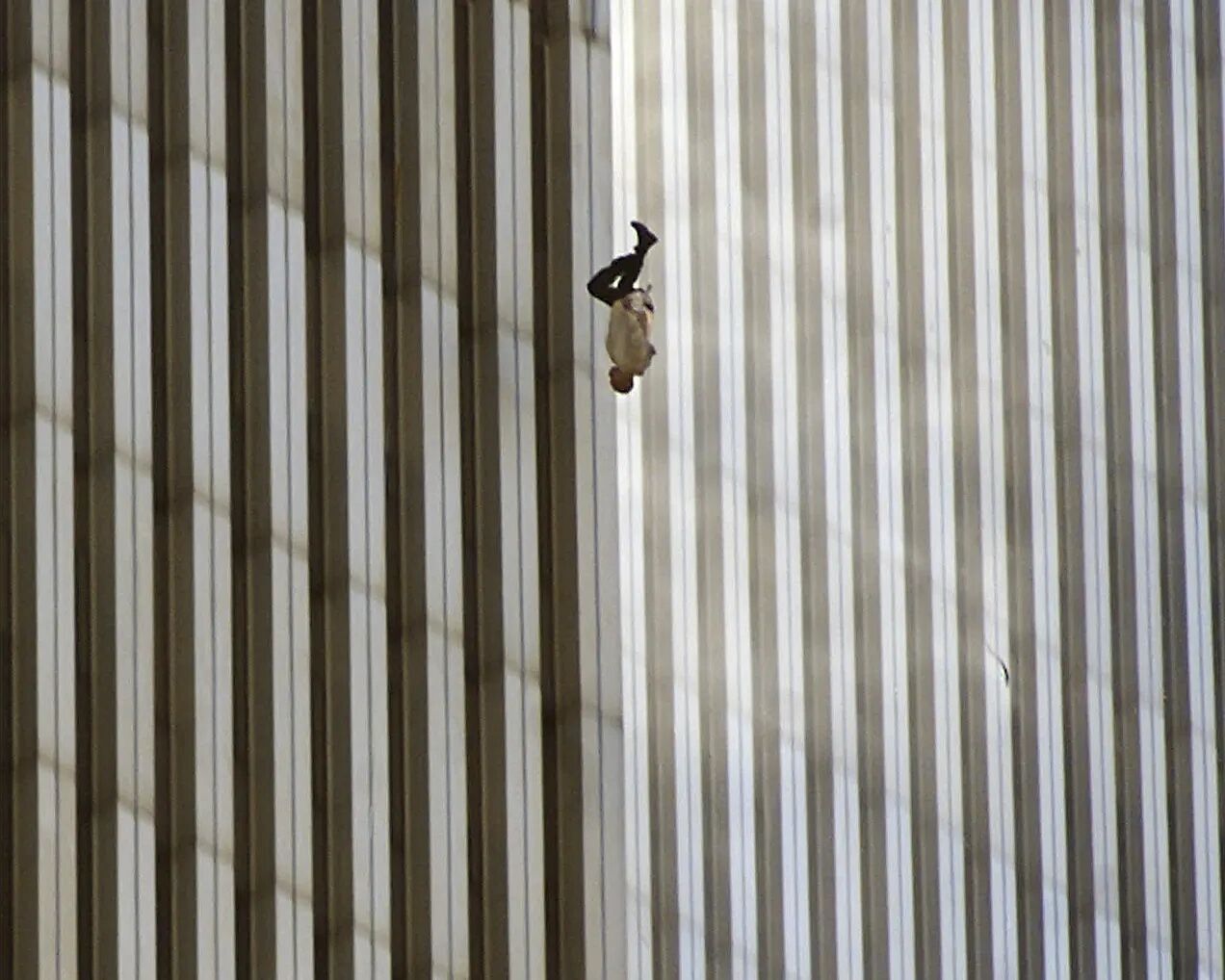
They told us to forget him. Just like they told us to forget everything else. But memory is resistance. We will never forget.
But the script is old now — older than Lavon, older than London, older than Mexico City — and once you've seen it, you start recognizing the handwriting everywhere, even across the Atlantic, even in the fires of 2001.
They told us to move on.
They told us it was confusion.
They told us not to connect the dots.
But the dots connect themselves.And we will never forget — not the Liberty, not the buried testimonies, not the echoes that reached us again on 9/11.
The era of their silence is ending.



Reader Comments
And of course I'm serious here, the whole narrative of the alleged jet impact on the twin towers is a mockery of science and physics in particular. Mind you, the "Matrix" movie was released at that time, demonstrating the Hollywood capabilities of "make believe" at that time. There were no planes.
The subtitle under the last picture is a more glaring example : All psychological and emotional manipulation, to trigger the indoctrinated reaction.
But if you look closely - that photo must have been shot from a larger distance. But how then can the man be in focus, and the walls, just a few yards behind him, are so blurred and out of focus ?
Because - look at his posture : this is an actor, falling from a few yards into a safe cushion, and he clearly enjoys the job. The greenscreen background was removed, and the falling actor photoshopped into this press cover image mockery.