
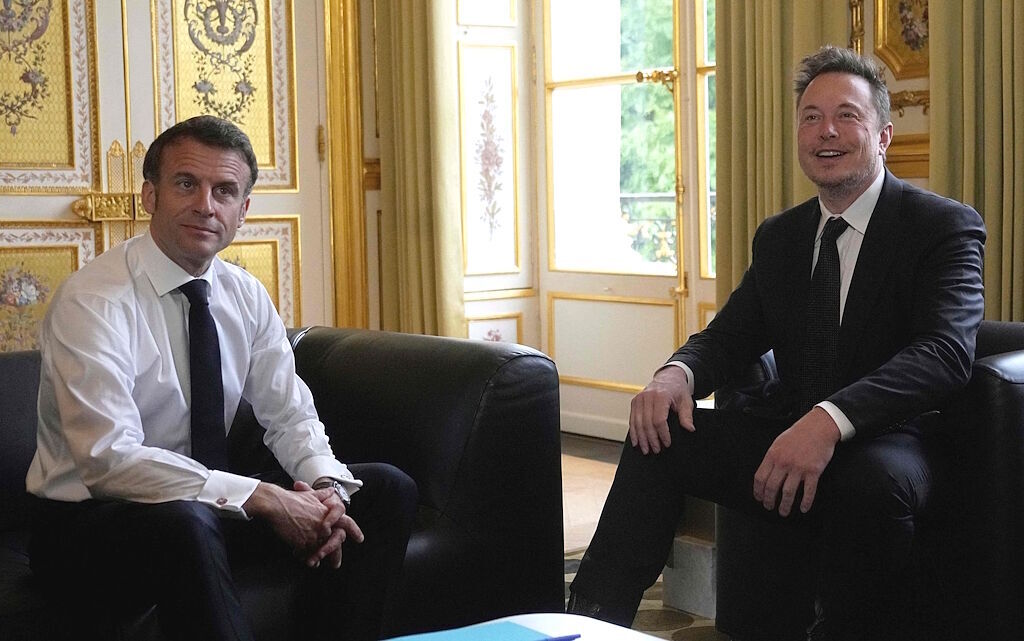
© Michel Euler/AFP/Getty ImagesThe EU knows if you can keep a topic off people’s feeds, you can do a surprising amount to shift political discourse
Having started down parallel paths of mass migration for their own historical reasons, Britain, France and Spain are now converging on a strategy for its management: cover up the consequences and shut down the spaces where they might be discussed.
This week, the authorities of all three countries took aim at Elon Musk's X (formerly Twitter), ostensibly in order to protect children. Spanish prime minister Pedro Sánchez - fresh from approving a plan to regularise half a million illegal migrants to "fight" the "far Right" - announced plans for a social media ban for under-16s. That was the headline measure.
Following in its wake, however, were references to taking action against "platforms whose algorithms amplify disinformation", insistence that "spreading hate must come at a cost... that platforms can no longer afford to ignore", and plans to make executives criminally liable for content on the platform.
In France, meanwhile, police raided X's Paris headquarters as part of an inquiry aiming to protect children by halting deepfakes. But the investigation was triggered in the first place by an MP in Emmanuel Macron's centrist party complaining after Musk's purchase that X had "reduced diversity of voices", and a separate complaint that the site hosted "nauseating political content".

© Remon Haazen/Getty ImagesPolice raided the French offices of Elon Musk’s X platform as part of a criminal investigation into sexually explicit deepfakes
There is a difference, however, between accepting that a problem should be addressed and accepting the Government's proposed solution. The capability in question - Grok editing pictures of real people into revealing clothing - shouldn't have been available in the first place, but it has now been fixed.
The state response, however, is still unfolding, and will still be unfolding months from now when the next digital scandal blows up. This dynamic, where the pace of regulation is outstripped by the pace of innovation, means that even well-intentioned legislation tends to grow out of control as it attempts to anticipate the future - as the Conservatives proved with the Online Safety Act. And it also gives marvellous cover to politicians looking to take broad control over speech.
Given the frequency with which Labour politicians have clashed with Elon Musk over political discussion on X - the aftermath of the Southport murders, the grooming gangs scandal - it doesn't seem unreasonable to suspect that this is precisely why Starmer and his colleagues are displaying such interest in this episode.
This is particularly so when Ofcom has no current investigations into Roblox - currently facing multiple lawsuits over allegedly facilitating child sexual exploitation (Roblox has said it strongly disputes the plaintiffs' allegations) - and when the Government itself seems hesitant to examine the grooming scandal in reliably Labour-voting communities.
For all its failings, X/Twitter was and still is one of the most prominent public forums in political life. Journalists, politicians, commentators, think-tankers and others used, and use, it compulsively. If you can keep a topic off people's feeds - or threaten one side with bans for speaking out - then you can do a surprising amount to shift political discourse in one direction or another.
Prior to Musk's purchase, the balance of moderation was shifted well to the Left, particularly on issues of gender identity and migration. Now, on both, it has shifted substantially.
The previous policy helped to cover up the worst details of incidents likely to provoke "community tensions", and to maintain the line that the New Europe was an improvement on the old. The new one gives criticism free rein.
Unsurprisingly, those politicians feeling the heat as a result would like things to return to the way they were. But as they are fond of telling voters who express that same sentiment to them, change is a part of life. The genie isn't going back into the lamp.





May Sanchez, Macron, Merz and Starmer receive what is due them...