

© Wikipedia CommonsGreat Pyramid of Giza.
In a paper released in January 2026, Italian engineer Alberto Donini presents an unconventional dating approach — known as the Relative Erosion Method (REM) — which he argues may challenge the long-accepted chronology placing the construction of the Pyramid of Khufu around 2560 BC. According to Donini's calculations, erosion patterns at the pyramid's base could suggest a construction date tens of thousands of years earlier, potentially as far back as the late Paleolithic period.
The claim, if substantiated, would have far-reaching implications for the history of ancient Egypt and early civilization. Yet it also raises immediate questions about methodology, assumptions, and how such results should be interpreted within archaeological science.
Dating Stone Through Erosion
At the core of Donini's work is REM, a method designed to estimate the age of stone structures by comparing relative erosion on adjacent rock surfaces made of the same material and exposed to the same environment.
The logic is straightforward. At Giza, much of the Great Pyramid was once covered with smooth limestone casing blocks. Historical sources indicate that these casing stones were systematically removed and reused in Cairo after major seismic events — particularly following the powerful earthquake of 1303 AD — and during the Mamluk period. This means that some limestone surfaces at the pyramid's base have been exposed to wind, moisture, salts, and foot traffic for roughly 675 years, while neighboring surfaces have remained exposed since the monument's original construction.
By measuring the difference in erosion between these two surfaces, Donini argues, it is possible to calculate how long the older surfaces must have been exposed.
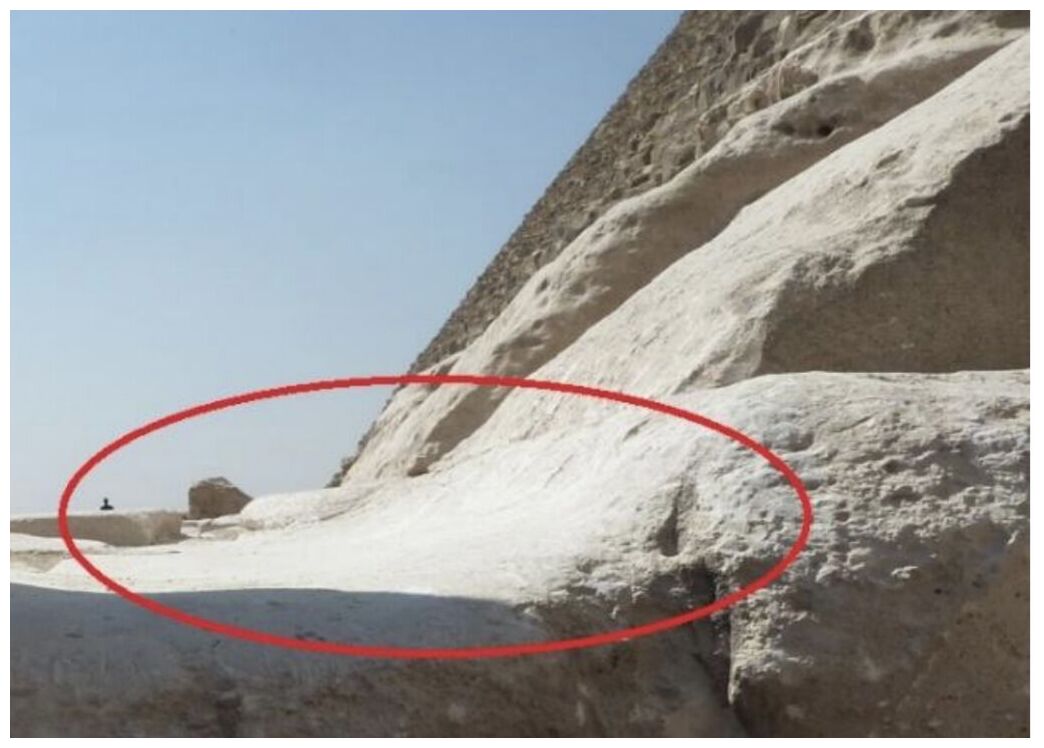
© Donini, A. (2026)Uniform erosion on limestone rock.
The study focuses on twelve measurement points around the base of the Great Pyramid. At each point, Donini examined either pitting erosion — small cavities formed by chemical and physical weathering — or uniform surface wear, estimating the volume or depth of material lost.
In one representative example, a pavement slab shows deeply pitted erosion on the side exposed since the pyramid's construction, compared with much shallower erosion on the side uncovered only after the casing stones were removed. Using the ratio between these two erosion volumes and applying a linear erosion model, Donini calculates an exposure time of over 5,700 years before present for that point alone.
Other points yield far higher values. Several measurements suggest erosion equivalent to 20,000 to more than 40,000 years of exposure, while the arithmetic mean of all twelve points produces a result of approximately 24,900 years before present, corresponding to roughly 22,900 BC.
Probability, Not Precision
Donini emphasizes that REM is not intended to provide an exact construction date. Instead, it estimates an order of magnitude. To address uncertainty, the study applies a basic statistical analysis, calculating a standard deviation and constructing a Gaussian probability curve.
Based on this model, the report concludes that there is a 68.2% probability that the Great Pyramid was constructed sometime between roughly 9,000 BC and 36,000 BC, with the highest probability centered around the early 20,000s BC.
The author stresses that these conclusions are preliminary and invites further measurements and collaboration.
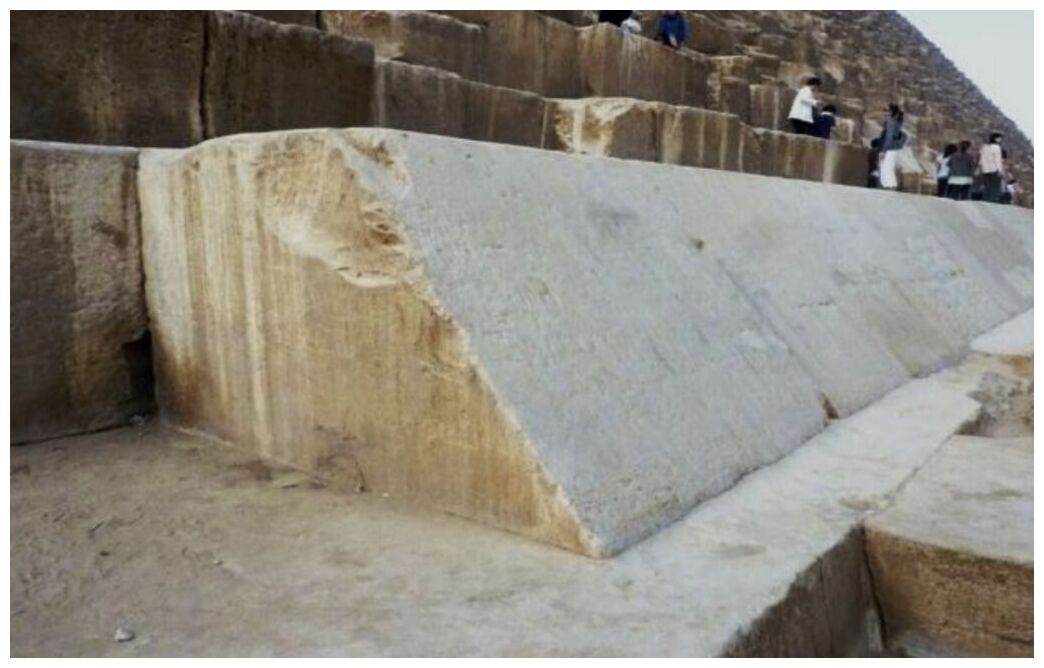
© Donini, A. (2026)Base of Akhet Khufu with the few remaining limestone blocks of the cladding.
The paper openly acknowledges numerous factors that could affect erosion rates over time. Climate conditions in ancient Egypt were likely wetter than today, potentially accelerating erosion in the distant past. Conversely, modern pollution and acid rain may have increased erosion rates in recent centuries, possibly skewing comparisons.
Human activity is another complicating factor. The base of the Great Pyramid now receives thousands of visitors daily, whereas foot traffic in antiquity would have been far lighter. Periodic burial of stone surfaces beneath sand — similar to what occurred at the Sphinx — may also have shielded parts of the pyramid from erosion for long intervals.
Because of these variables, Donini argues that individual measurement points may overestimate or underestimate age, but that averaging multiple points reduces error.
A Challenge to Established Chronology
The REM-based dates stand in sharp contrast to the conventional Egyptological timeline, which relies on historical records, inscriptions, tool marks, radiocarbon dating of associated organic material, and broader archaeological context to place Khufu's reign firmly in the Fourth Dynasty of the Old Kingdom.
Donini suggests that this discrepancy could mean the pyramid predates Khufu and was merely renovated or repurposed during his reign — a hypothesis long present in fringe literature but rejected by mainstream scholarship.
At present, the study has not undergone peer review in a major archaeological journal, and its conclusions remain outside academic consensus. Most archaeologists caution that erosion rates are highly variable and difficult to model linearly over tens of thousands of years.
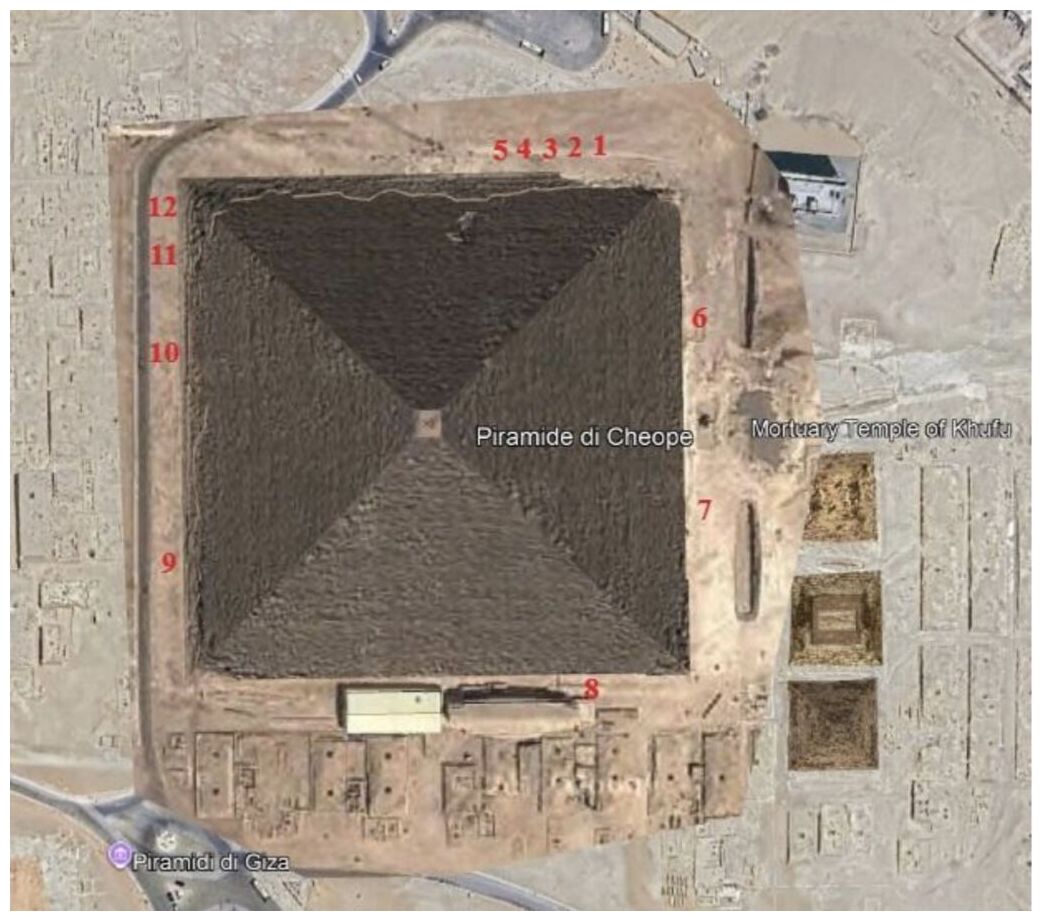
© Donini, A. (2026)Red markers indicate the points where relative erosion measurements were taken on the G1 Pyramid of Akhet Khufu (Google Earth image).
Whether REM will prove to be a useful complementary tool or a methodological dead end remains to be seen. What is certain is that the study underscores how even the most iconic monuments of the ancient world can still provoke fundamental questions.
For now, the Great Pyramid remains securely anchored in the Old Kingdom — yet studies like this ensure that debates about its origins are far from settled. As Donini himself notes, further measurements and independent verification will be essential before such extraordinary claims can be meaningfully assessed.
Reference:
Donini, A. (2026). Preliminary report on the absolute dating of the Khufu Pyramid using the Relative Erosion Method (REM). University of Bologna. DOI:10.5281/zenodo.18315238



Reader Comments
It's almost like they're gatekeeping Forcing interpretations to fit the preconceived notion that the old kingdom was an empire that built elaborate tombs for their deceased emperors.
Perhaps you are familiar with Fomenko. He interpreted hieroglyphic inscriptions on the Dendera temple as star formations, and thus dated the inscription to around 1450 AD.
Which, by sheer coincidence, is around the same time you get if you interpret the first chapters of the "book of revelation" as allegories to star formations. I mean those discursive description of persons, items and animals around the throne...
Not that I surely know he is true, but I'm quite confident the official story (history) is mostly a forgery.
Where is the interpretation of Revelation from? Is it also Fomenko?
Although his style is somewhat tedious and longwinded on occasion - a typical mathematician. But with a lot of interesting facts and theories.
We are in an age of disclosure, when we discover that many structures, buildings, civic water control, were created by other civilizations long before our known fake "history and archeology".
What does it mean? The source of all(God) or the more highly evolved beings use earth as an experiment in the development of consciousness and harmony. When the experiment is at a critical stage, like our current times, it all depends on whether humanity as a whole can wake up.
But there is no such thing as "academic consensus", it is totally meaningless. All that counts are facts. To quote Galileo :
The whole site from above reminds me of a circuit board.
Yeah, yeah, yeah. The usual idiotic denigration of previous people - they couldn't possibly be as smart as us. Well, they were. They were also much more patient, more hardy, more hard working, tougher and more determined than us, softened by centuries of laziness and so-called western 'civilisation..
A sufficiently advanced civilisation would have know of such an imminent catastrophe and been prepared, a bit like underground bunkers and frozen seed banks we now have. Hmm? Something that happens every 25,000 years or one half a rotation around the galaxy, which I believe to be a magnetic reversal.
Each end of the Milky way has a magnetic pole and the half way points are magnetically null points, hence our wandering poles now as we approach the halfway mark. The crust at the centre of the Atlantic repeatedly shows this magnetic reversal in the magna.
That the pyramid shows signs of being hit with destructive forces, e.g., the cracks in the granite lintels of the Kings chamber is indicative that possibly a massive tidal wave did hit it. That the Sphinx was buried is maybe another clue. And is there a second Sphinx waiting discovery? Don't "guardians" come in pairs?
The tubes that point up toward constellations or stars was, in my opinion, a way to observe from inside, the final moment when the earth had at last stabilised once more and it was safe to re-emerge. The elaborate locks and gates being activated from inside and subsequently dismantled and hauled away. The long sloping gallery used counter weights to actuate the locks.
Every pyramid since has been an attempt to replicate the advanced, machine built Khufu construction. There is much more I could add, but trying to keep it brief is the challenge.
Thunderbolts of the God's web site is a good place for exploring the 'myths' that populate our past and for insight into the previous cataclysms that have effected us.
That these studies indicate a 'mean' time of 25,000 years is significant.
Which is more likely:
1. They all made up the same story.
or
2. It happened and they wanted to remember it.
I'm of the same opinion as you, I believe it served as a refuge and historical record repository for future generations enlightenment to reoccurring global catastrophes.
Just take a second or two and think what the consequences of that would be if it happened. You don't even need to go as far as 'how' it could happen.
It looks like people here will believe practically anything, as long as it's not 'accepted'. (Not that 'everything' that is 'accepted' should be, but please - some rationality).
The version I have saved is only half the size of this updated version. It's a lot to get through.
I also have a document from the same site titled: "The Earth Turned Upside Down." But can't find a link in a cursory look.
Here's an edit from my saved copy of the intro; "Some have interpreted "the land was turned upside down" to signify social unrest. However, the literal meaning may be what was intended. And PAPYRUS 9:11 "The land is not light". & "PAPYRUS 2:8 "Forsooth, the land turns round like a potter's wheel." "I show thee the land upside down; it happened that which never had happened". Papyrus 1116b recto, publiched by Gardiner, Journal of Egyptian Archaeology. 1914 - may refer to the three days of darkness where the sun moved 540° with earth's rotation over the Pacific to keep Egypt in darkness for 3 X 12 hours. Thus the Egyptians would see all the stars of the night sky appear, disappear and reapper and thus feel like the potter's wheel. However earth would not have to shift to keep in the same season. Because the sun must have moved 180° west to set suddenly at noon March 1279 BC then move 540° east to stand still on the opposite side of earth to Egypt for three days of darkness. Even if earth flowed into a reverse orbit of the sun, that is the sun just moved 540°, the shift would be very small because this second last plague of Egypt happened about the time of the vernal equinox. "The sun - it has come to pass it riseth not. The winter is come (instead of) as summer, the months are reversed, and the hours disordered." Papyrus Anastasi IV The 120 day winter season ended March 20 Julian, then the summer season started. The Exodus was April 4 1279 BC. Thus this three days of darkness must have happened just as the summer season began. They would see the stars from the other half of heaven, the winter night sky. They would be cold in the darkness. They would see the zodiac pass in reverse with earth in a reverse orbit. After three days of darkness the hours would seem very disordered. Thus this is rather what seemed upside down. You can read the full account of the Papyrus Ipuwer at Admonitions of Ipuwer.
Isaiah 24:1 "Behold, the LORD maketh the earth empty, and maketh it waste, and turneth it upside down, and scattereth abroad the inhabitants thereof."
24:4 "The earth dries up and withers, the world languishes and fades away; heaven fades away together with the earth."
24:7 "the new wine dries up, the oil decays, all the merry makers groan."
Dead Sea Scrolls Bible. A climate change in the form of a drought is something to look for in a reverse orbit and we find it here. "heaven fades away" may refer to the stars of the night sky fading away in the sun as the sun moved 180°. Very likely this depicts a shift in earth's axis. If God moved the sun 180° around the earth, other than on the equiox, earth must twist on the ecliptic to keep in the same season. For many reasons they would think earth had "turned upside down". A shift in earth's axis to keep in the same winter or summer season would even more disorienting, the stars would not mark the seasons. Also with earth in a reverse orbit stars would progress in reverse, 1° west to east instead of east to west each night, as earth orbited the sun in reverse."
And just to throw a spanner in the works, there's this: [Link] Tychos, a concept that puts the earth at the centre of our system in a binary system with the sun that is very evident and typical throughout our galaxy while deftly explaining the retrograde motion of Venus and Mercury.
We know something was happening in space because the writer of Joshua states "the Lord hurled large stones from heaven on them as far as Azekah, and they died; there were more who died from the hailstones than those whom the sons of Israel killed with the sword."
The hailstones described here are not pieces of ice, they are rocks, meteorites.
[Link]
CIA has their redacted version available and my understanding they had a campaign to remove it from the public.
The Link above the full book not the 40 page CIA version.
The shape of the Grand Canyon is very Lichtenberg-ish, with it's branching. [Link]
Post flood, rain all the time.
Preflood, pyramid built.
Post flood, bad attempts to copy the first 3 pyramids.
Yawn
@boli:
you are again, wrong.
the great pyramid was actually built about 100 years from now, by a team of computer experts working in conjunction with their government leaders and a new and extremely formidable collection of a.i. assets and tools.
it's all about the money, control and total domination.
that is what is real.
have a great day.
ned,
out
Just take a second or two and think what the consequences of that would be if it happened. You don't even need to go as far as 'how' it could happen, but the forces involved would be astronomical (I walked into a trap there, eh. 😇 ).
It looks like people here will believe practically anything, as long as it's not 'accepted'. (Not that 'everything' that is 'accepted' should be, but please - some rationality).