
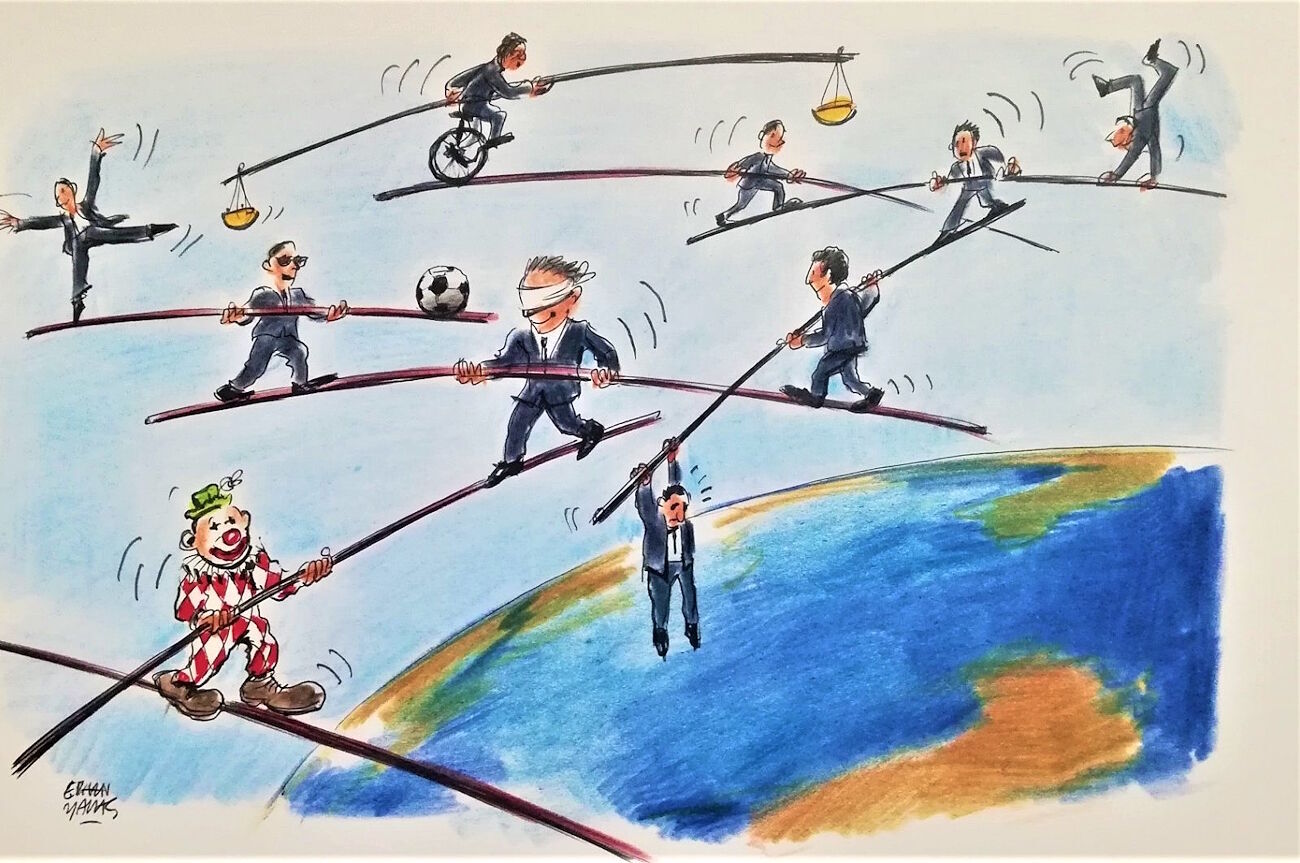
© Ehsan Ganji
From The End of History?, 1989:
"The twentieth century saw the developed world descend into a paroxysm of ideological violence, as liberalism contended first with the remnants of absolutism, then bolshevism and fascism, and finally an updated Marxism that threatened to lead to the ultimate apocalypse of nuclear war. But the century that began full of self-confidence in the ultimate triumph of Western liberal democracy seems at its close to be returning full circle to where it started: not to an "end of ideology" or a convergence between capitalism and socialism, as earlier predicted, but to an unabashed victory of economic and political liberalism.Liberalism today, liberalism tomorrow, liberalism forever! to paraphrase notorious Alabama segregationist George Wallace.
The triumph of the West, of the Western idea, is evident first of all in the total exhaustion of viable systematic alternatives to Western liberalism. In the past decade, there have been unmistakable changes in the intellectual climate of the world's two largest communist countries, and the beginnings of significant reform movements in both. But this phenomenon extends beyond high politics and it can be seen also in the ineluctable spread of consumerist Western culture in such diverse contexts as the peasants' markets and color television sets now omnipresent throughout China, the cooperative restaurants and clothing stores opened in the past year in Moscow, the Beethoven piped into Japanese department stores, and the rock music enjoyed alike in Prague, Rangoon, and Tehran.
What we may be witnessing is not just the end of the Cold War, or the passing of a particular period of postwar history, but the end of history as such: that is, the end point of mankind's ideological evolution and the universalization of Western liberal democracy as the final form of human government."
In chronological context, it was an understandable misapprehension that afflicted Fukuyama and clouded his crystal ball; in 1989, getting high on the liberal order supply was easy.
No serious ideological rivals to liberalism existed any longer at the international level; the liberal order, with the United States at the head, exercised global hegemony; everybody the world over wanted a pair of blue jeans and a Chevy Corvette and a hot blonde on their arm and all of the glorious excesses of liberal capitalism.
Alas, the utopian "End of History," ironically, didn't last long; by 2026, universalist liberalism has now reached what very much looks like the end of the line a mere three and a half decades since Fukuyama declared it the "final form of human government."
So-called "international law," which underpins the global liberal order, has always been heavier on the aspiration and lighter on the actual, existing in a nether-region between theory and practicality, applied and adhered to erratically and arbitrarily — with no consequences for those who violate it, provided they have the military power to thwart attempts at accountability.
Lots of examples abound, but a prime one, which has received relatively little attention with the heavy media focus on Latin America and the Middle East, was Xi Jinping announcing in his New Year's address that the forced "reunification" of Taiwan into the budding Sino Empire is "unstoppable" — a barely veiled flouting of the international powers that would threaten to oppose such a move militarily.
(I predict China will pull the trigger on the kinetic invasion before the end of the year if it can't submit Taiwan through economic or political pressure under threat of military action — the latter approach it would prefer for reasons of optics and because Taiwan is ethnically Chinese, likely tempering the bloodlust as the Chinese view the Taiwanese as their kin.)
While China has long signaled its intent to reclaim Taiwan, which it lost in the middle of the last century as the last stronghold of the nationalists fighting the CCP, Xi would not have offered such direct talk just a year ago. Yet, inch by inch, as the liberal order loses its grip on geopolitics, with it goes the diplomatic imperative to couch rhetoric in terms in keeping with international law.
In the same vein, Trump has more or less openly admitted that the political, economic and, military pressure applied to Venezuela, including the capture of its president, is about regional hegemony and natural resources: "We are going to have our very large United States oil companies go in, spend billions of dollars, fix the badly broken oil infrastructure and start making money for the country," he said.
The Western hemisphere "belongs to us," the mantra has gone of late. ("Us" meaning, ostensibly, the United States and the citizens thereof, although I don't feel it belongs to me as an American citizen quite as much as it will soon belong to Blackrock, Palantir, and Chevron.)
In a way, the Venezuela rhetoric is much more honest than the obviously insincere 2003-era talk of delivering "democracy" to Iraq, Afghanistan, et al. Those countries were never going to adopt "democracy" even if the United States government insisted on it — which, despite the nonstop lip service, it didn't anyway because it didn't care much for constitutional republicanism at home, let alone abroad. Nonetheless, liberal etiquette required the lie to maintain the façade that the world runs on democratic values.
So what will replace international liberalism?
Something, probably, on the order of multipolar realism — again, much less idealistic yet much more honest in a world that hitherto has functioned on pretty lies.
Via Independent Institute (emphasis added):
"Realism is one of the prominent international relations theories for explaining the behavior of states. The core essence of realism is an attempt to explain "world politics as they really are, rather than describe how they ought to be," presenting the world as a state of anarchy where nations, acting as unitary rational actors, compete with each other to maximize their power, "the only — variable of interest."
Realism is often juxtaposed with liberalism, the belief that the "national characteristics of individual States matter for their international relations" and that it is possible for different types of regimes to operate in different ways, such as Kant's theory of democratic peace. Liberal "institutionalism," the ideology on which diplomats in the West are brought up, is the belief that "international institutions facilitate cooperation and peace among countries." The difference between these schools of thought can be understood through their perspectives on international institutions.
While liberals assume that organizations like the United Nations are a genuine platform for international cooperation, realists assume that these institutions do very little to prevent states from pursuing their interests and can very often serve as a vector through which state interests are pursued."



Reader Comments
The US is about to rebuild it's own "Taiwan", meaning silicon processing and chip manufacturing facilities, on its own turf. For reasons not only related to China. This is the only thing of strategic importance of Taiwan, besides of being a nuisance to the Chinese mainland. But since the US effectively cannot project power 100 miles from the Chinese coast lines, they will move on to more promising endeavours. Like South America and the Arctic.
The idea of having critical components of your defense industry manufactured by your adversary is beyond stupid. That must have been intentional.
.
You can read his story in Derrick Broze new article: EXCLUSIVE: Former United Nations Employee Warns of the Dangers of the UN Digital ID Program [Link]
For $1.50 you can subscribe to Alex's substack per year. I find that a great value for a man whose heart is in the right place!
"...Trump left Davos without meeting Carney. When asked about the Canadian Prime Minister’s speech, Trump responded: “Canada lives because of the United States.” He called Canada a “freeloader” and maintained his “51st state” rhetoric. The exchange demonstrated that rhetorical resistance and operational accommodation can coexist. Carney criticizes in public. Carney negotiates in private. The asymmetry is not hypocrisy. It is the logic of middle-power survival in an era when middle powers have discovered they are not as powerful as they believed..." [Link]
What is interesting to me is that Putin stated he would give $1 billion from the EU "frozen assets" to this Board of Peace. Why?
Putin offers $1bn to Trump's 'peace board'
The contribution would come from the Russian assets frozen in the US Moscow is ready to contribute to US President Donald Trump's 'Board of Peace' initiative, President Vladimir Putin told the...It's rather ingenious. Putin wants a place at the table. If the Board of Peace fails, he & Russia have nothing to lose.
.
"... Russia received its invitation on January 20, 2026. The Kremlin’s response was extraordinary and deserves close attention because it reveals a model that other sanctioned nations may follow. Putin proposed paying the $1 billion membership fee using frozen Russian assets held in the United States since the Biden administration imposed sanctions. Russian state media reported Thursday that “Putin was ready to send $1bn to the Board of Peace to support the Palestinian people.”
Trump’s reaction: “I’m fine with that.”
The implications cascade through geopolitical analysis like dominoes falling. If accepted, Russia would convert sanctions into membership fees, transforming financial punishment into institutional access. The assets frozen to constrain Russian behavior would fund Russian participation in a body with authority over “areas affected or threatened by conflict” worldwide, including Ukraine. The precedent would demonstrate that sanctions are not permanent and that sanctioned assets can become leverage for the sanctioned party to purchase institutional rehabilitation. Every sanctioned nation on Earth is watching this negotiation..."
'Goebbels Said in 1945 What Those Who Still Oppose the Globalist Takeover Can Do' by Ray Horvath, "The Source" Jan 22, 2026 [Link]