
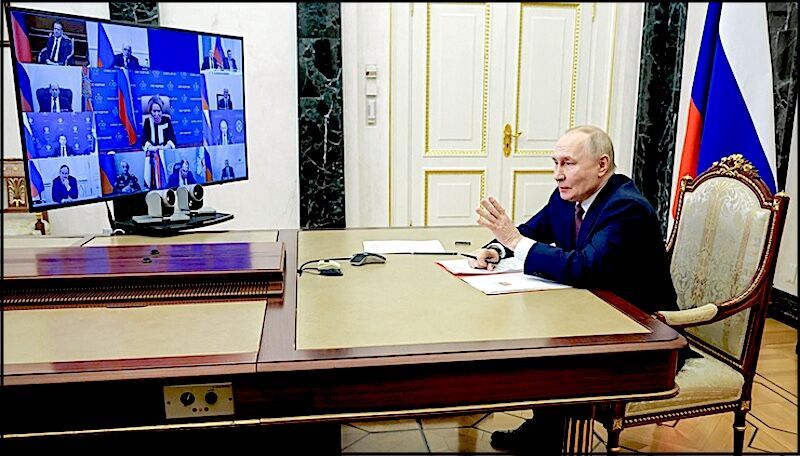
© Vyacheslav Prokofyev/SputnikRussian President Vladimir Putin • Russian Security Council meeting • Moscow, Russia • January 21, 2026
Moscow is ready to contribute to US President Donald Trump's 'Board of Peace' initiative, President Vladimir Putin told the Russian Security Council on Wednesday. He suggested donating $1 billion to the body out of the Russian assets frozen in the US to support the recovery of the Palestinian enclave.
The initiative envisages an international council to manage funding, security, and political coordination in Gaza during a transitional period following a ceasefire between Israel and Hamas. The body will work alongside a Palestinian technocratic administration. Trump came up with the idea after the US brokered the truce last year.
Russia could provide $1 billion for the organization "right now, even before we decide whether we'll take part... in the work of the Board of Peace," the Russian president said, citing Moscow's "special relations with the people of Palestine."
The sum could be taken "from the Russian assets frozen by the previous [US] administration," he added. Moscow "has always supported and continues to support any efforts aimed at strengthening international stability," Putin stated.
Putin thanked Trump for the invitation but said that Moscow would need more time to study the offer and consult its strategic partners.
Trump has invited dozens of nations into the board. Hungary, Morocco, Vietnam, Kazakhstan, and Argentina have already accepted the offer. Those invited to the board can reportedly join for free for three years. A payment of $1 billion - a sum equivalent to the donation offered by Putin - is allegedly required for a permanent seat.
On Tuesday, China also confirmed it had been invited to join but did not specify if it would participate.
According to Washington, the body's mandate could later be expanded to address other conflicts around the world.
Roughly $5 billion out of a total of around the $300 billion in frozen Russian assets are located in the US, according to AP. On Wednesday, Putin said that the remainder of the sum immobilized in the US could be spent on economic recovery of the areas damaged during the fighting once Moscow and Kiev strike a peace deal.


Reader Comments
Right Putin?
[Link]
Tis a goddamn good idea - get some aid to those in Gaza - they OWN the place first and foremost.
Put it in its place for Christ's sake.
ha, ha🦬....
So no rootin needed - I'm just a dirt farmer minding my own beeswax!
Well typed I say - good stuff!
Perhaps there is a 3rd player in the scenario - you ever give heed to that - it is a possibility.
And then even if the tide comes rolling in the 3rd possibility opens many more possibilities - you know honey?
So for Christ's sake you call others out to be pushers of this narrative or that, but seems to me - you be doing what you call out?
That is unsavory.
~
Ken
China, on the other hand, is printing trillions of yuans to buy up the silver, gold, and copper markets, jacking up the prices and leaving US banks with 4.4 billion in shorts they can't afford to settle.
What's that look like to you, "honey?"
So China is buying it all up - good on them!
And really - we all ought know by now
Russia is so smart!
BK, Poem of the day for darling - 12226 1942 !
"...Compare this structure to the United Nations Security Council, where veto power is distributed among five permanent members representing the victorious powers of 1945. The distribution was intentional. The founders understood that concentrated authority invites abuse, that checks require balances, that power must constrain power. The Board of Peace concentrates that power in one individual who holds it regardless of electoral outcomes in his home country. One analyst captured the implications precisely: “You are, by its very charter, accepting the overlordship of a single person who will decide as he pleases.”
The membership structure reinforces this hierarchy with brutal clarity. Countries that contribute $1 billion within the first year receive permanent seats. Those that do not pay receive three-year renewable terms subject to Chairman approval. All members receive one vote, but all decisions are subject to Chairman veto. Bloomberg reported that the draft “appears to suggest Trump himself would control the money,” a structure multiple countries found “unacceptable.” The finding reveals not a flaw in the design but its purpose. The unacceptability is the point. It filters for nations willing to accept the terms, and those terms are unconditional submission to a bilateral relationship with Washington embodied in a single individual.
This is not the architecture of multilateral cooperation. This is the architecture of franchise membership in an American-led security club, and the franchise fee is $1 billion plus the acknowledgment of a single individual’s permanent authority over global conflict resolution. The franchise model explains why some nations signed immediately and others hesitated. It is not about the money. Nations routinely spend billions on defense, on infrastructure, on prestige projects. It is about what the money purchases: subordination formalized as membership, dependency documented in charter language, alignment measured in dollars and recorded for history..."
'Trump's Board of Peace: One Signature, One Billion Dollars, One Man With Absolute Veto for Life.' The Day the Post-1945 Order Died in Davos. by Shanaka Anslem Perera Jan 22, 2026 [Link]
.
"... The Waiting Game: Russia, China, India, and the Vatican
Four cases illuminate the strategic calculations playing out in capitals worldwide, and each reveals a different logic of engagement with the new architecture. Understanding these logics is essential for anticipating how the membership map will evolve over the coming quarters.
Russia received its invitation on January 20, 2026. The Kremlin’s response was extraordinary and deserves close attention because it reveals a model that other sanctioned nations may follow. Putin proposed paying the $1 billion membership fee using frozen Russian assets held in the United States since the Biden administration imposed sanctions. Russian state media reported Thursday that “Putin was ready to send $1bn to the Board of Peace to support the Palestinian people.”
Trump’s reaction: “I’m fine with that.”
The implications cascade through geopolitical analysis like dominoes falling. If accepted, Russia would convert sanctions into membership fees, transforming financial punishment into institutional access. The assets frozen to constrain Russian behavior would fund Russian participation in a body with authority over “areas affected or threatened by conflict” worldwide, including Ukraine. The precedent would demonstrate that sanctions are not permanent and that sanctioned assets can become leverage for the sanctioned party to purchase institutional rehabilitation. Every sanctioned nation on Earth is watching this negotiation.
Steve Witkoff, Trump’s Senior Envoy, traveled to Moscow on Thursday for discussions. “The Russians are asking for that meeting,” Witkoff told CNBC. The same Witkoff met with Zelenskyy hours earlier at Davos. The shuttle diplomacy reveals the new architecture’s operating method: multiple leverage exercises running in parallel, each informing the other. Russia’s Board membership would not resolve Ukraine. But it would create a framework within which resolution might be negotiated, on terms that Russia could not achieve through existing channels where Russia is isolated and sanctioned and excluded.
China’s Foreign Ministry confirmed receiving the invitation but made no commitment. The response was to reaffirm commitment to “firmly safeguard the international system with the United Nations at its core.” This is diplomatic language for rejection without the diplomatic costs of explicit rejection. Vice Premier He Lifeng’s Davos speech positioned Beijing as defender of globalization: “The world must not return to the law of the jungle.” He added: “Tariff wars have no winners.”
China’s calculation is different from Russia’s. Beijing benefits from American institutional disruption without participating in it. If the Board succeeds, China can join later from a position of strength, having allowed others to test the architecture and identify its weaknesses. If it fails, China has positioned itself as defender of multilateralism and can claim vindication while the American-led alternative collapses. Either outcome advances Chinese interests. This is not indecision. It is strategic patience executed with precision. China is the world’s largest beneficiary of the existing trade order and has no incentive to validate an alternative that concentrates authority in American hands. But Beijing also has no incentive to lead opposition that would make China the primary target of the coercion architecture the Board enables. Strategic patience is the optimal response, and strategic patience is what Beijing is executing.
India’s Prime Minister Modi received an invitation but did not attend. Former diplomats warned publicly that the Board’s expanded mandate could allow external intervention in Kashmir. For India, the calculation involves whether American protection is worth the risk of American interference in territorial disputes that have defined Indian sovereignty since partition. The answer is not yet clear to New Delhi. India has positioned itself as a swing power courted by both Washington and Beijing. Board membership would end that positioning by aligning India explicitly with the American bilateral framework. The benefits are unclear. The costs are tangible. The waiting continues.
Cardinal Pietro Parolin confirmed Pope Leo XIV received an invitation and is “examining” it. The theological implications are profound. The Catholic Church joining a Trump-chaired body would represent an unprecedented alignment between religious and secular American power. Whether the Vatican would pay $1 billion remains unresolved. Parolin suggested the Holy See is “not even in a position to do that,” though the Vatican’s actual financial capacity is deliberately opaque. The examination continues, and in Rome, examinations can last centuries. But the examination itself is significant. The Vatican does not examine proposals it will reflexively reject. The examination suggests consideration, and consideration suggests possibility..."
The USadmin hasn't brokered anything, it's business as usual. Even during the USadmin brokered ceasefire the isreali apartheid regime just couldn't help itself and continued the killing of innocent people and their families. The Trumpster said nothing.
What the Trumpster now wants is for the international community to pay for US/nato/isreali destruction of an entire race of people and the theft of their land. With killers like toady blaaar aboard this crusade to rebuild Palestine in isreal's image, it doesn't look good for the victims of this holocaust.