
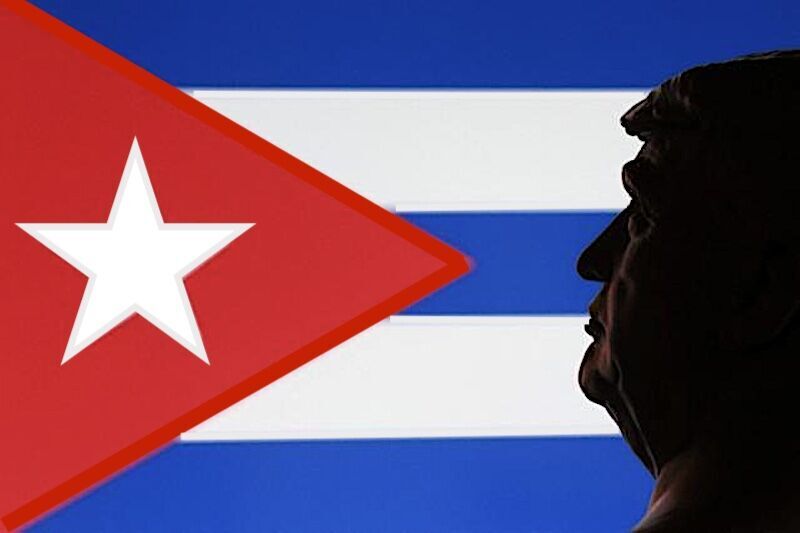
© UnknownUS President Donald Trump • Cuban Flag
After the U.S. military captured Venezuelan leader Nicolás Maduro on Jan. 3, interim Venezuelan leader Delcy Rodríguez has redirected oil deliveries to the United States.
Cutting off Venezuelan oil supply to Cuba, which has historically relied on support from Caracas, would apply significant pressure to the Caribbean country, which has been under communist control since Fidel Castro's 1959 revolution.
Referring to the Cuban security forces who were killed during the operation to capture Maduro and bring him to the United States to face a federal indictment, Trump wrote on social media:
"Cuba lived, for many years, on large amounts of OIL and MONEY from Venezuela. In return, Cuba provided 'Security Services' for the last two Venezuelan dictators, BUT NOT ANYMORE!Miguel Díaz-Canel Bermúdez, leader of the Cuban regime, responded to Trump in a series of social media posts on Jan. 10, saying:
"Venezuela no longer needs protection from Cuban security forces now that it has the United States, 'the most powerful military in the world' to protect its officials."
"THERE WILL BE NO MORE OIL OR MONEY GOING TO CUBA — ZERO! I strongly suggest they make a deal, BEFORE IT IS TOO LATE."
"Cuba is ready to defend the Homeland to the last drop of blood. Those who blame the [communist] Revolution for the severe economic shortages we suffer should hold their tongues in shame."As Jacob Burg reports for The Epoch Times, assessments by the U.S. Intelligence Community paint a grim picture inside the communist nation, with Cuba's tourism and agriculture industries significantly affected by routine blackouts, trade sanctions, and a host of other problems.
The island's tourism industry has seen a decline since the COVID-19 pandemic, and its economy has retracted alongside Venezuela's over the past decade. U.S. embargos have also added to Cuba's domestic concerns.
Between January 2025 and November 2025, Caracas sent an average of 27,000 barrels per day to Cuba, accounting for roughly 50 percent of the island's oil deficit, or a quarter of Cuba's total energy demand, according to the Venezuelan state oil company PDVSA's shipping data and reports.
Cuba also receives oil shipments from Russia, which will likely become one of the island's sole remaining suppliers if Washington's oil embargo continues.
Mexico has also supplied Cuba with oil, although Mexican President Claudia Sheinbaum said on Jan. 7 that recent oil exports to the island are not higher than what they have been historically.
Pressure on Cuba increased after the United States seized two additional Venezuelan-linked oil tankers on Jan. 7.
Trump recently told reporters on Air Force One that he thinks:
"Cuba looks like it is ready to fall. I don't know if they're going to hold out, but Cuba now has no income. They got all their income from Venezuela, from the Venezuelan oil."Richard Feinberg, a professor emeritus at the University of California-San Diego, who has served in several high-ranking U.S. national security roles, told Reuters:
"Cuba's economic conditions are certainly very bad. When a population is really hungry, what it does is, your day-to-day is just about survival. You don't think about politics, all you think about is putting bread on the table for your family. On the other hand, people can become so desperate that they lose their fear, and they take to the streets."






Comment: Trump scare tactics are loud and clear. Cuba so far has few options. Desperate times, desperate measures...