
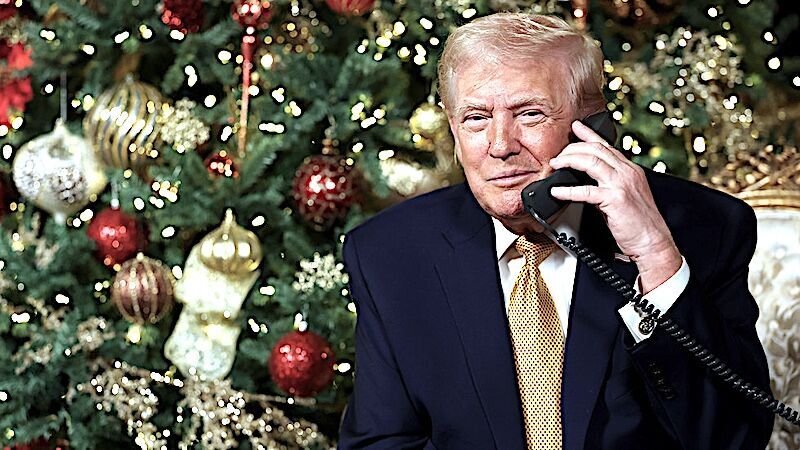
© Tasos Katopodis/Getty ImagesUS President Donald Trump
If there were a competition for "Breaking the Mould of the Year," the United States would be the runaway winner in 2025. At the start of the year, few expected Donald Trump's return to the White House to trigger such sharp shifts. Yet one of the biggest surprises has been Washington's change of course on Ukraine.
The US has moved from being Kiev's closest political patron to a calculating actor focused squarely on its own interests. The rhetoric of Russia's "unconditional defeat" has been discarded in favour of negotiations and compromise. If Ukraine has become a loss-making asset in America's geopolitical portfolio, Trump has signalled, then the loss must be recognised.
This has produced a series of gestures that shocked many Western observers: the public humiliation of the Ukrainian leader in Washington, demands that Kiev pay for military aid, a slowdown in sanctions policy, and the much-discussed summit in Alaska. The conflict has not been resolved, but the door to diplomacy has been left ajar. Moscow supports negotiations, but does not intend to retreat from its positions. The Russian army is advancing, and time, from Moscow's point of view, works in its favour.
Another dramatic break with past practice has been Trump's decision to launch a trade war against more than seventy countries. Only China responded with serious counter-measures. Beijing imposed retaliatory tariffs and strengthened its negotiating hand by introducing export controls on rare-earth metals vital to the US economy, while at the same time seeking a negotiated de-escalation.
India also refused to bend. US tariffs on its purchases of Russian oil barely affected Delhi's stance. The same is broadly true of Brazil. In several cases Washington applied tariffs for openly political reasons, even where the trade balance was to its advantage. Trade measures increasingly took on the character of sanctions; occasionally they were accompanied by military strikes, although the White House avoided sliding into a full-scale confrontation with Iran.
Perhaps the most unexpected development has been the deepening estrangement between the US and its traditional allies. Trump's revived talk of buying Greenland, part of Denmark, was symbolic in that respect. So too was Vice-President JD Vance's criticism of European democracy, suggesting that "Trumpism" in foreign policy is no longer confined to Trump himself. The new US National Security Strategy urges Western Europe to return to its civilisational roots, warns of the risks of war with Russia, and casts Washington less as a belligerent and more as a mediator. Even the EU has found itself targeted by American tariffs.
For Brussels, this turn was disorienting. While Western Europe was still marching toward confrontation with Russia, its key ally abruptly stepped aside. In response, EU institutions clung to the old paradigm of "war to the bitter end" and unconditional support for Kiev. Brussels introduced three new sanctions packages against Moscow, but they had no discernible impact on Russia's strategic course.
Of course, the contradictions inside the Western bloc should not be exaggerated. Binding military and political commitments remain in place, and previous eras have also seen friction. But the current rupture feels deeper than anything since the 1930s. The shifts underway clearly extend beyond Trump's personality and the short-term political cycle, and they may yet reshape the broader architecture of Euro-Atlantic relations.




For the Ukraine, the power player was NATO. NATO was using the Ukraine as the tip of its spear to attack and destabilize Russia, and then break up Russia into pieces to give to various corporate power players like Blackrock. However, NATO depends on the flow of "funding" and "military" and "intelligence" from the USA.
The Trump team has promoted the peace plan that recognizes that Ukraine territories seek to be part of Russia. The EU power structure (globalist) rejects that because it blocks their goal of breaking up Russia into smaller pieces.
What has happened? The Trump team has made visible that the Ukraine and NATO are not interested in peace. This means the Trump team can end funding, military aid and intelligence to NATO. The world public see NATO as a destructive force, and the EU censoring its people, and blocking peace. It moves countries away from the globalist power structure.
In my view, that is pragmatism.