
© Max Bender/Unsplash.com
- Are you deaf, or do you have serious difficulty hearing?
- Are you blind, or do you have serious difficulty seeing even when wearing glasses?
- Because of a physical, mental, or emotional condition, do you have serious difficulty concentrating, remembering, or making decisions?
- Do you have serious difficulty walking or climbing stairs?
- Do you have difficulty dressing or bathing?
- Because of a physical, mental, or emotional condition, do you have difficulty doing errands alone, such as visiting a doctor's office or shopping?
But let's say you run the same exact survey for 20 years. Even with inaccuracies in reporting, even with a tendency to exaggerate, the trend line would still be highly significant if only because the survey methods remain the same.
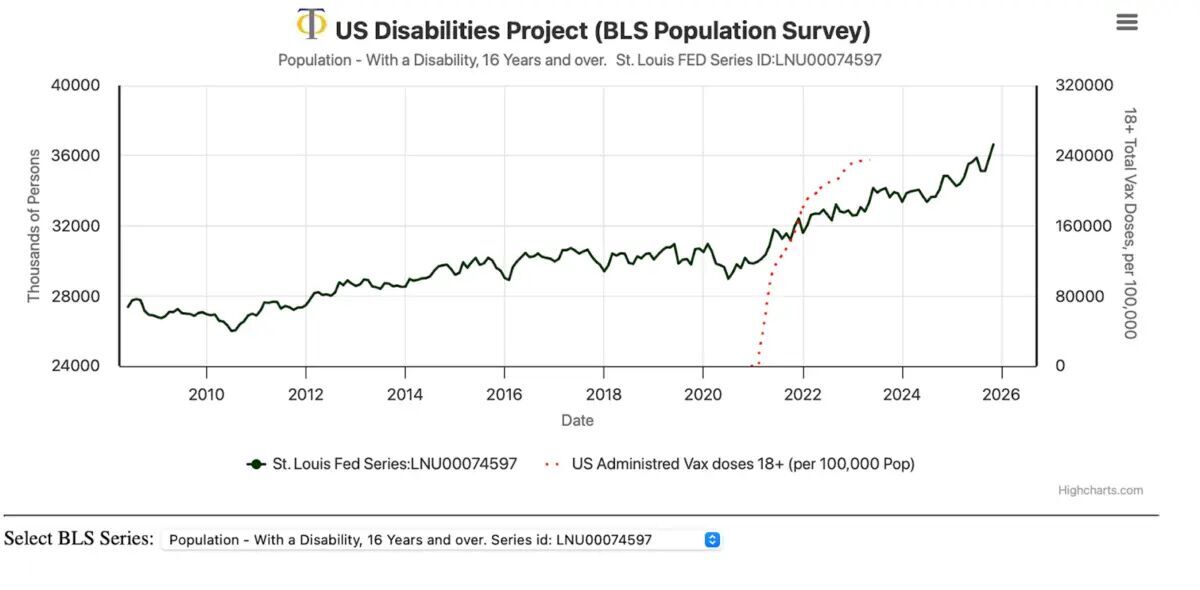
Here is where the news gets grim. The latest survey reports that 36.63 million Americans have a disability. That's an increase of 7 million over the summer of 2020, at the time when we were supposed to be in the midst of a debilitating pandemic. The disabilities began to soar only after the inoculation was pushed and sometimes forced on the public. The upward trend began in February 2021 and has not stopped.
Edward Dowd, investment analyst and author of "Cause Unknown: The Epidemic of Sudden Deaths in 2021 & 2022," comments: "The November US BLS Disability data has been updated and it's grim ... new highs across the board. Disaster."
Other factors aside from the vaccine gone wrong might be substance abuse, depression, lack of exercise, poor diet, and the chronic disease problem, generally speaking. The ill health, both physical and mental, in the United States is breaking all records. That is affecting reporting on disability and also the way in which labor markets are handling disability.
In the backdrop of this is a long-broken system for dealing with the disabled. People injured by the shots, for example, have essentially no options for redress because the makers lobbied for and obtained a liability shield in 1986. Even with documented and obvious harms, the injured have nowhere to go. One hopes that this unjust system will be revisited completely at some point.
My very first assignment in journalism school was to track the progress of the Americans with Disabilities Act in 1990. I worked with a top lobbyist on the bill. The architects of the legislation were very well-intentioned and wanted some federal attention on their plight. The bill banned discrimination, allocated vast new sums for benefits, and mandated all reasonable accommodation for the disabled, including physical upgrades of property.
As I looked at the legislation — and having many disabled friends myself — it became obvious to me that the legislation would certainly make a bad situation worse. It would turn a culture that was helpful toward the disabled into one that feared the liability associated with having them in the workforce. The mandates for physical improvements would be hard on business and breed resentment, and the jump in benefits would create a moral hazard that would increase the disabled population.
I explained all of this to the promoters of the legislation and begged them to back off, for the sake of the disabled population. They were aghast at my opinion and essentially told me to shut up. My report was eventually published (I wish I could find it) and warned of a coming disaster. That disaster did, in fact, come as unemployment among the disabled population grew for the rest of the decade. Businesses worried about liabilities and discrimination complaints worked on the margin to exclude these people from the workforce, and people began to resent rather than feel empathy toward the disabled population. None of this surprised me.
Sometimes the phrase "good intentions" gets thrown around too much. Not every government welfare program is rooted in good intentions. In the case of disability legislation, there is no question of the desire on the part of its promoters to advance the well-being of those with genuine issues and remove barriers. Sadly, the Americans with Disabilities Act did exactly the opposite, which was easily predicted by anyone with a modicum of economic understanding.
Since those days, the problem has gotten worse. It is ever harder for the disabled population to be hired. Consider someone with severe autism, for example. The stipulations in the law make it difficult for them to be hired, and even working as volunteers can be looked at unfavorably by labor regulators. It is just much easier to exclude them from the workforce, thus avoiding liability risks and garnering extra attention from the law enforcers.
Now we see the problem getting much worse. With 36.63 million Americans reporting a debilitating disability, we see grave strains on health insurance and institutions that care for such people. With one in 31 children aged 8 or younger identified as autistic, the problem is set to get much worse in the years ahead. Many of these people require full-time care, depending fundamentally on family. But when the family is not there, what happens? The institutions have to pick up the bill.
We have here the makings of a medical, social, and economic problem that no president or legislature is in a position to solve. It's one that will vex national well-being for many decades during our lifetimes. Society aspires to care for such people and treat them with dignity, but the regulations and laws have made that very difficult.
There is truth to the observation that societies should be judged by how they treat those least fortunate. The United States has generally done well, but will it in the decades ahead?




Reader Comments
But - they been so comfortable - living easy - above and beyond the troubles of others.....they just can't bring themselves to realize - tis a big world out there - and the suffering of others is not independent of YOU!
In general many of the members of said generation are most complicit - but they never will admit it now will they - seems they basically are nothing but spoiled rotten brats - that is what we think or I do in the generation followed.....you know - to generalize and such!
~
So no wonder so many baby boomers are becoming disabled.
And know wonder - the "skip" generation is FULL of spoiled rotten brats even worse!
Entitled they are.....pathetic really...sad..
Just to generalize and such....
~
BK, 122225 1814
For example, why is obesity on the rise?
What is the effect of puberty blockers?
We live in an endless social media environment, people glued to their cell phones.
Pre-teens and teenagers are raised on video gaming, leading to a virtual life attached to ephemeral values. Tik-tok is the rage for short-term memory.
What is the effect of fast and processed foods?
What is the effect of pesticides and herbicides?
And of course, "All vaccines are safe and effective", right?
These people then get "mis"diagnosed and usually take even more harmful pharmaceuticals. In the medical paradigm they blame their own bodies for this, which also keeps them from overcoming their disabilities - what would happen if these people didn't feel like they're trapped in their faulty bodies, but had trust in their bodies ability to heal and overcome any traumatic experience?
The root issue is people trust a system that is selling them the idea that their body is wrong or diseased. Why does the system perpetuate this belief? To sell them (fake) cures.
Perhaps the US should look at their overabundance of over processed foods and polluted city water supplies.
There were brave people, who stood firm and said "Fuck You and your experimental fluid injections".
I guess we are the "sometimes" part.