
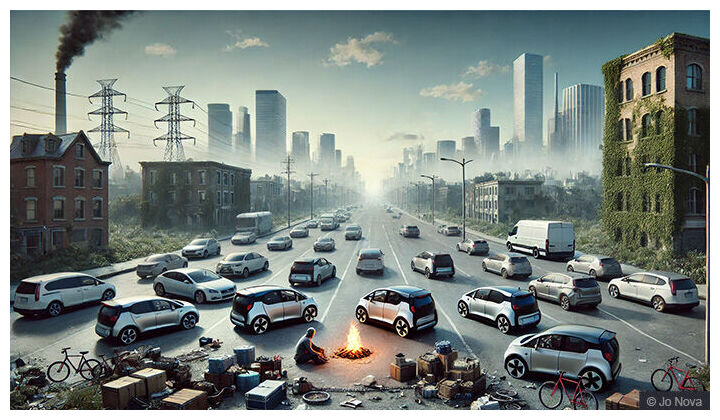
© joannenova.com.au
The pagan quest to do rain-dances with electrical generators has become an existential threat. If AI is the next revolution, then the lands of green fantasia have already lost the race. There's a global contest to create the first world dominating AI before anyone else does. This is not an exponential curve we can afford to lose. The first nation to crack adversaries encryption codes, hack their defenses, design the killer bioweapon, or build a self replicating drone army — potentially takes it all.
The contest is, above all, an energy competition. Ponder that gram for gram, each day the human brain uses ten times the energy than muscle does, yet despite that stupendous cost, it conquered the world.
For twenty years some rich countries became mired in corruption and virtuous beauty contests. They toyed with fripperies like imaginary weather-control a century hence, while their adversaries built the engines of real power.
Europe's Green Energy Rush Slashed Emissions — and Crippled the EconomyThe WSJ authors have plenty of stories of crippled business — Ireland had to stop new data centres opening for at least three years, because existing data centres consumed a fifth of the nations electricity supply. One German data centre operator wanted to expand but was told he'd have to wait ten years for the electricity supply to grow.
By Tom Fairless and Max Colchester, The Wall Street Journal
Europe has succeeded in slashing carbon emissions more than any other region — by 30% from 2005 levels, compared with a 17% drop for the U.S. But along the way, the rush to renewables has helped drive up electricity prices in much of the continent.
Germany now has the highest domestic electricity prices in the developed world, while the U.K. has the highest industrial electricity rates, according to a basket of 28 major economies analyzed by the International Energy Agency. Italy isn't far behind. Average electricity prices for heavy industries in the European Union remain roughly twice those in the U.S. and 50% above China. Energy prices have also grown more volatile as the share of renewables increased.
It is crippling industry and hobbling Europe's ability to attract key economic drivers like artificial intelligence, which requires cheap and abundant electricity.© WSJ
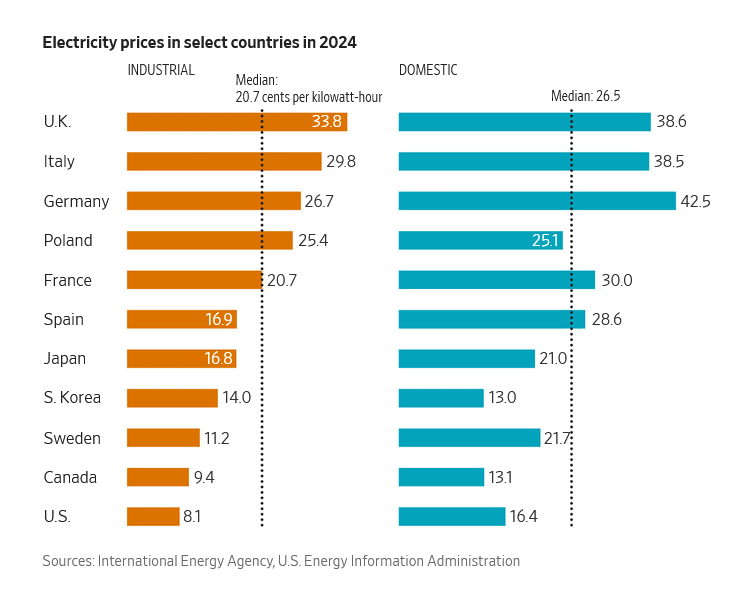
Polls show half of British consumers are planning to ration energy use this winter as they struggle with wholesale electricity costs that are 80% higher than the U.S.Suddenly the consensus has flipped
This is a big shift. After twenty years of "clean energy" being cheaper , now they say that while the high energy prices aren't completely the fault of the green transition... (did you see what they did there?) "a good chunk of the increase is thanks to the shift to renewables, say business executives and some economists." So the generalized, unnamed mass of experts are now on the same side as the skeptics?
It's reasonably big picture
The WSJ explains all the things that skeptics have been saying for years. That the wind and sun might be "free" but collecting, distributing and storing the free energy turned out to be horribly expensive.
Only in Europe and the UK (and in Australia) did nations foolishly cut off (or blow up) the old reliable energy system before they had a working substitute in place. In past energy transitions people kept using the old fuel until the new one was widely available and cheaper. This fake transition was driven by ideology, not the free market:
"Very clearly the cost of the transition has never been admitted or recognized," said Gordon Hughes, a professor at the University of Edinburgh and a former adviser on energy to the World Bank. "There is a massive dishonesty involved."Finally — A professor said something useful!
Even the Greens themselves want oil and gas now
The tide is receding so fast on green energy that even former fans are calling for oil and gas to step up (probably because they know a widespread blackout or horror show in the bills would be bad for renewable subsidy farmers):
Some green entrepreneurs in the U.K. have started pushing politicians to ensure the oil-and-gas industry can help ease the transition. Greg Jackson, founder of Octopus Energy, which has championed wind farms, called on the U.K. to renew offshore oil-and-gas exploration in the North Sea, so that it doesn't have to ship gas in from across the globe. Dale Vince, founder of Ecotricity and a climate activist who used to fund the protest group Just Stop Oil, wants lower taxes for existing oil-and-gas projects in the North Sea.It's just one feature article in one newspaper, but word will spread.
One of the first comments:
David Eyke: Much of the information in this article has been available for years and has been frequently posted here by Commentators.h/t to Helen Dyer who says "Energy poverty in this country, so rich in coal, gas, uranium and thorium, is a crime against our people. "
The Media has ignored the facts and refused to report them. I'm shocked WSJ has broken ranks with its Leftist herd.



Reader Comments
Has WSJ turned a corner or are the owners trying to end the hemorrhaging of viewers?
The initial assumption was the globalist cabal could contain nationalism (Trump) in the US, reduce population numbers worldwide with the plandemic injections ( including Russia and China), and are thus are in a position to make the "Second" and "Third World" pay for their splendid green phantasy at home.
It didn't work out. They understimated both the internal resistence from Western nationalist factions (Trump), and the economic and military strength of civilisational states like Russia and China. Now they literally must fight for their personal survival.
What data the NWO does present via the UN keeps changing and has no basis in scientific fact. The only thing backing their narrative is money from scammers who want to keep this gravy train running a little longer.
Me thinks that Mother Nature is about to ruin their narrative even further.