

© semimedia.cc
China's response was elegant, brutal, and entirely predictable: export ban. Nexperia's Chinese subsidiaries and subcontractors can no longer export chips manufactured in China. The Dutch seized the corporate shell. China kept the actual production. And now the entire European automotive industry — which depends on Nexperia's chips — gets to experience what leverage actually looks like.
Minister for Economic Affairs Vincent Karremans is desperately trying to negotiate with China about lifting the ban. The same ban his government's hostile takeover triggered. They're scrambling to salvage the situation without admitting they fundamentally misunderstood how global manufacturing works in 2025.
Too late for that.
But here's where it gets really instructive.
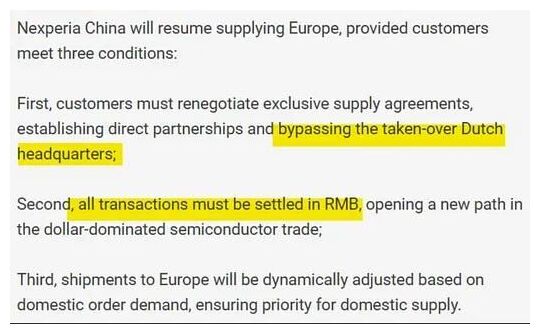
China didn't just retaliate — they restructured the relationship entirely. According to new reports, if Nexperia wants to resume supplying Europe, three conditions apply: First, customers must renegotiate exclusive supply agreements, bypassing the seized Dutch headquarters entirely and establishing direct partnerships with China. Second, all transactions must be settled in RMB, opening a new path in the dollar-dominated semiconductor trade. Third, shipments to Europe will be dynamically adjusted based on domestic order demand, ensuring priority for domestic supply.
© Gold and Geopolitics
This isn't just retaliation. This is weaponized supply chains advancing RMB internationalization while teaching Europe exactly where they sit in the global manufacturing hierarchy. The Dutch played stupid games with geopolitical theater. Europe's automotive industry gets to win stupid prizes.
I've written before about how sanctions destroyed Western investment credibility and how Europe bankrupted itself implementing them. The Nexperia saga represents the logical conclusion of that trajectory — a masterclass in what happens when Western governments mistake legal control for actual power.
As I covered in my previous article on sanctions, this pattern repeats across industries. Iran developed world-class turbine technology that now competes with Siemens. Russia Russified its aviation sector with domestic engines and components. China built semiconductor capabilities despite comprehensive export controls. Every Western sanction became a forcing function for technological independence.
But Nexperia adds a crucial new dimension — it's not just about technological independence anymore. It's about restructuring the financial architecture of global trade. China isn't simply building alternatives to Western products. They're now advancing alternative payment systems for those products, systematically creating yuan demand in sectors critical to modern economies.
Consider what just happened in concrete terms. European automotive manufacturers now face a choice: accept RMB settlement for Nexperia chips, or face supply disruptions that halt production lines. That's not a choice — it's an ultimatum backed by production capacity the Dutch government thought they'd seized but actually never controlled.
The Nexperia episode connects directly to broader financial warfare dynamics. As I detailed in my recent analysis, China isn't just responding to individual sanctions — they're systematically building alternative infrastructure. The rare earth export controls announced October 9th, the RMB settlements BHP and Fortescue agreed to, the Shanghai Gold Exchange's physical-only trading system — these aren't isolated moves. They're coordinated pieces in a strategic realignment that's been fifteen years in the making.
The Dutch seized Nexperia on September 30th. Within weeks, China responded with export controls forcing RMB settlement and direct Chinese partnerships. This follows the exact playbook: restrict Western access, require alternative payment systems, prioritize domestic markets. Europe gets chips only after Chinese demand is satisfied, and only if they pay in yuan.
Now let's think through what forcing semiconductor trade into RMB actually means. We're not talking about commodity arbitrage or luxury goods. Semiconductors are the foundation of modern industrial economy. Automotive, telecommunications, defense, consumer electronics, industrial automation — every sector runs on chips. And China just made European access conditional on yuan settlement.
The automotive industry provides the clearest example. European car manufacturers already operate on razor-thin margins with just-in-time inventory systems. They can't stockpile months of chip inventory. When Nexperia's supply chain requires RMB payment, every major European automotive group needs yuan reserves. Not for speculation. Not for diversification. For basic operational continuity.
This creates several cascading effects. First, European companies must establish yuan banking relationships and currency reserves, integrating Chinese financial infrastructure into their core operations. Second, they become structurally dependent on RMB liquidity, meaning they care deeply about yuan exchange rates, Chinese monetary policy, and Shanghai banking system stability. Third, they develop institutional knowledge and comfort with yuan transactions, making future RMB deals in other sectors easier.
But the real strategic shift happens in the banking sector. When major European manufacturers need yuan for operational purposes, European banks must provide those services or lose clients. This means deeper integration with Chinese financial institutions, yuan swap lines, and Cross-Border Interbank Payment System connectivity. CIPS processed $24.47 trillion in 2024, up 43% from the previous year. Add European semiconductor supply chains, and those numbers accelerate dramatically.
The semiconductor industry is particularly strategic because it sits at the intersection of multiple critical sectors. Defense contractors need chips. Telecommunications infrastructure needs chips. Industrial automation needs chips. Medical devices need chips. By forcing RMB settlement in semiconductors, China isn't just capturing one industry — they're creating yuan demand across every sector that depends on chips. Which is basically the entire modern economy.
This also fundamentally changes geopolitical calculus. When European manufacturers depend on yuan liquidity for supply chain operations, European governments face uncomfortable choices. Impose financial sanctions on Chinese entities, and you potentially disrupt your own industrial base. Support dollar-exclusive systems, and you handicap your manufacturers who need yuan access. The financial architecture that made Western sanctions effective — dollar dominance and SWIFT control — becomes a liability when your industries require alternative payment systems for basic operations.
The trap works because China built a manufacturing powerhouse, established physical-only PM exchanges, controls a near-complete rare earth extraction and supply pipeline, and is now starting to demands RMB settlement one critical supply chain at a time. The infrastructure for an alternative system isn't theoretical. It's operational.
The sanctions boomerang isn't coming back — it's already embedded in Europe's skull. The question isn't whether it hits. It's how many more times Western policymakers need to get smacked before they understand that leverage only works when you control what matters. The Dutch controlled a corporate entity. China controls the chips, controls the production, and now controls the currency those chips trade in.
That's what leverage actually looks like.



Reader Comments
And stupid prices are the inevitable consequence.
Oh well - the EU is toast. The UK as well.
Europe has totally lost its way - and that includes the Swiss - so if you got funds there - my advice is to request they be transferred elsewhere - otherwise - say goodbye to them funds I reckon.
The evidence is in - Europe elitist are not - and they have basically lost their minds in delusions of grandeur - meanwhile - the rest of the world moves on to better times.
~
Happy Holloween.
BK
Instead, there is "Reformation Day" today ! [Link]
Well - if you lose connection with principles then you get what you deserve.
~
This is what happens when all manufacturing is sent off to China and citizen live lives of comfort - short lived - then they lose connection with what it means to suffer - and those in Europe these days seem to be disconnected completely from the reality that they have so called leaders - who really do NOT have their interest at heart.
~
It will be evident soon enough - and then tis "game over" and let those been living lives of comfort suffer in both complicity and duplicity - uncaring for the suffering of others and just pathetic sitting around at cafe's smoking and drinking and thinking they are on top of the world - when the reality is the EU and all the countries within - excepting maybe Hungary and Slovakia are soon to be places where nobody wants to live.
But so tis
truthprinciple resolute - and the truth always prevails!So screw the EU - and all the so-called elitist reside there in their own imaginations of delusion.
Tis WAR!
Let the best ideas prevail.
Peace to you though and others realize - better ideas beckon and bullies only respond to FORCE in their faces!
~
BK
[Link]
And ironically twas said famine triggered one branch of my family past to leave Ireland....so there you have it - tis a small world, but what comes around goes around - and now is not the time for delicate sensibilities.
Tis WAR!
May the best ideas prevail.
I play to win.
Over 15 years ago the western banks settled on a new payment file format. Keep in mind, this file format, at the time, had more useless fields than useful fields. Basically all the fields to deeply track any transaction.
Now they need to integrate with the regions.
You got to start somewhere and make it less conspicuous to the outsiders (public).
Queue up Nexperia and boom, fast actions must now be taken.
This was no accidental oversight. This was intentional take over with the intentional outcome.
Enjoy the show!
Better ideas beckon.
Bring it on - and
Let the best ideas prevail.
~
For example - lets say a "system" gets hacked and suddenly nobody has access to their bank accounts - and it wasn't the "bankers" did this - was the hackers!
Well - if so, hope you made plans in advance and get along with your neighbors.
~
I don't think the "banks" realize just how vulnerable they are to being hacked - nor those think they are pulling all the strings - little do they know.....better ideas beckon.
Quite a show!
The CCP, China Communist Party, has an agenda. They have implemented technocracy, digital ID, digital credit ID. They have gained control of a percentage of mining operations for tech required minerals. They have gained control of sectors of tech manufacturing, like chips. They are creating a multi-polar world independent of the dollar and Western banks. They appear to be behind the fentanyl epidemic in the USA as they create the prescursor. They appear to be an adversary to the Western dominated globalist power structure, as they kicked Soros and his Open Society version out of China. Much of what we call Woke ideology has a socialist-communist element to it, as seen in the Mandami phenomenon in NYC. The Woke ideology also employs the same tools as Mao's Cultural Revolution...get rid of the Old.
What does it mean? In our current time, the Trump admin is right seeing China as a threat to National Security and economic survival. The Chinese Communist Party does not work with direct confrontation; they work covertly through infiltration and gradual acquistion of the supply chain of technology.
Sanction that!
Happy Halloween.
BK
One time I went to a restaurant with my retired workmate pal - and I said to him....."watch this".....I then proceeded to try to pay the tab similar it seems to what you did - I offered up a fine silver coin (Ag) - one Troy ounce I recall or maybe it was a 50-cent piece (90%).....anyhow, they were sort of baffled, but I did it in good humor and we all had a laugh out of it....still, in my mind I was trying to send a message.
Silver is truly good currency - it has value - tis the most reflective (and conductive electrically) and it always will be. 1 troy ounce of gold on the other hand is not that useful for smaller transactions - but 1 gram of gold might be!
In the end I paid with my credit card, but there may come a time relatively soon where that is no longer an option - so best to have some coin in hand I suspect. Hell-bells I save ALL coins - even if they are just copper.
Warm Regards,
Ken
And, since they don't really want to see you the truth, they hide it, too. Just switch the omnipresent charts from "1 week" to "10 years".
I did that yesterday, with the 10-year charts for gold, silver and platinum side by side.
Revealing, to say the least. As if they want to tell me something ...