
© Gold and Geopolitics
Let's be clear about what this law was designed for. It was enacted during the early Cold War, when the Dutch government was genuinely worried about Soviet tanks rolling through the Fulda Gap and needing emergency powers to secure strategic resources. The law exists for when the country faces imminent invasion.
The Netherlands has not, to my knowledge, been invaded by China.
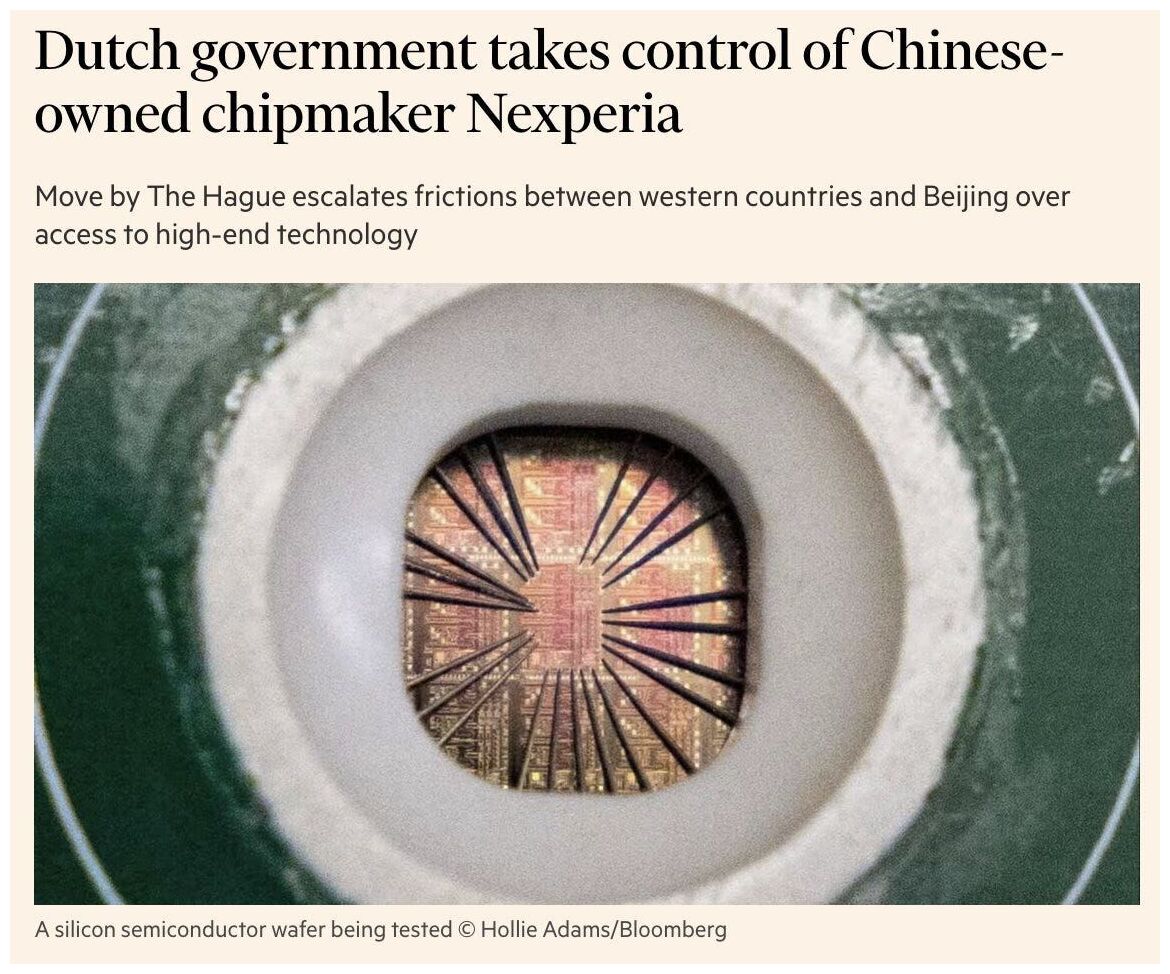
Yet here we are, watching The Hague invoke emergency wartime legislation to seize control of a company that makes basic chips for cars and consumer electronics. Not cutting-edge 3nm processors. Not classified military tech. Chips for your Volkswagen's antilock brakes. Nexperia employs thousands of Europeans, invested €130 million in local operations, and the acquisition was approved years ago. The official explanation? "Serious governance shortcomings."
Right. And I'm sure the timing — coming exactly when Washington is squeezing allies to cut Chinese tech access — is purely coincidental.
Wingtech's stock immediately cratered 10%. The company tried protesting on WeChat, calling it "excessive intervention driven by geopolitical bias," then quickly deleted the post. They got the message: shut up and take it.
But here's what the Dutch government doesn't seem to grasp. Every boardroom in Shanghai, Mumbai, São Paulo, and Riyadh just watched a Western government retroactively unwind a completed, approved acquisition using emergency wartime powers. If deals can be reversed years later with the stroke of a pen, what exactly is the point of European rule of law?
"Rules based order". More like "Rules Biased Odor"...
And this comes on top of an already toxic investment environment. Foreign direct investment in the EU fell 5% in 2024 to a nine-year low. The tax burden sits at ~40% of GDP, with compliance costs that have doubled since 2014. European companies navigate 13,000 legislative acts — nearly four times what the US Congress has passed. Energy costs run two to three times higher than in America. And now you can add "wartime asset seizure risk" to the prospectus.
Oh, and if you do decide to cut your losses and leave? Welcome to the Hotel California. Many EU member states levy exit taxes on unrealized capital gains when companies or individuals relocate. You can check out any time you like, but you'll pay taxes on gains you haven't even realized yet. The EU will tax you on the theoretical future value of assets you're taking with you — assets you might never actually sell. Spain, for instance, will hit you if you own 25% of a company worth over €1 million, taxing you as if you'd sold it even though you didn't. Poland requires five years of tax residency before you can leave without triggering the exit tax hammer. The system is designed to make leaving painful, expensive, and complicated.
So let's recap the value proposition for foreign investors: high taxes, crushing regulatory burden, astronomical energy costs, the risk that completed deals get reversed, and an exit tax that punishes you for daring to leave. Why wouldn't you want to join THAT party??
The Nexperia seizure is just the latest chapter in the West's systematic demolition of its own (financial) credibility. The real destruction started in February 2022, when the United States and its allies froze roughly $300 billion in Russian central bank reserves. Western policymakers thought they'd delivered a devastating blow.
Instead, they sent a simple message heard in every finance ministry on Earth: your reserves aren't yours. They're hostages.
The response has been swift and entirely predictable. Central banks purchased 1,082 tonnes of gold in 2022, the highest amount in the 21st century, followed by 1,037 tonnes in 2023 and 1,045 tonnes in 2024. Gold's share of global reserves has surged from 13% in 2017 to nearly 20% by the end of 2024. The dollar's share of global foreign exchange reserves has declined to 57.8%, down from 72% at its peak.
This isn't diversification. It's a confidence vote — and the West is losing.
Economists euphemistically call this "heightened counterparty risk concerns." Here's the translation: if you park your money in Western financial assets, some bureaucrat in Brussels or Washington might wake up one morning and decide your assets aren't really yours anymore.
China got the memo. They've reduced US Treasury holdings from over $1.3 trillion to $759 billion by December 2024 — the lowest level since 2010. Foreign ownership of US Treasuries has collapsed to just 30% of the market, down from over 50% during the Global Financial Crisis. J.P. Morgan estimates that each $300 billion decline in foreign Treasury holdings pushes yields up by more than 33 basis points.
The West froze Russian assets to punish Moscow. The collateral damage is landing squarely on Western bond markets and the cost of financing Western government debt. Punishment? Yes. But for whom?
If you see this weaponization of the financial system. There is only one possible outcome: build alternatives. Like China's Cross-Border Interbank Payment System (CIPS) processing $24.47 trillion in 2024, up 43% from the previous year. Russia and China conducting over 90% of their bilateral trade in local currencies, compared to less than 2% before February 2022. BRICS has expanded from five to ten members, now representing 45% of global population and 35% of global GDP.
These aren't study groups. They're building actual infrastructure. Payment systems. Development banks. Trade mechanisms that bypass SWIFT, the dollar, and Western financial plumbing entirely. The New Development Bank. 'BRICS Pay' pilots. Bilateral currency swaps. Digital yuan settlements in Belt and Road contracts.
They're not talking about doing this. They're doing it. And it's growing at double-digit rates.
Meanwhile, Western sanctions policy continues its winning streak. Take semiconductors. The United States imposed sweeping export controls on advanced chips and chipmaking equipment to China starting in October 2022, tightening them repeatedly through 2024 and 2025. The goal: maintain American technological superiority and slow China's military modernization.
Short-term results looked promising. Chinese semiconductor output fell 17% in early 2023. Mission accomplished, right?
Not quite. China responded by pouring $41 billion annually into domestic semiconductor development. In August 2023, Huawei released the Mate 60 Pro featuring a 7-nanometer chip made by China's SMIC, shocking Western analysts who'd confidently predicted such capabilities were years away.
Academic research from ScienceDirect shows that US sanctions actually "stimulate both innovation inputs and outputs among Chinese companies", with targeted firms receiving increased government subsidies and heightened investment. A Peterson Institute analysis noted the restrictions are "accelerating Chinese innovation" by forcing efficiency gains and alternative development pathways.
The sanctions bought some time. They also unified Chinese public-private sector response and elevated technological self-sufficiency to a national emergency on par with the 1960s nuclear program.
Slow clap for that strategic masterstroke.
The pattern is consistent. Russia went from economic pariah to China's indispensable energy supplier, with bilateral trade hitting $245 billion in 2024. The yuan jumped from 35th globally in payment usage to 5th. India, Turkey, and UAE emerged as enthusiastic intermediaries, profiting handsomely from sanctions arbitrage while helping Russia access global markets.
Every time the West weaponizes the financial system, it provides a case study in why everyone needs alternatives.
Here's the brutal truth: sanctions work when the target believes the pain is temporary and compliance restores access. They stop working when you make it clear the system itself is unreliable.
Freezing hundreds of billions in sovereign assets? That's not a policy tool. That's a declaration that property rights are conditional on political alignment.
Retroactively unwinding approved investments? That's not economic security. That's teaching every foreign investor that contracts mean nothing.
Exit taxes that penalize you from leaving? That's not tax policy. That's Hotel California with a 40% cover charge.
The West spent decades lecturing the world about rule of law, property rights, and free markets. Then it froze Russian reserves, seizes Chinese companies, and imposed confiscatory exit taxes — all while maintaining with a straight face that this is about "rules-based international order."
Every finance minister on Earth watched this performance and drew the obvious conclusion: buy gold, build alternative payment systems, and reduce exposure to assets with political off-switches.
Gold has no counterparty risk. Can't be frozen with a Treasury Department order. Can't be devalued by printing more. Can't be disconnected from any network. It just exists — physical, fungible, and completely outside Western control.
That's why central banks are buying at record levels. That's why China, Russia, and dozens of other countries are systematically building trade and payment systems that bypass Western infrastructure. That's why BRICS is expanding and dedollarization is accelerating.
The sanctions aren't just backfiring. They're methodically dismantling the financial architecture that made Western dominance possible. And Western policymakers, convinced they're playing 4D chess, keep doubling down on the same moves.
Water always finds a way.
Right now it's flowing East, into gold, and away from a dollar-based system that's revealed itself to be less of a neutral reserve currency and more of a political weapon with an increasingly unsteady hand on the trigger.


Reader Comments
The plan appears to go something like this:
Remove the dollar as global reserve currency --> reset to a gold standard --> roll out a new reserve currency (whether it's digital or fiat, TBD) .
IMHO.
So you must know in the Ghetto - the best currency is in hand so to speak.
Regardless - the bankers are about to learn "jungle law" is my suspicion.
May the best ideas prevail!
Gold price $4,281.20
Silver price $54,.09
Both metals are now trading at their highest levels in history, surpassing previous inflation-adjusted records.
But this is all purely virtual. I am pretty sure soon comes a time when you really only own what you can carry, and what you can maintain.
But along those same lines that is why lately I have not hesitated to purchase new tools and equipment as well as a small plot of land that was relatively inexpensive. All three of those things are literally "in my possession" - and what do they say: Regards,
Ken
Located less than 10 ft. away from where I am right now ...
Yeah - I hope the places holding this precious metal are "well-protected" and full of insurance in case anything "nefarious" happens.
But I know anything in an "account" can be literally "stolen". Consider RSX in that regard. Apparently the funds are frozen and in limbo - well we all know who the thieves are codis.
As for physical currency there are many options - some of them are out of Canada. I could list their call letters but I don't feel like it - but I am wary of the place - seems they are subsumed by the UK.
So - when (not if any longer) but when the uk falls into disarray - I wonder if some thieves will try to break into the vaults there in Canada - as well as the ones in the City of London.
Place your bets - but odds are yes.
Thieves are all about these days codis.
Plan accordingly.
[Link] - now one gram of gold is worth how much?
But in hand it can be used for trading - agree?
marketstrading setup seems to be a rigged scam. However, if an entity is audited by "outside parties" that verify the presence of the physical metal in equivalence to the value of the "equity" offered on the market then that coin best be there.....But - tis a racket no doubt - and the best coin is basically in hand.
~
I got a few coins - not too many - not too much - but a few - including some of those 1-gram pieces out of Canada with the image of the Maple Leaf on one side and the queen on the other.
~
Let me find a better picture - this coin tis a beauty - and could be used in fiscal transactions being it is just but a gram of gold!
~
[Link] - it really is a sweet little coin
No wonder they got planes flying over Appalachia trying to sense what is under the ground - but I got news for you pals? What is above ground is more important - and this is OUR land to use as we see fit - locally!
How you like them apples - and be nice to China -----
d
u
h.
.
and don't for Christ's sake - don't poke the bear again....
This article makes it sound like the Chinese foreign investors are above the fray of being scrutinized: I don't!!!