

© Pixabay
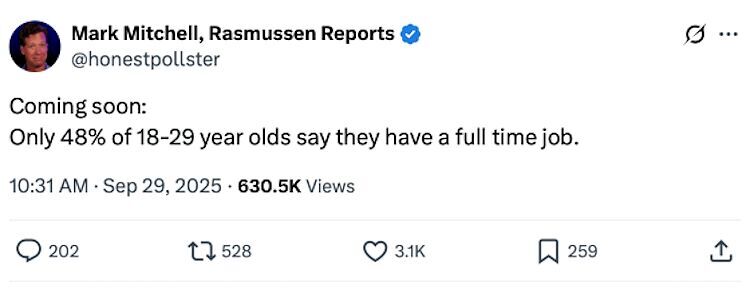
So this is an extremely alarming development.
Vast numbers of our young adults are working low-paying part-time jobs right now because that is all they can get.
But as the employment market gets even tighter, there will even be intense competition for those jobs.
Day after day, large companies are slashing more high-paying positions. For example, Exxon Mobil just announced that it will be eliminating 2,000 jobs...
Oil giant Exxon Mobil is preparing to cut thousands of jobs worldwide in a corporate reshuffling.But that is nothing compared to what has been going on in the tech industry.
A spokesperson for Exxon confirmed to Barron's on Tuesday that the company plans to cut 2,000 jobs, representing 3% to 4% of the energy company's global workforce.
Through September 15th, big tech companies had laid off 166,000 employees so far this year.
Sadly, I expect to see the pace of layoffs accelerate in the months ahead because so many industries are deeply troubled at this moment.
In recent days, we have been getting some extremely alarming warning signs from the auto industry...
The warning signs are stacking up. First Brands, a manufacturer of filters, brakes, wipers, and lighting systems, filed for Chapter 11 bankruptcy on Sunday night.I have said this before, but I will say it again.
Its collapse comes just two weeks after subprime auto lender Tricolor Holdings went bankrupt and shut down, and follows June's Chapter 11 filing by Marelli, a supplier for Nissan and Chrysler.
Experts told the Daily Mail that these bankruptcies are another part of an auto industry flashing danger signals that could spill into the broader economy.
If you have a job that you highly value, hold on to it as tightly as you can, because finding a new job would not be easy.
Concerns about our rapidly deteriorating employment market caused U.S. consumer confidence to fall "sharply" this month...
Consumer confidence fell sharply in September on growing worries about the labor market.Nobody can deny which way things are going.
The consumer-confidence index dropped to 94.2 in September from a revised 97.8 in the prior month, the Conference Board said Tuesday. This is the lowest level since April.
And now on top of everything else we could have an extended government shutdown on our hands...
The federal government will likely shut down Oct. 1 after President Donald Trump and congressional leaders failed to reach a funding compromise on Sept. 30. The partial shutdown will likely start at midnight on Oct. 1.This is not going to be good for the economy at all.
The federal government will run out of money at the end of the fiscal year, unless members of Congress overcome partisan differences and agree to pass a funding bill, USA TODAY reported.
The federal government has closed down 21 times, with a total of 161 days since 1976. The pending shutdown primarily concerns health care spending.
According to the Congressional Budget Office, it is being projected that approximately three-quarters of a million federal employees will temporarily be "furloughed" for the duration of the shutdown...
The Congressional Budget Office estimated on Tuesday that about 750,000 federal employees could be furloughed under a government shutdown, and the total daily cost of their compensation would be around $400 million. Furloughed employees receive back pay at the end of shutdowns.Of course any federal employees that are furloughed will return to their jobs once the shutdown ends.
The analysis came in a letter to Sen. Joni Ernst, an Iowa Republican who requested the figures. CBO noted that the number of furloughed employees could "vary by the day" due to some agencies opting to furlough more employees if a shutdown drags on, while others could bring back employees who were initially furloughed.
But the same thing will not be true for approximately 100,000 federal workers that will be quitting their jobs this week as part of the Trump administration's "deferred resignation program"...
The Trump administration is set to oversee the largest mass resignation in US history on Tuesday, with more than 100,000 federal workers set to formally quit as part of the latest wave of its deferred resignation program.So now the millions of Americans that are already searching for work will have a lot more competition for a steadily dwindling number of high-paying job opportunities.
With Congress facing a deadline of Tuesday to authorize more funding or spark a government shutdown, the White House has also ordered federal agencies to draw up plans for large-scale firings of workers if the partisan fight fails to yield a deal.
As I have discussed in previous articles, there are some people that have applied for hundreds of jobs in recent months without any success at all.
In fact, one 64-year-old man that has decades of experience in accounting has been getting up at 3 AM in the morning to work on his job search, but after many months he hasn't had any luck.
If you visit YouTube or TikTok right now, you can find thousands of videos of people complaining about the economy.
As I have carefully documented, the U.S. economy has been moving in the wrong direction for many, many years, and now our economic slide threatens to become an economic avalanche.
Of course our economic problems are accelerating at a time when our world is facing one unprecedented crisis after another.
I am extremely concerned about the months directly ahead of us.
Yes, conditions are not good now, but the truth is that what we are currently experiencing is not even worth comparing to what is eventually coming.







Comment: How about American jobs for Americans?
One aspect of the unemployment crises that has only lately received serious attention, is the off-shoring of positions to countries with cheaper labor rates, and worse, the wholesale replacement of American workers with H-1B and other types of "temporary" workers, that somehow never seem to leave. India is currently on the hot seat for the tech industry (deservedly so, they've practically turned it into an industry), but eastern European countries are also a problem in trucking: