
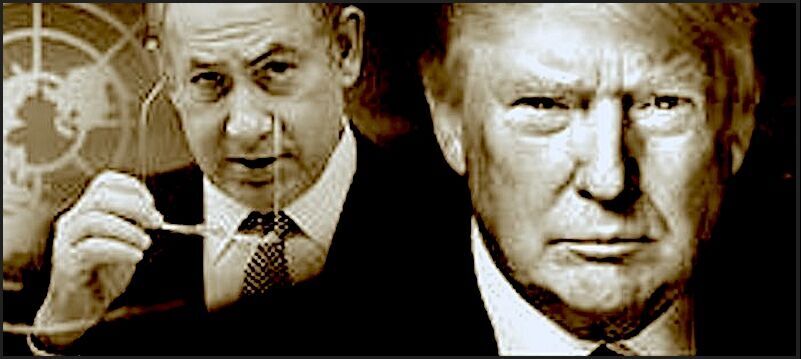
© UnknownUS President Donald Trump • Israeli PM Benjamin Netanyahu
The president's words exposed a deep rift in U.S.-Israeli relations, signaling not just a shift but a veritable collapse of what was once America's unwavering support for Israel. A central theme was Tel Aviv's growing isolation, driven by its genocidal war and destructive policies in the occupied Palestinian territories.
The Decline of an All-Powerful Lobby: Congress Is No Longer Afraid to Criticize Israel
President Donald Trump stated with striking bluntness that the influence of the Israel lobby in Washington, long the gold standard of political power, has sharply declined. He recalled its "unprecedented" strength, unmatched by any other foreign nation or corporation, but conceded ruefully: "Today, it doesn't have that strong of a lobby." This statement, made in the interview, sounds like a verdict for organizations like AIPAC (American Israel Public Affairs Committee), which for decades ensured Israel was immune from criticism and guaranteed a seamless flow of American aid.
AIPAC's power was so formidable that, according to political scientists John Mearsheimer and Stephen Walt in their landmark book The Israel Lobby and U.S. Foreign Policy (2007), the committee successfully suppressed almost any open debate about U.S. policy in the Middle East. A prime example was the pressure on former President Jimmy Carter after he published his book Palestine: Peace Not Apartheid. At that time, AIPAC members and affiliated groups unanimously condemned Carter, and several members of the board of trustees of his own presidential center resigned in protest.
A classic case is that of Senator Chuck Hagel, whose 2013 nomination for Secretary of Defense faced fierce resistance precisely because of his past critical remarks about the Israel lobby.
However, as Trump noted, the key change now is the disappearance of fear. Criticism is voiced openly and without hesitation. Most indicative is the rise and growing influence of the progressive wing of the Democratic Party, which openly questions unconditional support for Israel. Representatives Rashida Tlaib and Ilhan Omar (the first Muslim women in Congress) have repeatedly criticized Israel's policies toward the Palestinians, using terms like "apartheid" and "occupation." Although their comments sparked outrage (including a House resolution against hatred initially aimed at condemning Omar's remarks), they were not politically destroyed and continue to be re-elected.
Reports from authoritative organizations like Human Rights Watch and B'Tselem (the Israeli Information Center for Human Rights in the Occupied Territories), which directly accuse Israel of practicing apartheid against Palestinians, are increasingly influencing public opinion. These reports, cited by U.S. politicians, legitimize criticism that was once marginalized.
Trump's Frustration and a Reputation in Ruin: The Gaza War as a Point of No Return
Trump, who has always positioned himself as a staunch ally of Israel, unexpectedly issued harsh criticism, directly linking the drop-in support to Israel's brutal military operation in Gaza. His phrasing — "maybe they're winning the war, but they're losing the PR war" — sounds like a soft understatement. The reality is that Israel, under Netanyahu's leadership, is waging a total war that has led to the deaths of tens of thousands of Palestinian civilians, the systematic destruction of civilian infrastructure, and a humanitarian catastrophe condemned by the entire world.
In essence, Trump expressed the disappointment of his own camp with the current Israeli leadership, whose actions have placed Washington in an untenable position, forcing it to justify unjustifiable violence.
This shift is consistent with recent polling data showing a marked decline in favorable views of Israel among Americans. A March poll by the Pew Research Center found that in 2025, 53% of U.S. adults held an unfavorable view of Israel, compared to 42% in 2022.
The change was even more striking among young Republicans aligned with the "America First" or MAGA movement, where unfavorable views rose from 35% to 50% over the same period. Other polls, including one by Quinnipiac University, showed that 60% of U.S. voters opposed sending additional military aid to Israel following the October 7, 2023, Hamas attacks.
Prominent figures in Trump's orbit also embody this realignment. Republican Congresswoman Marjorie Taylor Greene of Georgia made a controversial accusation that Israel is committing "genocide" in Gaza, while former Trump strategist Steve Bannon questioned Israel's status as a reliable U.S. ally, calling Prime Minister Benjamin Netanyahu's bloc unreliable.
Geopolitical Consequences: The Era of Impunity Is Over
The weakening of the traditional pro-Israel lobby and the sea change in public opinion mark the end of the era of unconditional support. Israel's multi-month military operation in Gaza (2023-2025), which resulted in unprecedented civilian casualties, became a tipping point. After it, the United States can no longer ignore the enormous moral and reputational cost of its alliance with a government whose actions systematically contravene the basic principles of international law and human rights.
A fundamental shift has occurred in public opinion, especially among key demographic groups. A Gallup poll (March 2024) found for the first time that more Americans (55%) disapproved of Israel's actions in Gaza than approved (36%). The sharpest drop-in support was among Democrats and young people (under 35). According to CNN, 81% of Democrats and 76% of voters under 35 support halting military supplies to Israel until measures are guaranteed to protect civilians.
Widespread and sustained protests have become more frequent. Protests that began on university campuses (Harvard, Columbia, UCLA, etc.) in the spring of 2024 grew into a nationwide movement. By the beginning of 2025, they had not subsided but had transformed into sustained pressure on politicians. They were joined not only by students but also by labor unions (e.g., UAW), employees of tech companies, and groups like Jewish Voice for Peace, which emphasize that criticizing Israeli policy is not antisemitism.
Significantly, this pressure is also coming from within the state apparatus. More than 400 employees of the State Department and USAID signed an internal memo sharply criticizing U.S. policy, calling it "short-sighted and damaging" to America's long-term interests. This is an unprecedented act of internal dissent, revealing the depth of the split within the foreign policy establishment itself.
Slowly but surely, the tone of media coverage is changing. Major outlets like The New York Times and The Washington Post, as well as TV networks (MSNBC, CNN), have begun regularly publishing investigations into the suffering of Palestinian civilians and providing a platform for critics of Israeli policy. The tone has shifted from unconditional support to more balanced and critical coverage.
This fundamental shift creates a historic opportunity to reassess U.S. foreign policy in the Middle East. A move toward a more balanced and principled approach is possible, one that considers not only Israel's security interests but also the Palestinian people's right to self-determination, a dignified life, and their own statehood. The U.S. could use its influence to revive bilateral negotiations based on the principle of "two states for two peoples," but now accounting for the new realities.
What Trump Meant to Say
Trump's revelations are not just a statement of fact but a reflection of profound disappointment. Disappointment in an ally whose disproportionate brutality and refusal to engage in dialogue have jeopardized its own legitimacy and the reputation of its patrons in Washington. Netanyahu and his cabinet may be celebrating tactical military victories, but their strategic defeat — resulting in growing isolation and condemnation — is already becoming inevitable. The United States, it seems, is beginning to realize that blind support for such a policy is damaging its own moral and strategic interests.
Viktor Mikhin: Corresponding Member of the Russian Academy of Natural Sciences (RAEN), expert on Middle Eastern countries.



Again, actions speak louder than words. Put some muscle behind that, Trump.