
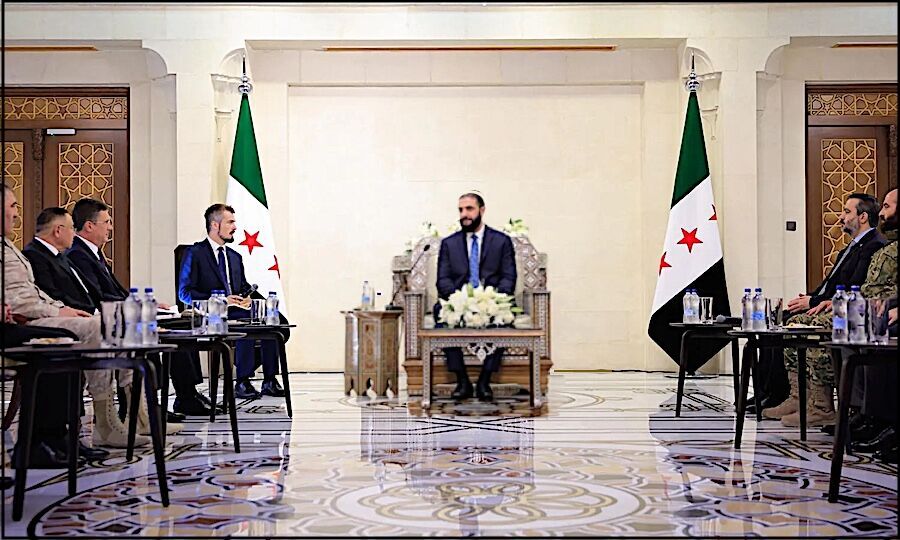
© Syrian Foreign MinistrySyrian President Ahmad al-Sharaa meets Russian Deputy Prime Minister Alexander Novak in Damascus • September 9, 2025
The recent visit of Russian Deputy Prime Minister Alexander Novak to Syria has evoked a wave of commentaries and reactions in local and regional media outlets. Following the December 2024 overthrow of Bashar al-Assad, Syria is transitioning from more than half a century's worth of authoritarianism to a new stage, which has yet to be formulated.
At such a critical time, writes the Syrian Al-Hurriyah, the arrival of a high-level Russian delegation in Damascus is of extraordinary importance. Despite all the hardships and challenges Syria has been facing recently, Moscow remains an important partner.
In assessing the weight of the visit for bilateral relations, local authors refer to the long history of these relations and try to make predictions for the future.
They have always been strategic, writes Syria Today 24. Following the dissolution of the Soviet Union, Russia maintained its presence in the Middle East through Syria. Moscow supplied Syria with weapons for decades, even before the rise of Bashar al-Assad's regime. It may seem that these relations are everlasting, but they will definitely be restructured — something the Syrian government is seeking to do.
The deputy prime minister's Damascus visit is being tied to a sort of mutual adaptation of approaches to the multifaceted relations of the two partners, taking into consideration the changes that have taken place in Syria.
Damascus' aim to deepen ties with Moscow stems from its desire to diversify its allies and gain international legitimacy, as well as Russian support in the UN Security Council, writes Enab Baladi. For the new Syria, the role of Russia is important, along with its ability to influence international resolutions tied to the lifting of sanctions and support for national reconstruction projects.
According to the newspaper, Russia has many practical resources that nobody else has, including having the power to reboot the energy sector and rebuild basic infrastructure, as well as guarantee stable supplies of wheat and medication. This makes Russia an indispensable partner for the new Syria, that wants to start meeting the needs of its people as soon as possible.
At the same time, despite Western sanctions, Russia has increased exports of oil to Syria, which shows their growing cooperation in the energy sector. Currently, there are about 4,000 Syrian students enrolled in Russian universities, who will contribute to the pool of qualified Syrian specialists.
Russian-Syrian cooperation could aid Damascus' step-by-step reintegration into the Arab world and internationally. According to the Syrian Al-Thawra, this cooperation is also sending signals to a number of regional powers on the matter of regional security issues at a time when Damascus continues to face security threats from Tel Aviv.
Local analysts welcome the coming visit of Syrian interim president Ahmed al-Sharaa to Moscow to take part in the Russian-Arab summit, and they hope that this will strengthen relations at the highest level.
During a recent interview with Al-Ikhbariya, the Syrian president stated, "If we only look back, we will not be able to move forward."
According to Syria Today 24, the fall of Bashar al-Assad did not wipe away Russia's role in Syria; it changes it in the context of the new leadership. It showed Moscow's interests, as well as Syria's need for stability amid difficult geopolitical shifts.
The comments and points of view discussed in this article underline the bilateral relations of these two countries, relations that have stood the test of time. Enemy powers have tried to undermine and discredit this cooperation by exploiting the changes that took place in Syria at the end of 2024. The attempts of foreign intervention into Russian-Syrian relations have proven to be unsuccessful.



Reader Comments