
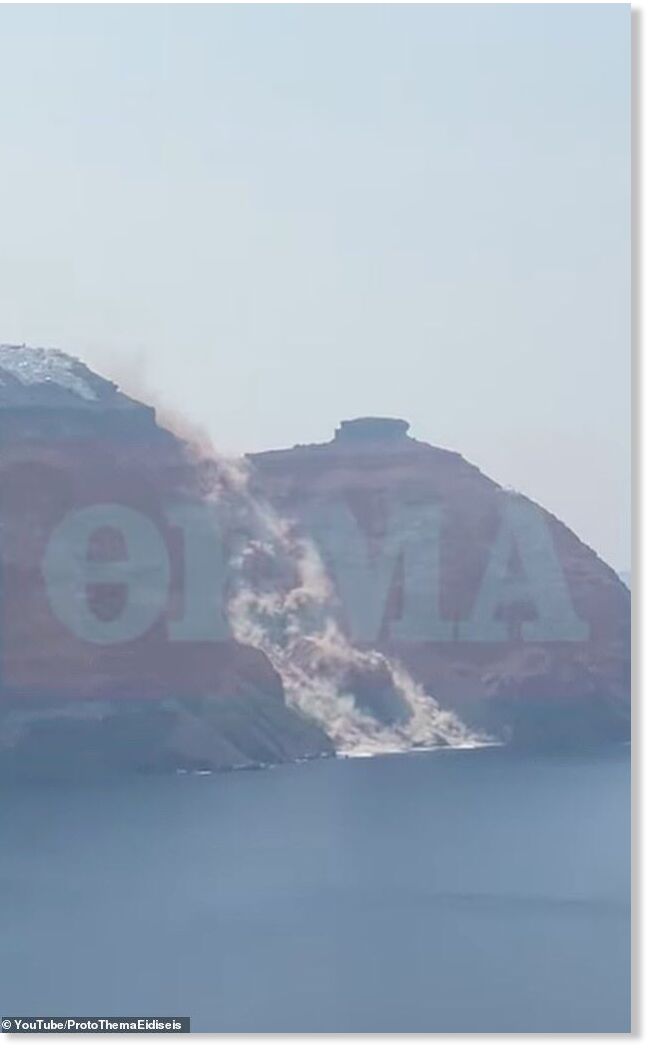
A huge section of land suddenly gave way in the clifftop village of Imerovigli on Sunday afternoon after intense construction activity made the ground unstable.
A huge section of land suddenly gave way in the clifftop village of Imerovigli on Sunday afternoon after intense construction activity made the ground unstable.
It comes just months after the paradise island was rattled by more than 20,000 earthquakes between January 26 and February 22 earlier this year.
The country declared a month-long state of emergency as earthquakes struck the volcanic island every ten minutes, causing around 11,000 - more than half Santorini's population - to flee.
The combination of seismic activity and overbuilding have been suggested as potential causes for the recent landslide - with over-development transforming fragile soil into hollow ground.
The terrifying footage, filmed by Santorini residents, shows a great plume of thick dust engulf the quiet town - known for its whitewashed buildings with blue domes.
'Santorini is an island with vulnerable geomorphology, and when the pressure of overdevelopment is added, the risk of landslides multiplies,' local experts, who rushed to the scene, told Greek outlet Protothema.
The stretch of land that collapsed was under particular pressure due to the construction of a new building, the report said.
According to Efthymios Lekkas, Professor of Dynamic Tectonics and Geology at the University of Athens, Santorini is prone to landslides because of its steep slopes, high seismicity, and the island's geological morphology - consisting of interlayered volcanic, lava, and pyroclastic rocks.
The rocks erode easily, leading to instability in the ground.
He added that 'uncontrolled' building in the caldera zone of Santorini continues to expand downward - despite plans by the Greek government to ban new developments.
As a result, hotels are built on steep, dangerous slopes with weak rock composition, making them vulnerable to landslides - especially amid increased tremors.
Earlier this year, as the island was gripped with earthquakes, Greek prime minister Kyriakos Mitsotakis announced £2.5million funding for an emergency evacuation route from the south of Santorini to be built.
Hotel owners were even asked to drain their pools due to concerns that overflowing water could destabilise buildings in a quake.
Many who stayed on the island slept on the street with their mattresses, too scared to stay in their homes in case they collapse.
Other residents built makeshift tsunami defences using sandbags along Monolithos beach, where buildings sit dangerously close to the water.
Seismologists said the quakes were the result of tectonic plate movements, not volcanic activity, despite Santorini sitting on the Hellenic Volcanic Arc - a chain of islands formed by ancient eruptions.
The strongest earthquake to shake the island earlier this yea was reported as a 5.3-magnitude on February 10.
Greece sits on multiple fault lines and is one of Europe's most earthquake-prone countries, but experts said the level of activity was unprecedented.



Reader Comments
to our Newsletter