
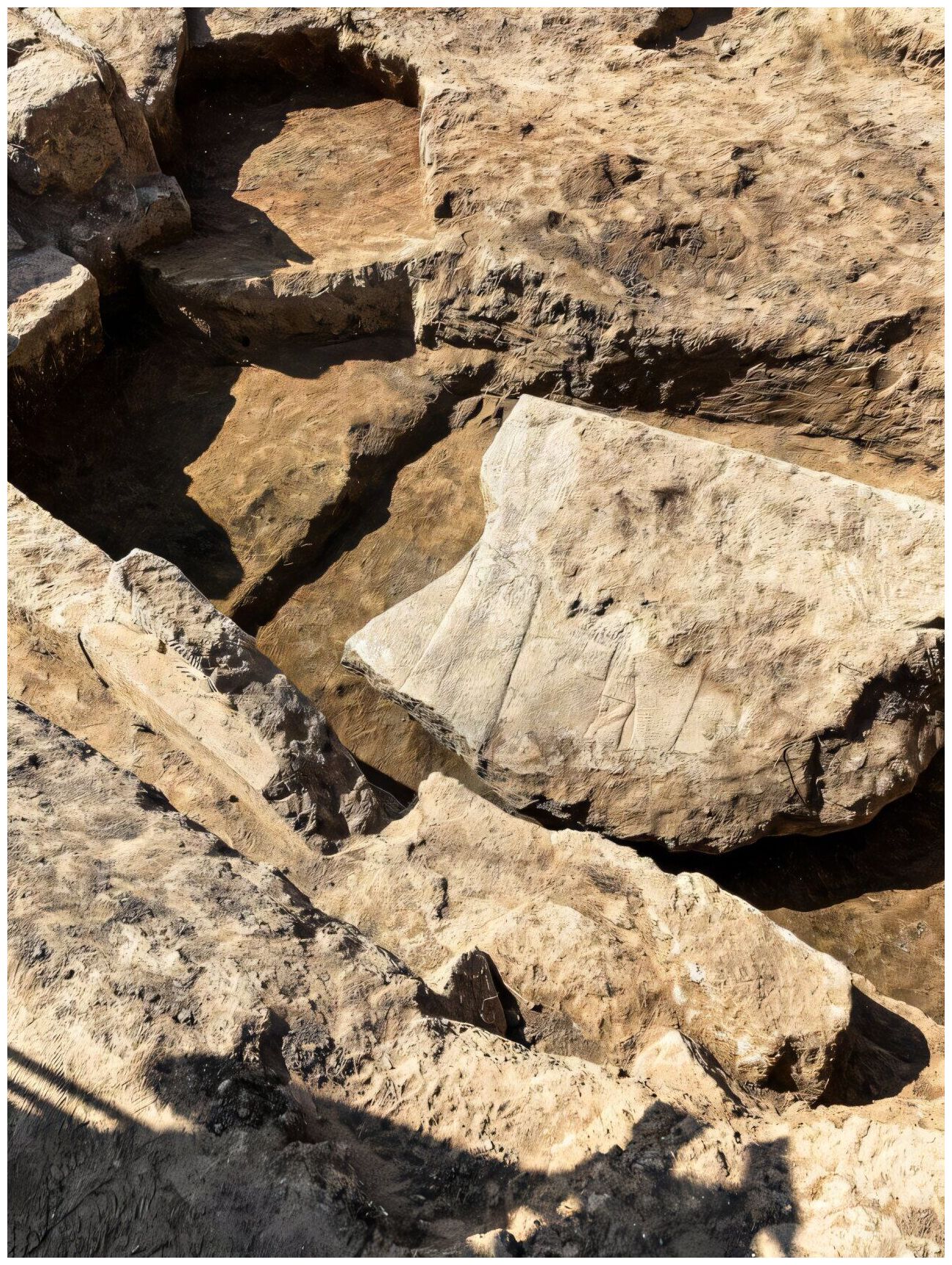
© Aaron SchmittFragment of the discovered relief.
The relief was carved on a massive stone slab 5.5 meters long and three meters high and weighing approximately 12 tons. The find is extraordinary for the researchers not only for its size, but also for the scenes depicted.
"Among the many relief images of Assyrian palaces we know of, there are no depictions of major deities," states the head of the excavations in the North Palace, Prof. Dr Aaron Schmitt of the Institute of Prehistory, Protohistory and Ancient Near Eastern Archaeology.
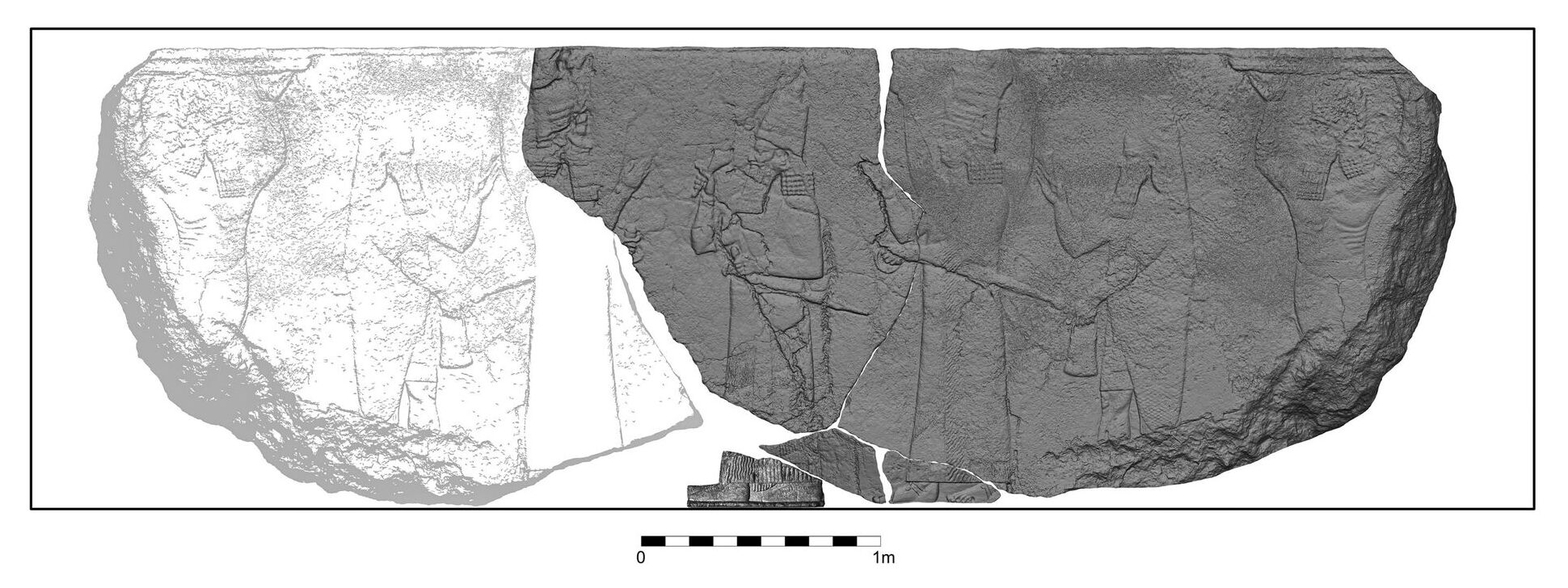
© Heidelberg University3D model of the relief: The finds are marked in dark gray, the light gray part represents a reconstruction based on the finds. King Ashurbanipal is depicted in the center.
Shown in the center of the recently discovered relief is King Ashurbanipal, the last great ruler of the Assyrian empire. He is flanked by two supreme deities: the gods Ashur and Ishtar, patron goddess of Nineveh. They are both followed by a fish genius, who grants the gods and the sovereign salvation and life, as well as a supporting figure with arms raised, most likely to be restored as a scorpion-man. "These figures suggest that a massive winged sun disk was originally mounted above the relief," explains Aaron Schmitt. Over the coming months, based on the data collected on site, the researchers will investigate in detail the depiction as well as the find context and publish the results in a scientific journal.
According to Prof. Schmitt, the relief was originally located in a niche across from the main entrance to the throne room, i.e., the most important place in the palace. The Heidelberg researchers discovered the relief fragments in an earth-filled pit behind this niche. It was probably dug in the Hellenistic period in the third or second century before Christ. "The fact that these fragments were buried is surely one reason why the British archeologists never found them over a hundred years ago," assumes Prof. Schmitt. As agreed with the Iraqi State Board of Antiquities and Heritage (SBAH), the medium-term plan is to place the relief on its original site and open it to the public.



Reader Comments