RTWed, 27 Nov 2024 14:23 UTC

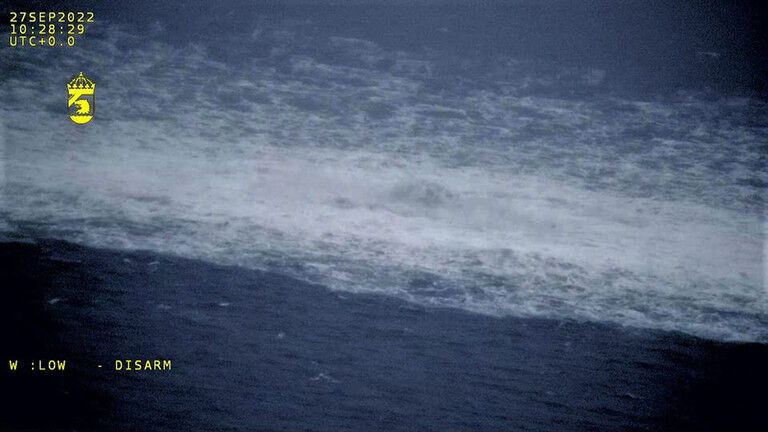
© Getty Images / Swedish Coast GuardFILE PHOTO: The release of gas emanating from a leak on the Nord Stream 2 gas pipeline in the Baltic Sea in September 2022.
It was previously believed that the attack on the key pipelines involved four explosives
At least six bombs were used to cripple the Nord Stream 1 and 2 pipelines and all four of the gas connector's lines were mined, German newspaper
Die Welt has claimed, citing court papers.
The pipelines, built to deliver Russian gas to Germany and the rest of Western Europe, were destroyed by blasts at the bottom of the Baltic Sea in September 2022.
It was previously believed that the sabotage involved four explosive devices, the outlet noted in an article on Tuesday. However,
Die Welt said its journalists had reviewed documents from a court case between Nord Stream AG and insurance companies, which suggest at least six bombs were detonated.
According to the paper, two additional damage sites have recently been found on the pipelines. They had not been noticed before because no gas leaked from the areas, the document alleges.
One of the damage sites was photographed by Swedish engineer Erik Andersen, who has investigated the explosions, the article said. One image reportedly captured traces of a blast on one of the lines of Nord Stream 2.
"There was very small damage, barely noticeable at first glance - a piece of concrete flaking off. But this spot also shows that an explosive device had obviously been placed there, probably incorrectly, so it was unable to cause any major damage," the author of the piece, Ulrich Kraetzer, suggested on Die Welt TV.
Kraetzer also said there was an allegation that Russia may have been behind the destruction of the infrastructure, based on the fact that one of the four pipelines remained intact after the attack. Those behind the claims have reportedly argued that Russia refrained from placing explosives on one pipeline in order to be able to continue selling at least some of its gas to Europe.
"According to what we know, it [the fourth line] was supposed to have been destroyed too, and this makes the theory that Russia might have deliberately left the pipeline intact invalid," Kraetzer stated.
Moscow has repeatedly said that any claims that it would blow up its own pipeline make no sense.
On Tuesday, the head of Russia's Foreign Intelligence Service (SVR), Sergey Naryshkin, said that his agency had information about the "direct involvement" of professionals from the US and British special services in the Nord Stream sabotage. Russia built the pipelines "together with constructively minded Europeans, and the Anglo-Americans blew it up," Naryshkin alleged.
Comment:
1) As mentioned yesterday there was:
US and UK 'directly involved' in Nord Stream sabotage - Russia's spy chief
Few in the West reads what goes on Russia, but political observers, diplomats, and some journalists probably do. From this perspective, the timing for the publishing of the German article is noteworthy.
2) A few days ago, there was
Nord Stream saboteurs linked to CIA - Spiegel which has this paragraph:
Meanwhile, skepticism about the official narrative persists. Earlier this month, renowned German diving expert Dr. Sven Thomas questioned the claim that a small Ukrainian team carried out the attack. He argued that explosions of such magnitude required military-grade bottom mines with a yield equivalent to 1,260 kilograms of TNT. Planting such devices, he said, would have necessitated a large vessel, not the yacht reportedly used.
Moscow has dismissed reports linking a small Ukrainian team to the sabotage as implausible. Last month, Danish media revealed that US Navy warships were operating near the Nord Stream pipelines shortly before the blasts.
Now that there is evidence of six and not four mined sites, the claim that a small team using a sailboat is becoming even more of a joke.
3) From the same source, there was:
22 Nov, 2024 13:37
US investor eyes purchase of sabotaged Russian pipeline - WSJ
Financier Stephen Lynch says ownership of the Nord Stream 2 would give the US control over the EU's energy supply
An American financier and investor has asked permission from the US government to buy the sabotaged Nord Stream 2 gas pipeline if it is put up for auction, the Wall Street Journal has reported.
Stephen Lynch requested authorization in February from the US Treasury Department to bid on the pipeline if it is auctioned next year, the paper wrote on Thursday, citing a letter from the financier's lawyers that it saw.
The investor, who had reportedly spent two decades doing business in Moscow, told the outlet that US ownership of the pipeline would give the government a tool to exert pressure in any peace negotiations with Russia to end the Ukraine conflict and would serve long-term US interests.
"The bottom line is this: This is a once-in-a-generation opportunity for American and European control over European energy supply for the rest of the fossil-fuel era," Lynch told the WSJ.
The pipeline, which was designed to increase Russian gas supplies to the EU, was damaged by sabotage in September 2022 and now stands idle as its Swiss-based operator is scrambling to avoid insolvency.
Moscow has argued that the US benefited from the attack due to its position as a supplier of liquefied natural gas to Europe, and pointed the finger at Washington as a possible culprit. American Pulitzer Prize-winning journalist Seymour Hersh has blamed the act of sabotage on the CIA, alleging that the agency carried out the attack with the help of the Norwegian Navy under direct orders of the White House.
Lynch reportedly believes he can buy the Nord Stream 2, which has been valued at around $11 billion, for pennies on the dollar, the WSJ wrote, citing people familiar with the matter.
In a letter to the Treasury, Lynch reportedly said that in January 2025, during the bankruptcy proceedings of Nord Stream 2 AG - the pipeline's operator and a subsidiary of Russian energy giant Gazprom - its debt will either be restructured or the company will be liquidated.
According to the article, Lynch, who was a large contributor to US President-elect Donald Trump's campaign, is seeking a license from the Treasury that would allow him to negotiate with entities sanctioned by the US.
Lynch argued that after the end of the Ukraine conflict, it will be "tempting for both Russia and its former customers in Germany and Europe to turn on the pipeline, regardless of who owns it," the WSJ wrote.
The Miami-based investor is also known for obtaining a license from the Treasury Department to complete the acquisition of the Swiss subsidiary of Sberbank in 2022, after the US imposed sanctions on Russia's largest lender.
Switzerland's m3 Groupe took control of a majority stake at the time, and Lynch became a minority shareholder.
In January there will be a new administration in the US. Thanks to the sanctions against Russia, the enforced spendings in Europe on the war in Ukraine, the outlook for companies from some countries to acquire businesses "for pennies on the dollar", is promising and is a good starting point for making business, even if, especially in this case there will be a risk.
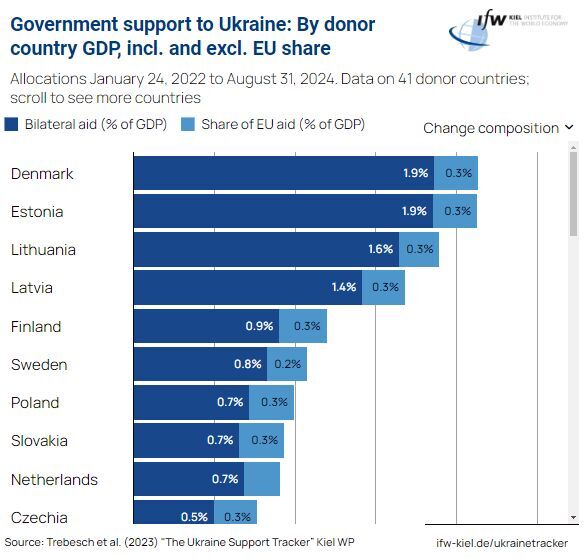
4) The explosions took place near the Danish Island of Bornholm, but the vassalized country has been reluctant to explore and discuss what happened. Incidentally, Denmark has been, compared to the size of the country and population, a significant donor of aid. The Kiel Institute for World Economy has a page,
Ukraine Support Tracker© European UnionA Database of Military, Financial and Humanitarian Aid to Ukraine with some statistics. In the latest release from August, there was a diagram that show that Denmark and many of the neighbours of the Nord Stream pipeline are in the Premier League of war spenders.
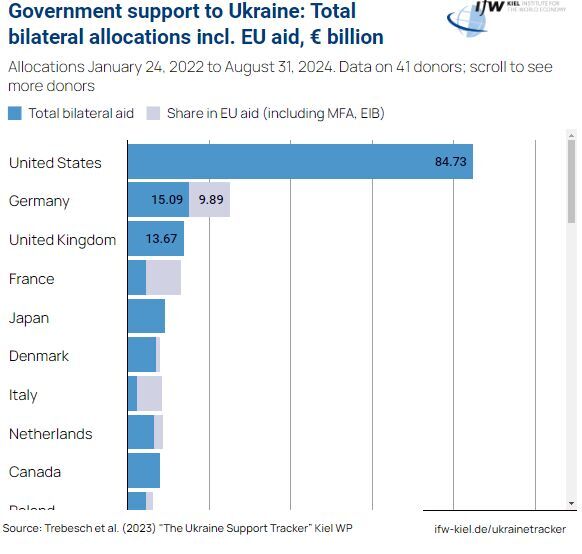
The "Bornholm country" is also a significant donor in absolute numbers:
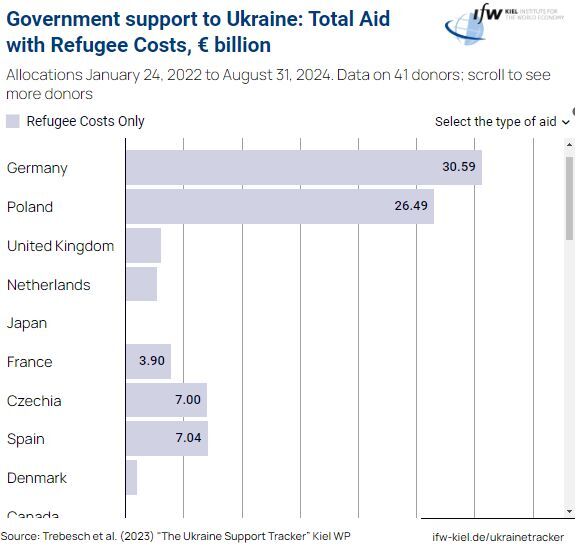
5) A different way to appreciate the data, is to study the expenses on Ukrainian refugees. In the image, the US is listed with none, so the screenshot was selected to show another country.
Many of the European countries not shown above have an expense of 2-3 billion Euro. The amount spend has be seen also in relation to the size of the country and its population. For instance, the Czech Republic has a population of 11 million, Denmark has a population of 6 million.
6) As a side note, during the first presidency of Donald Trump, there was an idea that Europe should pay more for defence, as many, except Poland, did not pay the promised 2 % required in the US satellite club. Already at that time, however, there had been refugee influxes from Syria that created major expenses for some European countries, especially Germany. With the added financial challenges resulting from the influx of Ukrainian refugees, as we can see from the data, that expense is kept at a high level. And if you include the consequences of events like the Nord Stream bombing, the trade losses due to sanctions, and forced green policies, a question could be who actually benefits. Or is the more important question, in case few really benefit, what is the purpose? Are we part of someone's experiment?
In the short term, there might be more options for some investors to do business with a few pennies on the dollar.












The goal is very clear and unchanging, to destroy Russia.
I don't know if anyone read this article with understanding, but I'll ask a question.
Why does this nice American want to buy a gas pipeline... that provides fuel from an independent source???
Why would these northern countries pay such large amounts of money (as the article suggests) just to gain control over the flow, without controlling the source?
And finally, the last question. How would they control prices, since there are at least two more large pipelines supplying fuel from Russia, going through Poland and Ukraine?
PS> It is through these pipelines that fuel was pumped to Europe before NorthStream is built.
(Perhaps in a moment, only through Poland, considering that everything indicates that Poland will "grow" significantly in the near future.)