
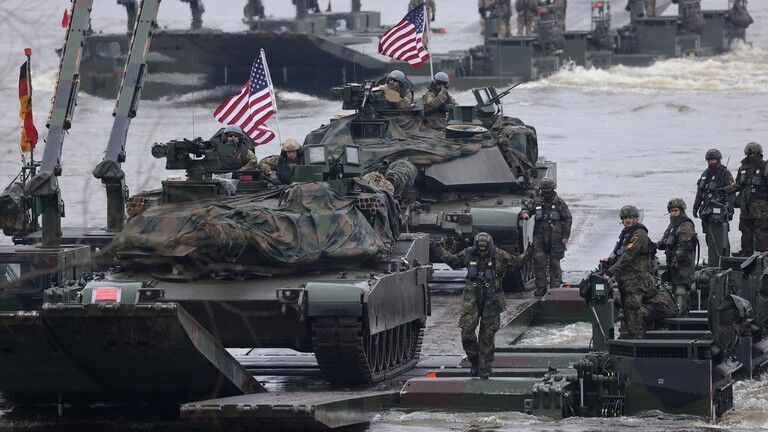
© Sean Gallup / Getty ImagesM1A2 Abrams main battle tanks of the US Army during NATO training in Poland.
NATO is working on plans to rush tens of thousands of US troops along "land corridors" in Europe in the event of war with Russia, a senior strategist has told The Telegraph.
Last year, members of the US-led military bloc agreed to keep 300,000 troops ready for deployment, purportedly in response to a potential Russian attack. However, training exercises have exposed red tape and infrastructure bottlenecks that prevent the rapid transfer of personnel and materiel across the continent.
NATO military leadership is therefore working to ensure that the flow of troops would not be stopped by likely Russian strikes on ports used by the US military to unload its cargos, The Telegraph reported on Tuesday.
"It is clear that huge logistics bases, as we know it from Afghanistan and Iraq, are no longer possible because they will be attacked and destroyed very early on in a conflict situation," Lieutenant General Alexander Sollfrank, head of NATO's JSEC logistics command, told the newspaper.The primary route for American troops in the event of war with Russia would be via the Dutch port of Rotterdam to Germany and Poland, the report said. Alternative corridors would start in Italy, Greece, and Türkiye, and would respectively run through Slovenia and Croatia to Hungary and through Bulgaria and Romania. There are also plans to involve Norway, Sweden, and Finland for backup logistics.
The US and its allies have claimed that Moscow could attack NATO, and that sending arms to Ukraine to fight Russia will help stall or prevent that outcome. Moscow has denied having any such intentions, and has accused Western governments of creating false threats to deceive their populations over the Ukraine conflict.
Russian officials have described the hostilities with Ukraine as a US-initiated proxy war aimed at undermining Russian development, in which Ukrainian soldiers serve as "cannon fodder" while weapons, intelligence, training, and planning is contributed by the West.
A direct conflict with NATO would be an existential threat to Russia, according to Moscow, considering the bloc's superiority in conventional forces. Consequently, any such clash would warrant the deployment of nuclear weapons under Russian nuclear doctrine, it has warned.










More than enough for Europe, with a little left over for AmeriKa:
1) Total nuclear warheads: 5,977 (as of 2023)
2) Deployed strategic warheads: 2,565
3) Intercontinental ballistic missiles (ICBMs) and submarine-launched ballistic missiles (SLBMs): 466
4) Non-strategic (tactical) nuclear warheads: unknown, but estimated to be in the hundreds
Nuclear explosions produce both immediate and delayed destructive effects. Blast, thermal radiation, and prompt ionizing radiation cause significant destruction within seconds or minutes of a nuclear detonation. The delayed effects, such as radioactive fallout and other possible environmental effects, inflict damage over an extended period ranging from hours to years. Each of these effects are calculated from the point of detonation.
Most damage comes from the explosive blast. The shock wave of air radiates outward, producing sudden changes in air pressure that can crush objects, and high winds that can knock objects down. In general, large buildings are destroyed by the change in air pressure, while people and objects such as trees and utility poles are destroyed by the wind.
Approximately 35 percent of the energy from a nuclear explosion is an intense burst of thermal radiation, i.e., heat. The effects are similar to the effect of a two-second flash from an enormous sunlamp. Since the thermal radiation travels at roughly the speed of light, the flash of light and heat precedes the blast wave by several seconds, just as lightning is seen before thunder is heard.
The thermal radiation from a nuclear explosion can directly ignite kindling materials. In general, ignitable materials outside the house, such as leaves or newspapers, are not surrounded by enough combustible material to generate a self-sustaining fire. Fires more likely to spread are those caused by thermal radiation passing through windows to ignite beds and overstuffed furniture inside houses. Another possible source of fires, which might be more damaging in urban areas, is indirect. Blast damage to Stores, water heaters, furnaces, electrical circuits or gas lines would ignite fires where fuel is plentiful.