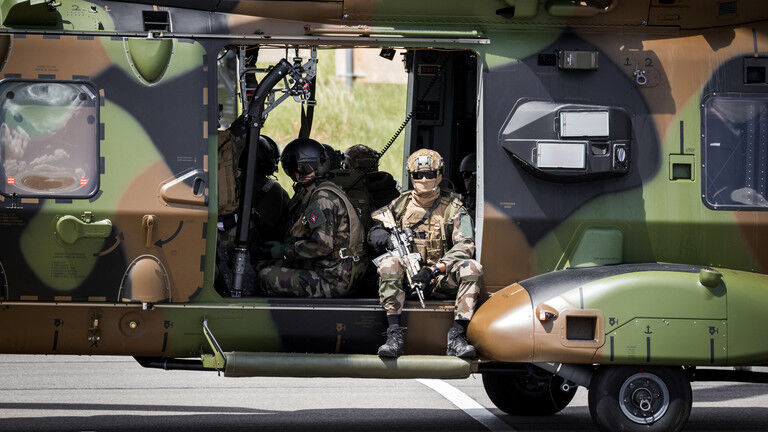
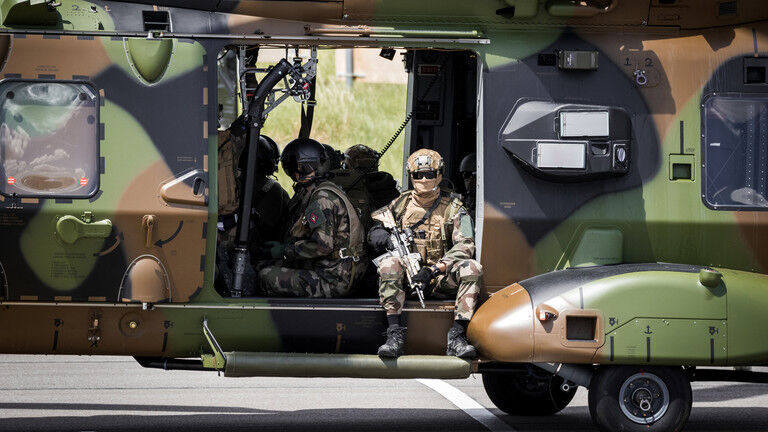
© Getty Images / VanderWolf-ImagesFrench Army NH90 transport helicopter, Le Bourget, France, June 21, 2019.
The country's army chief of staff reportedly approached his coalition peers with the idea weeks ago
France suggested deploying NATO troops to Ukraine in order to assist Kiev's forces with crucial tasks, the former US envoy to the bloc, Ivo Daalder,
wrote in an article for Politico news outlet published on Monday.
According to Daalder, the proposal came several weeks ago from the chief of staff of the French Army, General Thierry Burkhard, who wrote to half of his NATO colleagues to ask them to "explore the possibility" of deploying "a coalition of the willing" to Ukraine's front lines. The troops, Burkhard reportedly said, could man defensive systems on the ground, train troops, launch cyber operations, and provide help in demining.
Burkhard's proposal was swiftly rejected by "every ally," Daalder wrote, in line with NATO's longstanding policy of 'no troops on the ground in Ukraine'.The letter was reportedly sent well before French President Emmanuel Macron sparked controversy last week when he told journalists that the idea of deploying NATO troop to Ukraine should not be ruled out.
His comments prompted swift
reactions from other NATO nations, including the US, UK, Spain, Italy, and Germany, who rushed to state that they had no such plans. French Foreign Minister Stephane Sejourne attempted to clarify Macron's words,
telling state broadcaster Radio France Inter last Friday that Paris would not risk either its people or a direct conflict between Russia and NATO.
In his article, Daalder called Macron's words on troop deployment "another headline-grabbing statement" and an attempt to score geopolitical points, but said
the fact that his remarks followed Burkhard's proposal "may have revealed more serious thinking" regarding efforts to help Ukraine within the alliance.Kiev has been asking its Western backers for additional funding for months, citing dire shortages in ammunition and weaponry on the front lines. On Sunday, Ukrainian President Vladimir Zelensky
criticized NATO for the delays in allocating funds to help Kiev's war effort, making reference to the $60 billion US aid package which has been stalled in Congress for nearly a month.
Moscow has condemned the West for providing military aid to Kiev, warning that it will only prolong the conflict. Commenting on Macron's statement regarding the idea of deploying troops, Kremlin spokesman Dmitry Peskov warned that this type of move on the part of NATO would make a direct conflict between Russia and the bloc inevitable.
Comment: See also:
SOTT Focus:
NewsReal: How Serious Are Western Leaders About Full-on War With Russia? Russia 'well aware' US, UK, French military operating in Ukraine, 'attacks on Russian cities' not possible without Western help - Lavrov
SOTT Focus:
NATO Troops MIGHT Deploy to Ukraine? They're Already There, And Getting Killed
On the other hand, however, while Macron might have looked isolated for now, his rash comments point to the troubling dynamic of escalation by NATO since the CIA-backed coup in Kiev in 2014.
NATO has been vigorously arming and training the NeoNazi regime that was installed in Kiev since 2014. Even Jens Stoltenberg and other NATO officials have openly admitted that background involvement.
In admitting the NATO presence in Ukraine over the past decade that also corroborates Russia's reasoning of why it was compelled to launch its military intervention two years ago. Of course, the Western powers and their servile media never go as far as conceding that. They prefer to adopt a position of double-think and hypocrisy, claiming that Russia's military action was "unprovoked aggression".
Macron may have been shot down for now and made to look like a dangling clown. But as so often in the past, controversial NATO ideas are put forward and seemingly rejected out of hand, only to be adopted later. As Macron pointed out, Germany and other NATO nations were only two years ago reluctant to send military equipment beyond helmets and sleeping bags. Now these same entities have sent battlefield tanks and anti-aircraft missiles and are debating sending long-range weapons to strike deep into Russian territory
Korybko: Transnistria could become the tripwire for a wider warFrom a Russian website about military news, there was a opinion piece which translated has the title:
Bringing NATO troops to Ukraine: the alliance places consolidated units on the border with Belarus. Opinion
In late February, early March 2024, there were statements by some NATO politicians about the possibility of sending alliance forces to Ukraine. So, at a press conference, French President Emmanuel Macron did not rule out such an option, and Canadian Defense Minister Bill Blair said that the department is ready to send its units to Ukraine to train the Armed Forces of Ukraine. Let's try to understand how likely the transfer of NATO forces to Ukraine is and for what purpose the alliance is cautiously "probing" the ground, the reaction of the world community and mainly Russia to such actions. We will also give examples and the number of possible NATO units that can participate in such an operation.
Back on February 22, 2024, the Minister of Defense of the Republic of Belarus Viktor Khrenin, in an interview with Russia 24, noted that the Armed Forces of Ukraine concentrated 112-114 thousand people on the border with Belarus, of which only 17 thousand are involved in border protection. The statement of the Ministry of Defense of the Republic of Belarus Viktor Khrenin will be a fundamental vector in our further analysis. Even now, Western media are drawing maps of the deployment of NATO forces in Ukraine, near the border with Belarus.
Kiev's concerns. Most likely, Zelensky is seriously afraid of another blitzkrieg of the Russian army on Kiev, from Belarus, and therefore concentrated along the border with Belarus, a group with a total of about 30 military brigades. Of course, this number includes not only infantry and territorial defense, but also tankers, gunners, engineering units and short-range SAM crews.
About the actual possibilities for deploying NATO troops to Ukraine, the idea would be that NATO troops at the border with Belarus would deter Russia, while freeing up close to 100,000 Ukrainian troops that could then move to the active frontlines. The article has:
Border with Belarus. It should be noted that there are not so many roads, they can be "counted on your fingers", across the border with Belarus to Ukraine, despite the length of the border line of 1.3 thousand km. Most of the border between Ukraine and Belarus is dense forests and swampy terrain, where the passage of armored vehicles is impossible. In other words, a much smaller group would have been enough for Kiev, if not for its serious concerns.
Participating countries. Despite the assumptions of the Western media about sending NATO troops to Ukraine from 12 countries — it is more likely that only French, Polish and German military personnel can be involved in such an operation, and the rest of the countries will transfer additional parties of military advisers to Zelensky, including Canada.
The thing is that among the NATO countries (excluding the United States), only France, Germany and Poland have a sufficient number of military personnel, armored vehicles, artillery and air defense systems, and the armies of the other countries participating in the alliance are rather "funny regiments", however, they have modern weapons, as well as army and front-line aviation. So, for example, the Dutch army has long lost its independence and exists as a combat unit, only as part of the Bundeswehr.
Which NATO units will be deployed in Ukraine? The first applicant for the possibility of transfer is the Bundeswehr Rapid Reaction Division, with a total of about 5 thousand people, which includes the 11th Airmobile Brigade of the Netherlands with up to 2.5 thousand troops.
Poland may introduce to Ukraine the 6th airborne rapid response Brigade named after General Sosabovsky with up to 2.5 thousand people, as well as the special Polish-Lithuanian-Ukrainian LITPOLUKR brigade.
With a higher degree of probability, Paris will send a couple of regiments of the French Foreign Legion to Ukraine, which, unlike popular opinion, is part of the French Ground Forces.
Estimated number of employees. Now it is difficult to judge what the number of NATO troops in Ukraine will be. It will probably reach 30 thousand people. Such a large number can occupy roadblocks and some fortified areas made for the Armed Forces of Ukraine, on sections of key roads.
France and Macron proposed, but just because NATO refused does not mean they are not working on something.







Actually it was just French government — read „Grand Orient” freemasonry — and not „France”. From what I read 76% of French(wo)men don't want that.