RTThu, 16 Nov 2023 14:04 UTC
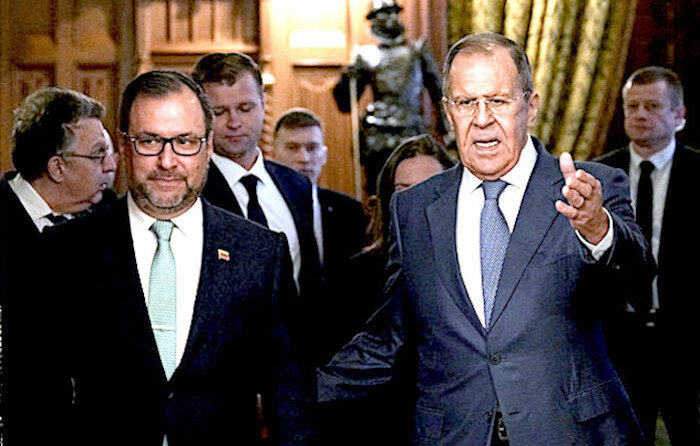
© Alexander Zemlianichenko/AFPRussian FM Sergey Lavrov • Venezuelan counterpart Yvan Gil Pinto
Moscow • November 16, 2023
The two countries will switch to national currencies in trade, the Venezuelan foreign minister has announced...
Moscow and Caracas are making progress towards de-dollarization and hope to switch to national currencies in trade soon, Venezuelan Foreign Minister Yvan Gil Pinto announced on Thursday.
Pinto, who is in Russia on a three-day official visit, was speaking at a joint press conference with his Russian counterpart Sergey Lavrov.
According to Pinto,
the central banks in Moscow and Caracas are working on the technical and technological side of the planned switch. Both partners will be able to shift away from the US dollar and start using local currencies in cross-border transactions "very soon," he added.
The foreign minister also pointed out that the leading developing nations, particularly the BRICS countries (Brazil, Russia, India, China, and South Africa), are pursuing the de-dollarization policy in order to reduce the influence of the US dollar.
The global trend towards using national currencies in trade instead of the US dollar began to gain momentum last year after Ukraine-related sanctions saw Russia cut off from the Western financial system and its foreign reserves frozen.
Venezuela has also been the subject of sanctions by the US and the EU in recent years. According to Russian Foreign Minister Sergey Lavrov, Moscow and Caracas are working to expand mutual trade and investment in order to make their economies more sustainable in the face of Western pressure.
Comment: On the flip side, Argentina's new president is
set against joining BRICS.
Javier Milei pledged to stay away from China and Brazil, as well as to dollarize the country's economy.
Argentina is not planning to become a member of BRICS on January 1, Diana Mondino, senior economic adviser to the country's president-elect, Javier Milei, told Sputnik Brazil on Monday. The invitation to join BRICS was approved in August and extended to Argentina, Egypt, Ethiopia, Iran, Saudi Arabia, and the United Arab Emirates. The current alliance consists of Brazil, Russia, India, China, and South Africa.
"I don't know why there is so much interest around BRICS," Mondino said, adding that it's unclear how joining the group would benefit Argentina. The candidate for Argentine foreign minister also said that the country's government will "analyze" if joining the organization promises advantages.
Milei, who beat Economy Minister Sergio Massa in Sunday's presidential runoff, had previously voiced opposition to joining BRICS. He has also expressed marked reluctance to support economic ties with China and Brazil while planning to work toward economic rapprochement with the US and Israel.
"I'm not going to push for deals with communists because they don't respect the basic parameters of free trade, freedom, and democracy; it's geopolitics. Some countries are not along those lines."
At the same time, the president-to-be pledged not to interfere with the country's businesses that are dealing with the BRICS countries. He has also vowed to "dollarize" the Argentinian economy.
Joining the BRICS group was viewed as a chance to open up a "new scenario" for Argentina, outgoing President Alberto Fernandez said back in August after accepting the invitation.
The South American nation is currently struggling with the worst economic crisis in decades. Inflation surged 60% over the past year alone. The severely devalued peso forced the country's government to refinance its $44 billion debt to the IMF.
Wait, there's
more:
Argentina's president-elect, Javier Milei, has promised "shock therapy" to fix the country's beleaguered economy, which has been hit by one of the world's fastest inflation rates and a looming recession, Bloomberg reported on Monday.
Milei pledged radical measures for the Argentine economy that will reportedly include shutting the central bank, ditching the peso for the US dollar and slashing public spending.
Argentina is faced with a debt of $44 billion due to be paid to international bondholders and the International Monetary Fund next year. To cover the arrears, the country will require "a big current account surplus amid a stabilization plan," according to Martin Castellano, head of Latin America research at the Institute of International Finance.
This puts Milei, a 53-year-old economist, former TV pundit, and one-time legislator without executive experience, in front of an "enormous" challenge at a time when state coffers are empty and inflation is nearing 150%.
Argentina's president-elect used to carry a chainsaw as a symbol of his planned cuts but has shelved it in recent weeks to help boost his moderate image.
Bloomberg's Latin America economist Adriana Dupita said:
"Milei's ambitious vision of a market-friendly, small-state, dollarized Argentina will finally be put to test. He has yet to clarify on timing and process for dollarization — which, with negative reserves, doesn't seem feasible for the near term."
Experts warn that dollarizing the $622 billion economy at a time when international reserves are depleted could plunge the South American nation into another spell of hyperinflation.
The cost of reality can be really, really high.




Made for the USA
[Link]