
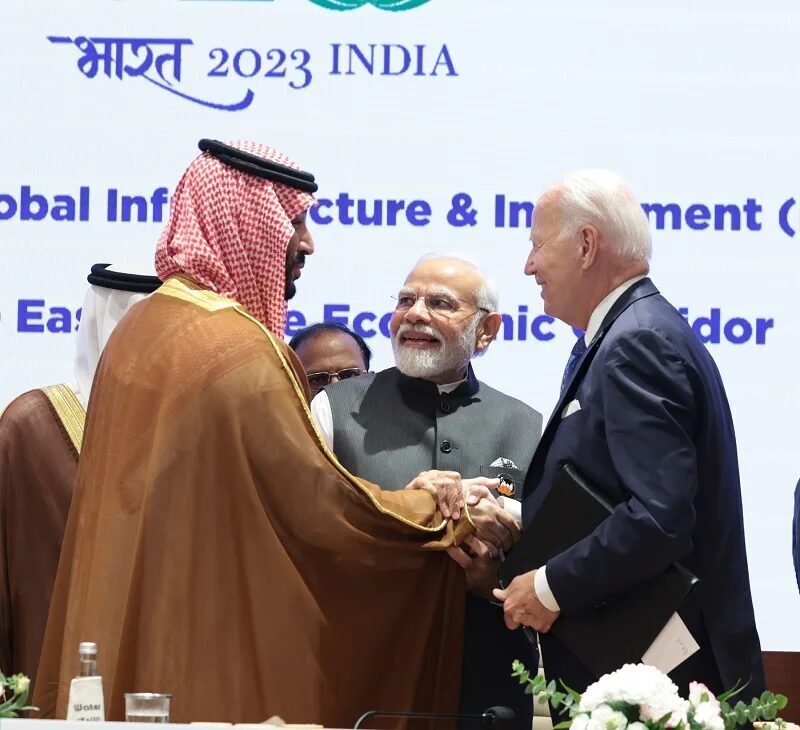
© PIBPrime Minister Narendra Modi with the US President Joe Biden and Saudi Arabian Crown Prince Mohammed bin Salman Al Saud at the Partnership for Global Infrastructure and Investment and India-Middle East-Europe Economics Corridor event in New Delhi on Saturday
The colossal strategic infrastructure project that is seen by many analysts as an alternative to China's controversial Belt and Road Initiative - also billed as the new Silk Road - was launched by Prime Minister Narendra Modi, US President Joe Biden, Saudi Arabian Crown Prince Mohammed bin Salman Al Saud and European Commission President Ursula von der Leyen at the G20 Leaders' event on the Partnership for Global Infrastructure and Investment (PGII) in the Indian capital.
"Charting a journey of shared aspirations and dreams, the India-Middle East-Europe Economic Corridor promises to be a beacon of cooperation, innovation, and shared progress. As history unfolds, may this corridor be a testament to human endeavour and unity across continents," tweeted PM Modi later in the evening.
Comment: Map showing the proposed route:
According to the Memorandum of Understanding (MoU) signed between the partners, the massive project will comprise of two separate corridors - the east one connecting India to the Arabian Gulf and the northern corridor connecting the Arabian Gulf to Europe.
It will include railway connectivity - linked through ports connecting Europe, the Middle East, and Asia - that, upon completion, will provide a reliable and cost-effective cross-border ship-to-rail transit network to supplement existing maritime and road transport routes.
Once completed, it will eventually enable goods and services to transit to, from, and between India, the UAE, Saudi Arabia, Jordan, Israel, and Europe.
Along the railway route, the participants intend to enable the laying of cable for electricity and digital connectivity, as well as pipe for clean hydrogen export.
Unlike China, India has maintained its longstanding and consistent position on connectivity projects respecting the sovereignty and territorial integrity of countries, a stand that has been endorsed by several like-minded nations in different continents.
Comment: Actually, China has more than proven its respect for national sovereignty; the author does realise that the US, destabiliser of the Middle East, destroyer of gas pipelines, and global coup extraordinaire, is part of this project?
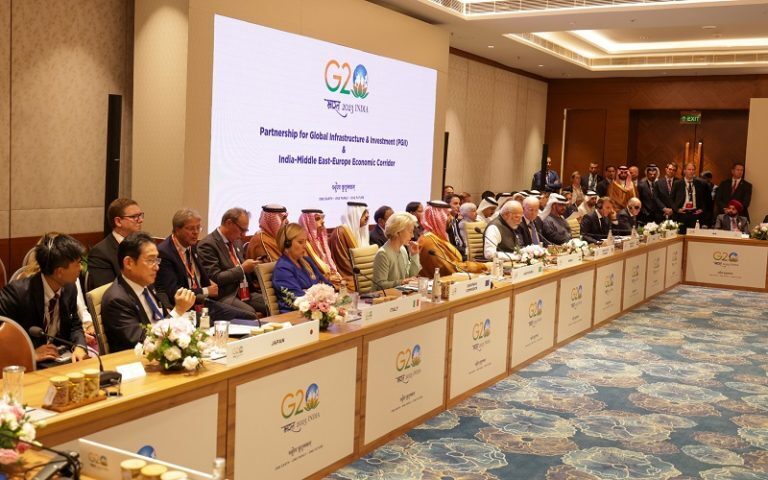
PM Narendra Modi addressing the Partnership for Global Infrastructure and Investment and India-Middle East-Europe Economics Corridor event during G20 Summit, in New Delhi on Saturday
"This is a big deal. This is a really big deal," said US President Joe Biden after the announcement in New Delhi.
Comment: That Biden managed a full sentence, without any gibberish, stuttering, or narcolepsy, is an achievement in itself.
Hailing the landmark corridor, the White House stated that it envisions driving existing trade and manufacturing and strengthening food security and supply chains through the corridor besides unlocking new investments and spur the creation of quality jobs.
At the 2023 G7 Summit in Hiroshima this May - that was also attended by PM Modi - the world leaders had affirmed their commitment to identify new opportunities to scale the Partnership for Global Infrastructure and Investment (PGII) - a flagship infrastructure initiative backed by the US and the grouping.
During the Summit, the G7 Leaders were joined by leaders and senior officials of India, Australia, Comoros, Cook Islands, Indonesia, Vietnam, South Korea, and the World Bank along with private sector executives of Citi, Global Infrastructure Partners, Japan Foreign Trade Council, and Nokia to reaffirm their commitment to opening a serious, sustainable channel for unlocking public and private capital for these projects in the developing world.
The United States is supporting the development of the Lobito Corridor with an initial investment in a rail expansion that may become the primary open access transportation infrastructure connecting Congo and Zambia with global markets through Angola.
Comment: The US' own rail infrastructure is falling apart, what makes anyone think it's capable of such projects abroad?
PGII is actively pursuing additional opportunities to connect the initial Lobito Corridor investments across the continent, to Tanzania and, ultimately, the Indian Ocean.
"Two years after the launch of the Partnership for Global Infrastructure and Investment with POTUS, two new large-scale projects are seeing the light: The India - Middle East - Europe Economic Corridor and the Trans-African Corridor," tweeted Ursula von der Leyen, President of the EU Commission.



Comment: See also: China's Xi Jinping likely to skip G20 summit in India, Putin has already declined invitation