

© Jack Boland/Toronto SunToronto Police Forensics officer Det.-Const. Rhonda Haley takes images of bullet that pierced a window at a day-care centre as a result of a drive-by shooting.
"While crime was higher in some categories back in the 1990s, the critical level of violence and weapons we are seeing today is beyond comparison," he said.
In May, McFee said publicly that the system had "once again failed" after a mother and child were randomly attacked and killed. The man apprehended by police, who died in hospital after being shot, had recently been freed despite a history of violence. And the interim three months have only yielded a cascade of additional murders and violent assaults. McFee called the trends "alarming" and spoke of families living "in fear" and unable to enjoy their communities.
The statements stood in sharp contrast to those of Canada's newly sworn-in justice minister, Arif Virani, who began his tenure last Monday by saying that the real problem was Canadians' inaccurate perception that crime was getting worse.
"Empirically, it's unlikely," he said to suggestions that Canada is becoming less safe. Rather, his ministry would need to counter "a sense coming out of the pandemic that people's safety is more in jeopardy."
The empirical statistics say otherwise. Whichever way you frame it, Canada is facing a crime wave that is unlike anything in its recent history. While there have been bloodier years in Canada's past, the country has never quite encountered violence that has been so anarchic, so ubiquitous, and so easily preventable. In the words of Chief McFee, "without question, we are at a crossroads in Canada." The violence is "not an anomaly being experienced by a few metropolitan communities."
Statistics Canada figures released just last week had Canada's 2022 Violent Crime Severity Index higher than at any point since 2007.
Homicide rates — the most reliable measure of violent crime rates — are hitting 30-year highs. In 2022, Canada recorded 2.25 homicides per 100,000, the highest since 1992.
To put that in context, if, in 2022, Canada experienced murder rates more in line with the Canada of 2019, more than 150 fewer people would be dead.
And within these figures are crime trends well beyond anything previously faced by Canadians, even in the high-crime 1970s and 1980s.
More Canadian police are now being killed in the line of duty than ever before. Between 1961 and 2009, an average of two to three law-enforcement officers were murdered on duty each year. But in just the last 10 months, eight police officers have been killed, often in targeted ambush attacks.
Cities across Canada are also facing down the terrifying new phenomena of "stranger attacks." Random, unprovoked killings are still statistically rare, but they're no longer anomalous. This summer has yielded near-daily incidents in which a Canadian was injured or killed in public for no apparent reason.
Comment: This is alarming and speaks to the collective mental health of the country.
In just the prior week before this story went to press, a Vancouver transit bus was the scene of a man choking and strangling a fellow passenger seemingly out of the blue. A 67-year-old Chilean woman visiting family was punched unconscious in a random attack at an Edmonton LRT station. A 54-year-old pushing a shopping cart in Barrie suddenly lunged at a passing pedestrian with a knife. An 84-year-old woman was hospitalized after being randomly attacked on the streets of Windsor.
And these trends have been showing themselves for some time. In November, Statistics Canada was reporting a sharp uptick in gang-related shootings, in addition to double-digit spikes in hate-motivated crimes and "level one" sexual assaults. The month before, an Angus Reid Institute survey found that a clear majority of Canadians (60 per cent) were reporting that crime in their neighbourhoods was on the increase.
As for what's causing this, Canadians are largely in agreement that this is a policy issue. In a wide-ranging June poll conducted by Leger, near-unanimous numbers of Canadian respondents blamed the crime wave on a justice system that was too "lenient" on violent offenders, particularly when it came to the issue of bail. An incredible 79 per cent of respondents agreed with the statement that "there are too many repeat violent offenders being offered bail."
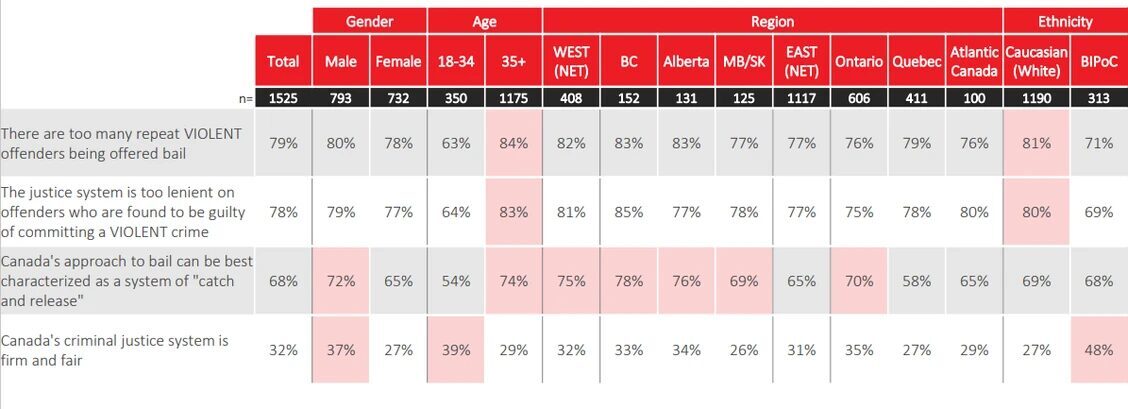
© LegerResults, broken down by demographic, on questions related to criminal justice and bail.
Perhaps most notably, shootings have doubled since 2015, despite Prime Minister Justin Trudeau championing the issue of gun control and introduced some of the most sweeping gun bans ever pursued by a Canadian government.
Meanwhile, everyone from First Nations leaders to mayors to police departments to an unanimous declaration of all 13 premiers have been saying for months on end that a significant chunk of this crime would be remarkably easy to stop.
In the April words of the Council of the Federation — the organization representing Canada's premiers — much of this violence could be brought to an end if the federal government would take action against the scourge of "violent crimes committed by repeat offenders."
It's not necessarily that more people are getting bail now; the vast majority of accused offenders have always been set free in advance of a court date. It's that new bail guidelines have utterly gutted the ability of police to enforce even the most rudimentary bail conditions.
In cases of violent charges, it's typical for a bail hearing to impose conditions on an accused; someone accused of sexual assault may be instructed to avoid contact with the alleged victim, for instance. Prior to a suite of Liberal bail reforms introduced in 2019, any violation of such conditions would typically result in immediate detention. But now, the more typical response is simply more bail.
"When bail/release is being considered for repeat offenders, it's hard to establish that they have a significant past history of not respecting the conditions imposed on them, which makes it far more likely they'll receive bail over and over," Michael Gendron, spokesperson for the Canadian Police Association, told the National Post in April.
Despite this, Ottawa is dragging its feet on even the most milquetoast of reforms. It was March when now-former justice minister David Lametti first acknowledged that some "targeted" changes to bail might be needed "to maintain the public's confidence in the administration of justice."
It took another two months before his ministry finally issued Bill C-48, an eight-page bail reform proposal that, according to legal analysts, would be largely ineffective in changing the status quo. For one thing, it imposes no hard guidelines on bail sentencing. For judges who have gotten accustomed to immediately granting bail to high-risk offenders, there's nothing in the bill explicitly compelling them to stop.
And even then, the bill has been stuck in limbo ever since May, with no prospect of getting picked up again until at least Sept. 18, when the House of Common reconvenes.
The frustration at the delay has been palpable.
B.C. Premier David Eby — a former attorney general who used to work as a street-level activist in Vancouver's Downtown Eastside — has been one of the most vocal about federal inaction on bail reform. As far back as March, he was saying that bail was not a difficult problem to solve; and that it was a "straightforward" issue to simply stop releasing repeat violent offenders into the community.
"I really can't express the level of urgency that people feel about this in communities," Eby said in June, after it became clear that Bill C-48 would be stalled until the autumn.
"The basic requirement of our justice system is that it keeps people safe, and it's not meeting that standard right now."






"don't believe your lying eyes"
How can he fix what's broken if he can't admit it's broken?
Who hired this spin doctor.