
© MintPress News
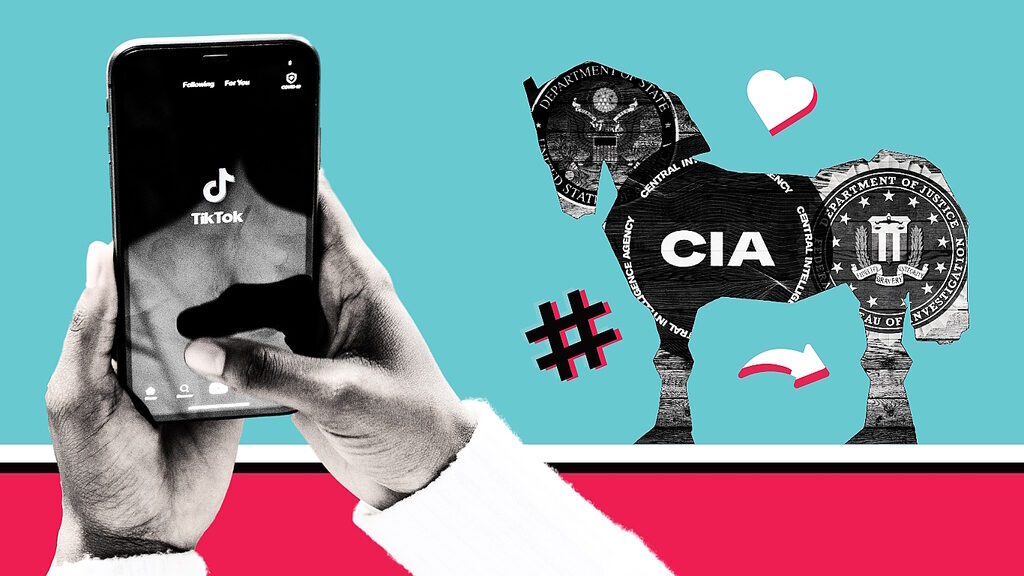
While American politicians demand the app be banned on national security grounds, try to force through an internet surveillance act that would turn the country into an Orwellian state, make clueless statements about how TikTok is dangerous because it connects to your Wi-Fi, it is possible that TikTok is already much closer to Washington than it is to Beijing.
State Department-affiliated media
For quite some time, TikTok has been recruiting former State Department officials to run its operations. The company's head of data public policy for Europe, for example, is Jade Nester. Before being recruited for that influential role, Nester was a senior official in Washington, serving for four years as the State Department's director of Internet public policy.

© LinkedInMariola Janik left government security roles to work for Tik Tok
While there is no suggestion that Janik is anything other than a model employee, the fact that a U.S. government agent walked into such an influential position at the social media giant should be cause for concern. If, for instance, a high Chinese official was hired to influence what the U.S. public saw in their social media feeds, it would likely be the centerpiece of the TikTok furor currently gripping Washington.
Janik is not the only former security official working on TikTok's trust and safety team, however. Between 2008 and 2021, Christian Cardona enjoyed a distinguished career at the State Department, serving in Poland, Turkey and Oman, and was in the thick of U.S. interventionism in the Middle East. Between 2012 and 2013, he was an assistant to the U.S. ambassador in Kabul. He later left that role to become the political and military affairs manager for Iran.
In the summer of 2021, he went straight from his top State Department job to become product policy manager for trust and safety at TikTok, a position that, on paper, he appears completely unqualified for. Earlier this year, Cardona left the company.
Another influential individual at TikTok is recruiting coordinator Katrina Villacisneros. Yet before she was choosing whom the company hires, Villacisneros worked at the State Department's Office of Human Rights and Humanitarian Affairs. And until 2021, she was part of Army Cyber Command, the U.S. military unit that oversees cyberattacks and information warfare online.
Other TikTok employees with long histories in the U.S. national security state include: Brad Earman, global lead of criminal and civil investigations, who spent 21 years as a special agent in the Air Force Office of Special Investigation and also worked as a program manager for antiterrorism at the State Department; and Ryan Walsh, escalations management lead for trust and safety at TikTok, who, until 2020, was the government's senior advisor for digital strategy. A central part of Walsh's State Department job, his own résumé notes, was "advanc[ing] supportive narratives" for the U.S. and NATO online.
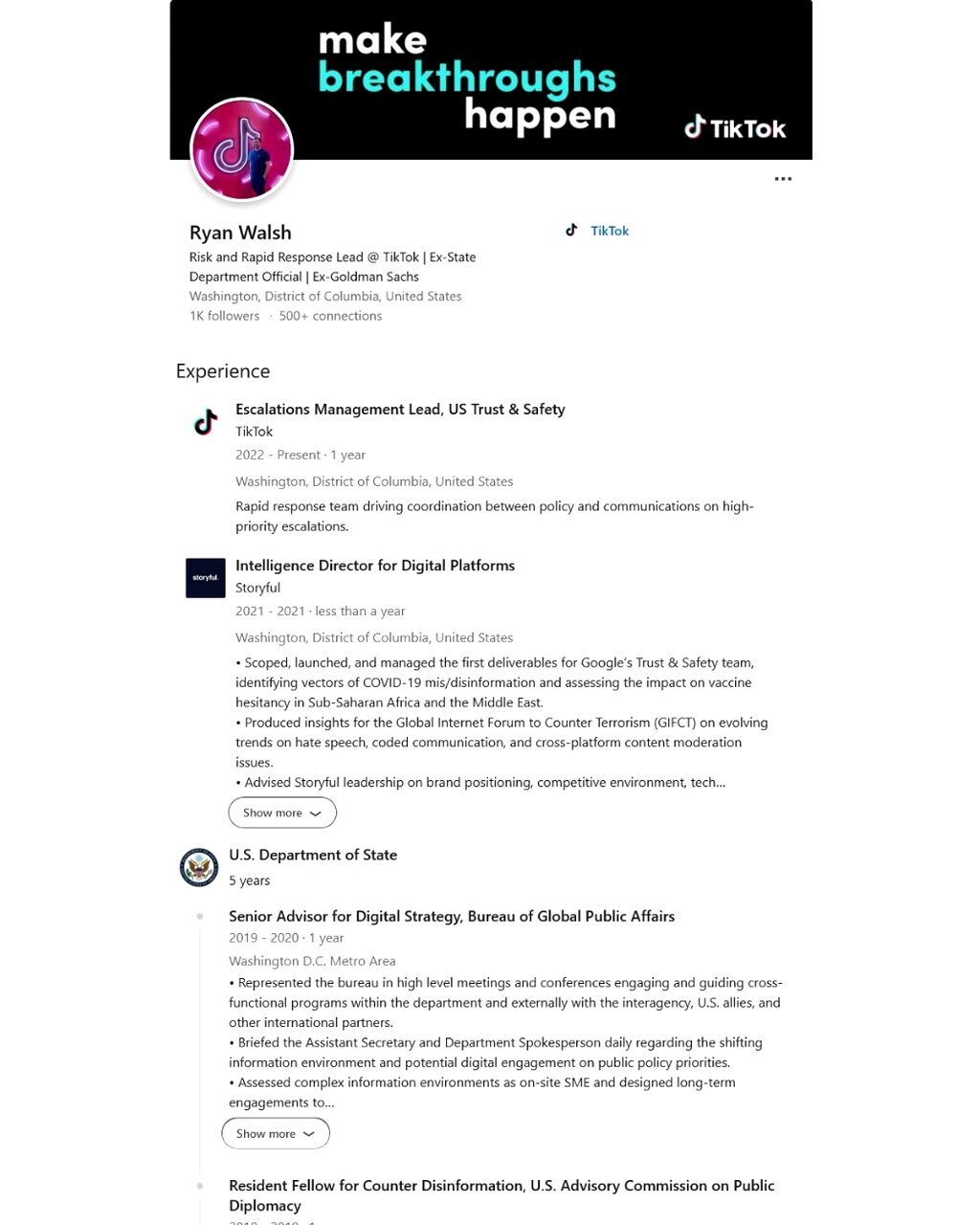
© LinkedInRyan Walsh is illustrative of the wave of government employees attempting to manipulate the global town square moving to the private sector
For all the talk of digital influence operations emanating from Russia or other U.S. adversaries, the United States is surely the worst offender when it comes to manipulating public opinion online. It is known, for instance, that the Department of Defense employs an army of at least 60,000 people whose job is to influence the public sphere, most of whom serve as "keyboard warriors" and trolls aiming to promote U.S. government or military interests. And earlier this year, the Twitter Files exposed how social media giants collaborated with the Pentagon to help run online influence operations and fake news campaigns aimed at regime change in the Middle East.
Don't mess with Project Texas
The influx of State Department officials into TikTok's upper ranks is a consequence of "Project Texas," an initiative the company began in 2020 in the hopes of avoiding being banned altogether in the United States. During his time in office, Secretary of State Mike Pompeo led the charge to shut the platform down, frequently labeling it a "spying app" and a "propaganda tool for the Chinese Communist Party."
It was widely reported that the U.S. government had forced the sale of TikTok to Walmart and then Microsoft. But in late 2020, as Project Texas began, those deals mysteriously fell through, and the rhetoric about the dangers of TikTok from officials evaporated.
Project Texas is a $1.5 billion security operation to move the company's data to Austin. In doing so, it announced that it was partnering with tech giant Oracle, a corporation that, as MintPress has reported on, is the CIA in all but name.

© MintPress News
A number of influential TikTok employees are former longtime CIA agents. Alex S., the company's former trust and safety/global content integrity policy lead, was previously a leadership analyst at agency headquarters in Langley, VA, for almost nine years. Before the CIA, she worked for the State Department and U.S. Pacific Command.
Casey Getz, meanwhile, spent nearly 11 years at the CIA, rising to become branch chief, before later being hired by TikTok to work on data security and security integration. He was also previously a director for cybersecurity at the National Security Council at the White House.
And according to the résumé of TikTok trust and safety manager Beau Patteson, not only was he a CIA targeting analyst until 2020, he is also a currently serving military intelligence officer in the U.S. Army while moonlighting at the social media behemoth.
Comment: Interesting that most of the profiles cited in this article have been scrubbed from the LInkedIn site.
Indeed, virtually every branch of the national security state is present at TikTok. Before becoming the company's trust and safety manager, Kathryn Grant spent more than three years working at the White House before moving to the National Security Council and then the Department of Energy. Her TikTok trust and safety colleague Victoria McCullough has a similarly state-heavy background, working two years at the Department of Homeland Security before joining Grant at the White House, where she was an associate director in the Office of Public Engagement. And TikTok crisis manager Jim Ammons served for more than 21 years as a unit chief in the FBI.
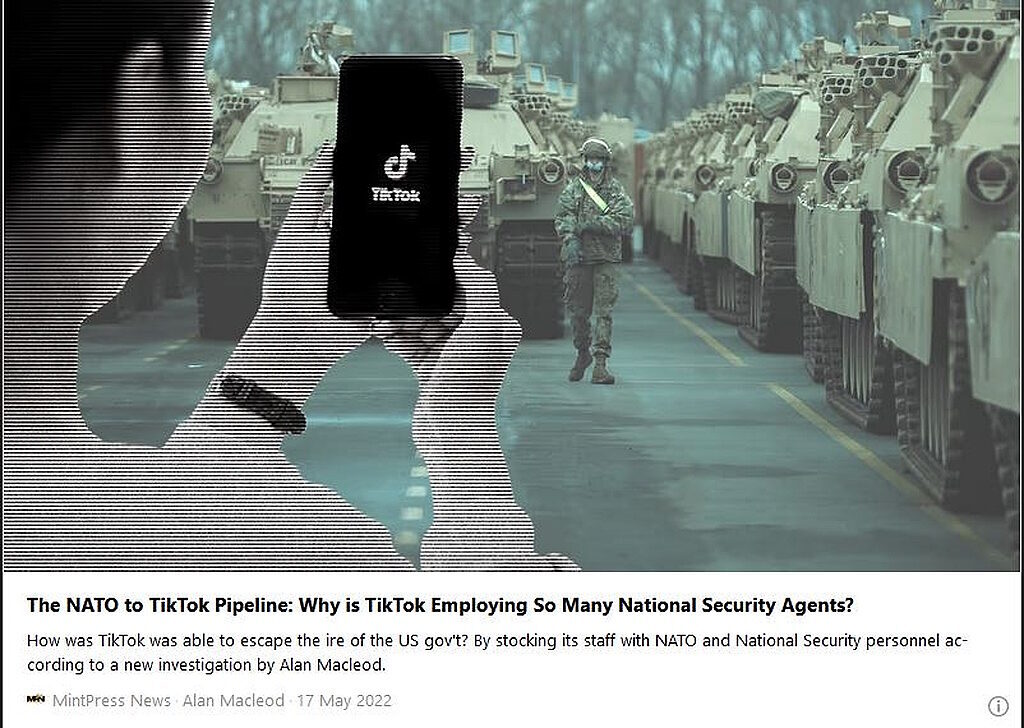
Meanwhile, a 2022 MintPress study described what it called a "NATO-to-TikTok-pipeline" whereby dozens of officials from the military alliance had also been given jobs in key fields within the company. Perhaps the most startling of these hires were Greg Andersen, whose own LinkedIn profile noted that he worked on "psychological operations" for NATO immediately before moving to work in social media.
© MintPress News
Political Theater
TikTok is an immensely influential medium shaping how the world understands itself, particularly for younger generations. A 2021 study found that 31% of people aged between 18 and 24 worldwide had used the app in the past week, with 9% using it as a primary source of news.
This is, no doubt, part of the reason U.S. officials are so concerned with it. Last month, TikTok CEO Chew Shou Zi was brought before Congress and challenged on his company's connections to the People's Republic of China. Though TikTok is a subsidiary of Chinese firm ByteDance, it insists it operates as an independent entity and that it has never shared any user data with Beijing.
Nevertheless, questions persist about the app's practices and security features. Unfortunately, the opportunity to interrogate Chew on more substantive issues was overtaken by political grandstanding from elected officials, who seemed uninterested in his answers and more concerned with scoring political points or achieving quotable soundbites.
There was also more than an undertone of xenophobia throughout the events, with Chew, on multiple occasions, having to remind his questioners that he was not, in fact, Chinese, only for them to ignore him and continue to insinuate that he was. Republican senator Tom Cotton went further, demanding that Chew be deported and insisting that "We can't allow Chinese citizens, or anyone affiliated with the [Communist Party of China], to own one more inch of American soil" - a statement that evokes memories of the Chinese Exclusion Act, a racist immigration bill that was only fully repudiated in the 1960s. Chew is from Singapore.
"We're committed to providing a safe, secure platform that fosters an inclusive place for our amazing, diverse communities to call home. It's a shame today's conversation felt rooted in xenophobia," wrote TikTok COO Vanessa Pappas.
Chew was also subjected to bizarre questioning from politicians entirely ignorant of how modern telecommunications work. Congressman Richard Hudson (R — NC) asked whether TikTok could access Wi-Fi networks, a question so obvious it left Chew assuming he had misunderstood the question. Meanwhile, Buddy Carter (R — GA) demanded to know whether the app utilized users' phone cameras to track dilation in their eyes so that they could market shocking videos more effectively to them. Watching "clueless" Congresspersons asking boomer questions was "hard to watch," concluded tech magazine Futurism.
20 years for watching a dance video
Nevertheless, these ignorant politicians are currently legislating an anti-TikTok bill that would forever change the internet and prove a death knell to privacy online.
"HR 1153, the DATA Act, which recently passed the House Foreign Affairs Committee, is almost surreal in some of its implications," wrote the Institute for Responsible Statecraft. Not only would TikTok (and possibly other large Chinese apps like WeChat) be banned, but accessing them using a VPN would become a criminal federal offense and subject to 20 years in prison and a fine of up to $1 million.
The bill also gives the government the power to secretly and permanently spy on any individual it suspects of interacting with foreign adversaries. While it names those adversaries as including China, Cuba, Venezuela, Iran, Russia and North Korea, it also notes that the list can be changed at any time. Thus, the bill would blow apart freedom of speech online and implement some of the most Draconian, authoritarian internet laws anywhere on the planet, far more strict than even the famously censorious Chinese government.
Spies in our midst
Some of the furor over TikTok's supposed threat has been stoked artificially by its rivals. Facebook, for example, is known to have contracted a PR firm to carry out a nationwide smear campaign against TikTok, presenting the platform as a "threat to children" and placing articles talking up the dangers of its competitors in newspapers across the country.
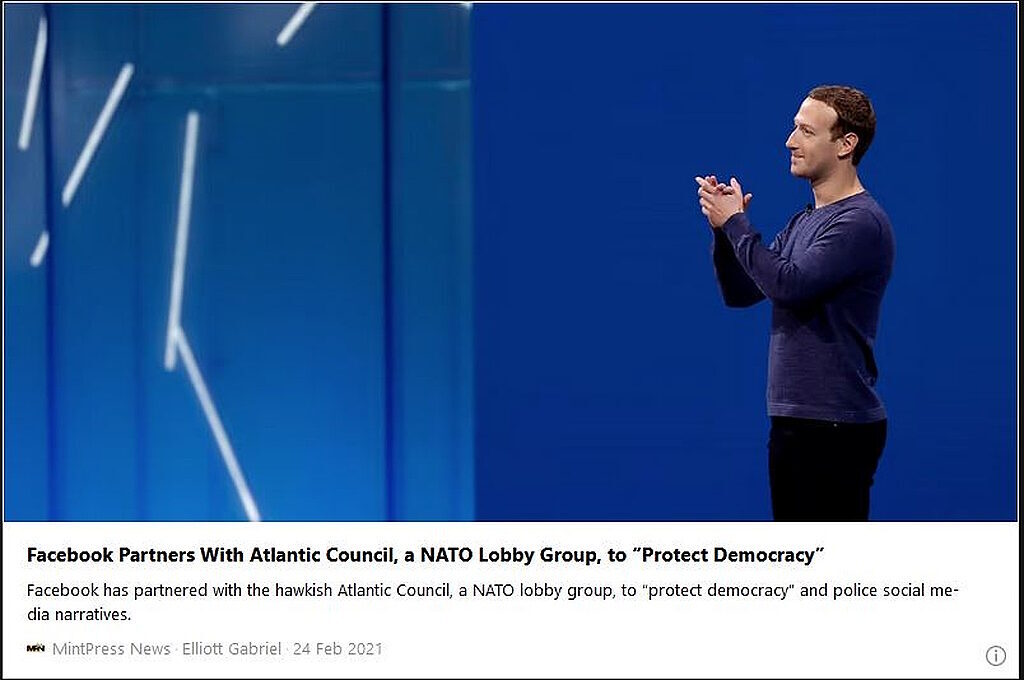
Yet Facebook itself has been subject to the government TikTok treatment. In 2018, Mark Zuckerberg was hauled before Congress and grilled for hours on the dangers of his platform. Elected officials discussed breaking the company up or even imprisoning Zuckerberg for his role in promoting misinformation. If the goal was to intimidate him into giving up editorial control of the platform, then it may have worked. Only weeks after the inquest, Facebook announced that it was "partnering" with the Atlantic Council, an arm of NATO, whereby the group would now influence what billions of people saw - and did not see - in their news feeds.
© MintPress News
As a result of recent algorithm changes, Facebook traffic to alternative news websites has been completely throttled, as the platform strongly privileges establishment media or conservative outlets. MintPress, for instance, has lost over 99% of its Facebook traffic. For the state, this sort of corporate algorithmic strangulation is far more effective than outright government bans; it achieves virtually the same suppression metrics while provoking far less public outrage.
Facebook itself is teeming with agents from the national security state. Aaron Berman, for instance, who leads the team that is ultimately in charge of content moderation for the platform, was, until 2019, a high-ranking member of the CIA, writing the president's daily briefings until he jumped ship to Facebook.
Another Berman, Deborah, spent nearly a decade as an intelligence analyst at Langley. As a Syria specialist, it is quite possible she was part of the CIA's ongoing dirty war against the country, whereby the agency funded, trained and maintained an army of jihadists to overthrow the Assad government. In early 2022, however, she left the CIA to take up a position managing Meta's trust and safety team.
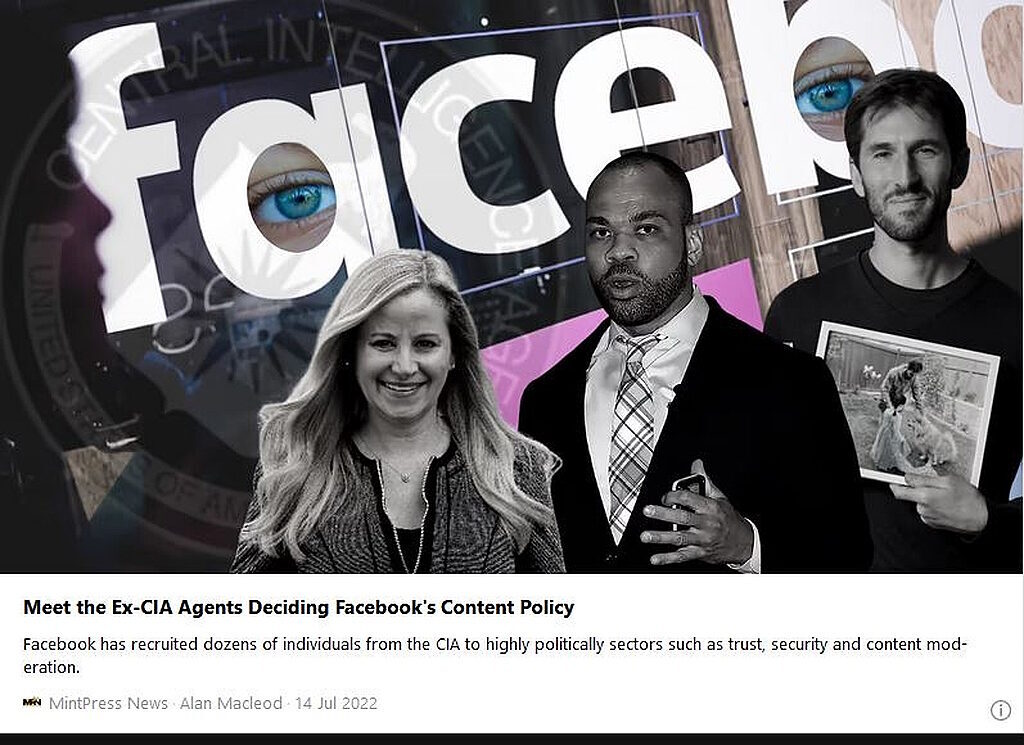
The Bermans are just two of dozens of CIA agents now running Facebook's worldwide operations that were profiled in a previous MintPress investigation, "Meet the Ex-CIA Agents Deciding Facebook's Content Policy."
Facebook and TikTok are far from outliers, however. It is sometimes difficult to find a senior Google employee who was not previously a member of the CIA; Twitter has been hiring an alarming number of FBI agents to run its operations; and Reddit mysteriously appointed hawkish Atlantic Council member Jessica Ashooh to become its director of operations, despite her having little to no relevant experience.
© MintPress News
While it was once seen as an endless source of cheap labor and a potential ally, over the past decade, Washington's position on China has radically changed. Beginning with the Obama administration's 2012 "Pivot to Asia," the U.S. began preparing to go to war with Beijing in order to prevent its economic rise.
To date, it has encircled China with 400 military bases and attempted to form what many have called an "Asian NATO" - a military alliance of states seeking to counter Beijing. One willing participant is Australia, which has recently agreed (under considerable American pressure) to purchase a fleet of nuclear submarines, potentially costing a quarter-trillion U.S. dollars. This is all despite the fact that China is Australia's largest trading partner.
The United States has used sanctions and other acts of economic warfare in its attempt to slow down China's seemingly inevitable rise. Last year, it banned Chinese semiconductor chips from American products and blocked electronics giant Huawei from operating in the U.S.
Furthermore, It has engaged in a massive propaganda war against Beijing, painting the country as a menace. Domestically, the propaganda has worked; only five years ago, a majority of Americans held positive opinions about China. Today, that figure has crashed to an all-time low of 15%.
Washington has supported all manner of separatist groups in China, including in Xinjiang, Tibet, Hong Kong and Taiwan, and attempted to highlight China's mistreatment of its minority populations on a world stage. Its efforts have largely fallen on deaf ears internationally as countries in the Global South continue to pursue ever-deeper economic, cultural and political ties with the emerging superpower. Many nations see Chinese cooperation coming with comparatively few strings attached and no threat of a military response, unlike working with the United States.
Even more concerning for war planners in Washington is the rapid advancement of the de-dollarization trend worldwide. In past weeks, countries around the world have announced that they are moving away from using the dollar for international trade, a move that will drastically weaken the U.S. economically and reduce its ability to use sanctions as a means of coercion.
It is in this light, then, that we should see the latest TikTok furor in Congress. A global empire is on the decline and is desperately attempting to maintain its hold over the worldwide means of communication. TikTok certainly does record an alarming amount of personal data on its users, and there needs to be a debate on the ethics and implications of such practices. But this data model is a little different from that of its competitors.
With billions of users worldwide, big social media companies hold vastly more power to influence global public opinion than even the largest of old media empires. The U.S. clearly understands that he who controls the algorithm controls minds. In decades gone by, the State Department and the CIA spent fortunes creating networks of hundreds of paid informants in newsrooms across America and even secretly set up hundreds of newspapers and magazines to plant information (or misinformation) to alter public opinion. Today, however, for the U.S. government, it is much quicker and simpler to place a few operatives into key positions in big tech companies - and they can have a much greater effect.
Thus, Americans should not fear that TikTok is some sort of Communist Chinese Trojan Horse; it is already being run by the State Department.
Alan MacLeod is Senior Staff Writer for MintPress News. After completing his PhD in 2017 he published two books: Bad News From Venezuela: Twenty Years of Fake News and Misreporting and Propaganda in the Information Age: Still Manufacturing Consent, as well as a number of academic articles. He has also contributed to FAIR.org, The Guardian, Salon, The Grayzone, Jacobin Magazine, and Common Dreams.



Reader Comments
[Link]
The year is 2023 . America has not been discovered, there is no such thing as electricity, and sailing ships still do not sail out of sight of land, for fear of falling off the edge of the flat earth. Pope Urban XXVIII expresses satisfaction in the fact that truth has prevailed all these years. People still eat off wooden plates, live in mud huts, ride horses, and die of bubonic plague.
But truth prevails.
I would think that if the U.S. dollar continues its slide into oblivion as we rush to a sustainable future, those of us who are unwillingly connected to the 'empire' will once again be eating off wooden plates, living in mud huts, riding horses (if we can find any), and dying of bubonic plague (and hunger).
Hi Folks, Truthstream Media posted this recently and it's much of what we talk about here, the unreality of our world. Melissa has connected some more dots for us to digest and I just wanted to share with as many of you as possible and give all of you a heads up as to just how far the deception goes. Discernment is very important from here on in. Jordan Peterson and Elon both said earlier this year, AI is a worry and rightly so.
I'd been thinking lately about some of the articles here these last couple of months and the slant the MSM is pushing. What if, some of it isn't truly real. Have a listen or not, I think it would be helpful to us all to rethink and understand just how low they can truly go.
[Link]
That video was scary. And AI gets better and better, exponentially, just like the early days of computers. Remember PacMan? Only about 25-30 years ago. Now look at computer games today. A different universe. The same will happen with AI - In 25 years we won't know if we are talking to a real person or a machine.
Thinking out loud, I can imagine them trying out some of the live action on video ads.
Best to you JTF. I shared that video with many including my family and my daughters in particular.
Hey guess what?
It is the 23rd day in the 23rd year in the month of April and it is 4:25 pm where I reside presently. I worked hard today outside and it felt so good. It is good to be alive. Oops - tis 4:26 now.
See you around and later on I'm going to post the number of shapes associated with 6 perfect hexagons.
Ken
Double Square Brackets[[]], I have to remember that going forward. I just wanted to include the people I see posting here the most, without being too Inclusive or is it disclusive (and that aint a word apparently).
It's a good vid as for me I've been seeing lots of things on the MSM lately were somehow slightly off. Like some advertising. Glad you shared the video! I like TruthStream Media. The seem like a fun family and are not always about showing their faces, I prefer the visuals of what you are talking about not you face, if you get my drift.
Guess what? 2 hours sleep last night, insomnia. Couldn't sleep to start, then my beautiful black lab kept me up with her doggie dreams. Wish I knew what she was woofing and wining at in her dreams. Saw a meteor at 3:30am. Read, watch some TV, tried again at 7:30, had a frightening lucid dream, got up at 9:30am. Lost my day as I had things to do out side and now it's 5:55pm. Definitely an early night tonight, fogs' rolling in, so no meteor watching tonight.
The riddle, I haven't forgotten. I hope it's not 666.
JTFT
An hour and a half well spent
Sounds like you have a beautiful black lab who dreams when sleeping and to get to hear the labs dreams and then see a meteor at 3:30 am.....well, I hope you must know.....somebody blessed you I reckon!
ha, ha.
Ken
ps - eff 666....it is just a fearful narrative with numbers...I prefer 661 which is prime, and the top PRIME divider of 666 is......??? Too late - tis 37.
We've discussed this already....don't give heed to a number.
Anyhow, I think the final number of six hexagons connected 2-dimensionally for the purposes of determining discrete shapes made is going to be a prime number.....something like.....well a number between 81 and 111. When I figure it out, you can rest assured I will make a post assuming I'm not like John Lennon - although, did you know there is a fella who has a theory on John Lennon some find odd, but with the recent news seems to me his theory might actually have merit - even though we all know the value of pi. At least statically it is known and if you can't stop time sometimes in imagination how you gonna ever figure anything out?
Ken