
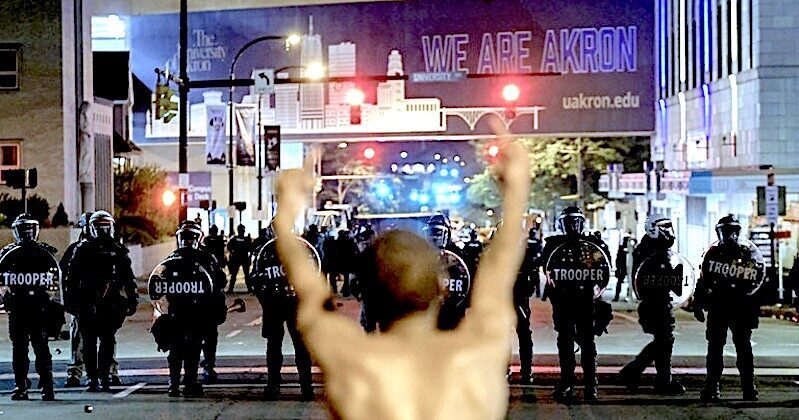
© Matthew Hatcher/AFPProtest over the killing of Jayland Walker shot by police
Akron, Ohio • July 3, 2022
Akron, Ohio • July 3, 2022
Mapping Police Violence - a project connected to the Black Lives Matter movement - found that police fatally shot, beat, tased and restrained 31 more people last year than in 2021, when they killed 1,145 people. 2022's total of 1,176 is the highest annual tally since the nonprofit group began tracking such statistics in 2013.
There were only 12 days without a single police killing last year. Officers killed an average of more than three people every day, the statistics show. 132 of these killings involved victims who hadn't been suspected of a crime, and 98 fatal encounters began as traffic stops.
Some 24% of those killed were black, despite black people making up only 13% of the US population.
Comment: Locations have different racial density statistics.
The violent crime rate in the US has more than halved since 1993. However, violent offenses rose dramatically in some cities in the aftermath of the 2020 Black Lives Matter protests, and officers have argued that liberal criminal justice reforms enacted after the police murder of George Floyd that year are costing them their lives.
A total of 323 officers were shot in the line of duty across the US in 2022, the National Fraternal Order of Police (FOP) revealed in a report last month. Of these officers shot, 60 died, an increase of 23% in fatalities since 2019. FOP National President Patrick Yoes blamed the figures on "rogue prosecutors," whom he said are failing "to prosecute violent offenders for their crimes or, even worse, releasing repeat offenders."
New Orleans in Louisiana became the US murder capital in 2022, taking the grim title from St. Louis, Missouri and recording comparatively more homicides than the crime-ridden cities of Chicago and New York. At least 280 people were murdered in New Orleans last year, and police there killed 13 people.




However, a more recent study looking at convictions in the state of Virginia during the 1970s and 1980s and matching them to later DNA analysis estimates a rate of wrongful conviction at 11.6%.
A 2014 study published in Proceedings of the National Academy of Sciences made a conservative estimate that 4.1% of inmates awaiting execution on death row in the United States are innocent, and that at least 340 innocent people may have been executed since 1973.
Another study estimated that up to 10,000 people may be wrongfully convicted of serious crimes in the United States each year.
Noble cause corruption
Police may become convinced a particular suspect is guilty but not have sufficient evidence to prove it. Sometimes they may 'plant' evidence in order to secure a conviction because they believe it is in the public interest, or that there is a greater good, in convicting this particular person. In other words, they believe that the ends (or the outcome) justifies the means. This is known as noble cause corruption.
Plea bargaining
Further information: Plea bargain
Another technique used by police is plea bargaining whereby the prosecutor provides a concession to the defendant in exchange for a plea of guilt. This generally occurs when the defendant pleads guilty to a less serious charge, or to one of several charges, in return for the dismissal of the main charge; or it may mean that the defendant pleads guilty to the main charge in return for a more lenient sentence.
Other issues
Withholding or destruction of evidence by police or prosecution
Fabrication of evidence or outright perjury by police (see testilying), or prosecution witnesses
Biased editing of evidence
Prejudice against the class of people to which the defendant belongs
Misdirection of a jury by a judge during trial
Perjured evidence by the real guilty party or their accomplices (frameup)
Perjured evidence by the alleged victim or their accomplices
Conspiracy between court of appeal judges and prosecutors to uphold conviction of the innocent
Fraudulent conduct by a judge: Judicial Misconduct
Ineffective defence counsel
[Link]